<!-- wp:paragraph -->
<p>Most first-time visitors imagine their Taj Mahal trip as effortless. The reality, for many, looks different. A shared taxi that runs late. A driver who does not speak much English. A ticket line that eats away the morning light. By the time travelers reach the marble dome, they are tired, hurried, and short on the one thing they came for: a calm, memorable moment in front of one of the world's most photographed monuments.</p>
<!-- /wp:paragraph -->
<!-- wp:paragraph -->
<p>This is exactly why more travelers are choosing a premium car tour for their Delhi to Agra journey.</p>
<!-- /wp:paragraph -->
<!-- wp:paragraph -->
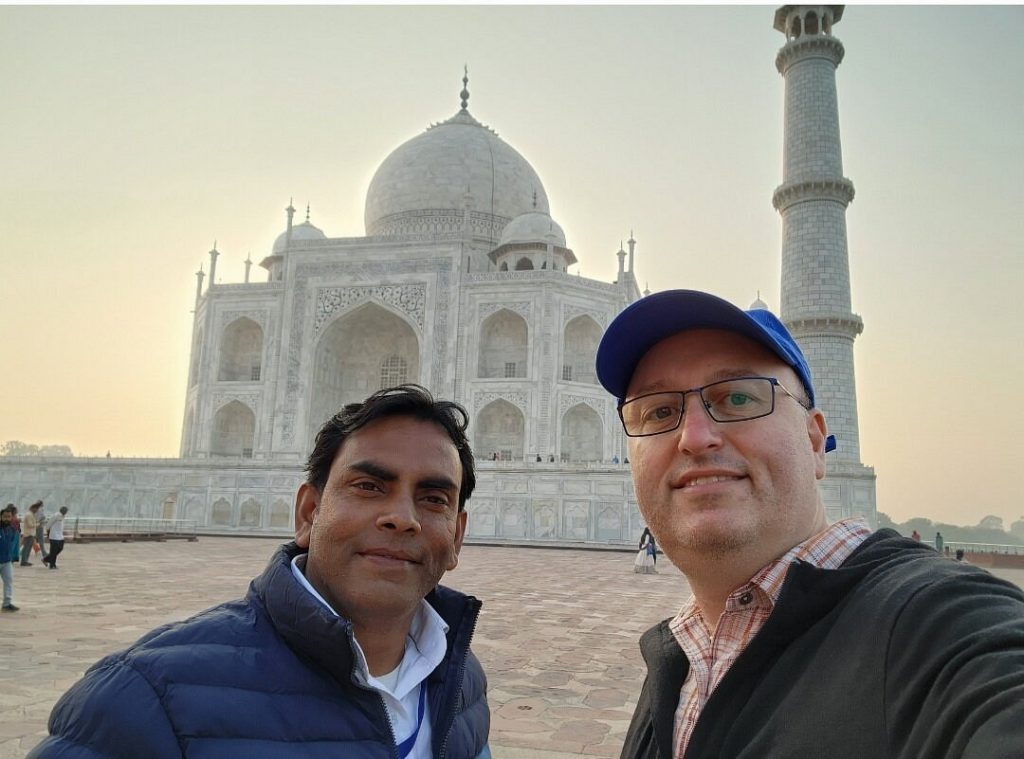
<p>A well-organized <a href="https://www.tajadventureholidays.com/tours/taj-mahal-and-agra-tour-by-premium-cars-from-delhi/">Premium Taj Mahal Tour</a> is not about luxury for its own sake. It is about control. Control over departure time, over pace, over which sites get more attention, and over how the day actually feels. After organizing hundreds of Delhi-Agra trips, one pattern is consistent: the travelers who leave happiest are the ones who never had to think about logistics at all. For readers planning a wider India trip, the Ministry of Tourism, Government of India is a useful starting point for official national travel guidance.</p>
<!-- /wp:paragraph -->
<!-- wp:paragraph -->
<p>Common mistakes on a standard Agra day trip include starting too late to catch sunrise, relying on a driver unfamiliar with skip-the-line counters, and underestimating how much a bumpy, shared vehicle can drain energy before the sightseeing even begins. Luxury transportation solves each of these problems directly, and it does so at a price point that is far more accessible than most people expect.</p>
<!-- /wp:paragraph -->
<!-- wp:paragraph -->
<p>This guide walks through exactly why a premium car tour outperforms every other way to see the Taj Mahal from Delhi, what to expect on the road, which attractions deserve a place on the itinerary, and how to plan the day like someone who has done it before.</p>
<!-- /wp:paragraph -->
<!-- wp:heading -->
<h2 class="wp-block-heading">Why Premium Travel Creates a Better Taj Mahal Experience</h2>
<!-- /wp:heading -->
<!-- wp:paragraph -->
<p>The Taj Mahal rewards patience and timing. Its marble changes color through the day, from a soft pink at dawn to a warm gold at sunset. Seeing that shift, or even just catching the monument at its best hour, requires a schedule that bends around the traveler rather than the other way around.</p>
<!-- /wp:paragraph -->
<!-- wp:paragraph -->
<p>A Luxury Taj Mahal Tour creates that flexibility in three ways.</p>
<!-- /wp:paragraph -->
<!-- wp:paragraph -->
<p>First, the vehicle departs when the traveler is ready, not when a shared group fills up. Second, the driver and guide are dedicated to one group for the entire day, so there is no rushing between waiting passengers. Third, premium vehicles are maintained for long highway drives, meaning fewer breakdowns, better air conditioning, and a smoother ride on the Yamuna Expressway.</p>
<!-- /wp:paragraph -->
<!-- wp:paragraph -->
<p>None of this is about status. It is about protecting the parts of the day that actually matter: the light at sunrise, the energy to enjoy Agra Fort afterward, and the freedom to linger at Mehtab Bagh for one more photograph.</p>
<!-- /wp:paragraph -->
<!-- wp:heading -->
<h2 class="wp-block-heading">Benefits of Traveling from Delhi to Agra by Luxury Car</h2>
<!-- /wp:heading -->
<!-- wp:paragraph -->
<p>The 233-kilometer stretch between Delhi and Agra takes roughly three to three and a half hours by road, largely along the well-built Yamuna Expressway, whose official authority publishes route and toll information directly. That drive time is the same whether the vehicle is a shared van or a private sedan. What differs entirely is how that time is spent.</p>
<!-- /wp:paragraph -->
<!-- wp:paragraph -->
<p>A Chauffeur-Driven Taj Mahal Tour typically includes a clean, air-conditioned vehicle with reclining seats, bottled water, and a driver trained specifically for tourist routes. Many travelers use the drive itself to rest before a long day of walking, something that is far harder to do in a crowded shared taxi.</p>
<!-- /wp:paragraph -->
<!-- wp:paragraph -->
<p>There is also a safety dimension. Professional operators vet their drivers, maintain their vehicles regularly, and carry proper permits for interstate tourist transport. For international visitors and solo travelers especially, this reduces a real source of anxiety around unfamiliar roads and unregulated local taxis.</p>
<!-- /wp:paragraph -->
<!-- wp:paragraph -->
<p>Finally, private vehicles allow spontaneous stops. A roadside dhaba for breakfast, a quick photo stop, or an early arrival because the group is ready to go, none of this is possible on a fixed shared schedule.</p>
<!-- /wp:paragraph -->
<!-- wp:heading -->
<h2 class="wp-block-heading">Premium Cars vs Standard Taxi Services</h2>
<!-- /wp:heading -->
<!-- wp:paragraph -->
<p>Standard taxi services are not inherently bad. Many are reliable and affordable. But there is a meaningful gap between a standard taxi and a genuinely premium tour, and it shows up in several places.</p>
<!-- /wp:paragraph -->
<!-- wp:paragraph -->
<p>Standard taxis are often booked through local stands with limited vetting, meaning vehicle quality and driver experience can vary widely from one booking to the next. A Premium Agra Tour uses pre-inspected vehicles and drivers who specialize in the Delhi-Agra tourist corridor, often with years of experience guiding first-time visitors.</p>
<!-- /wp:paragraph -->
<!-- wp:paragraph -->
<p>Communication is another gap. A standard taxi driver may have limited English, which becomes a real obstacle when navigating ticket counters, security checks, or last-minute itinerary changes. Premium tour drivers and accompanying guides are typically fluent in English and trained in hospitality, not just driving.</p>
<!-- /wp:paragraph -->
<!-- wp:paragraph -->
<p>Then there is accountability. A premium tour operator manages the entire day as a single service, including tickets, timing, and any issues that arise. With an independent taxi, the traveler is often the one solving problems that come up mid-trip.</p>
<!-- /wp:paragraph -->
<!-- wp:paragraph -->
<p>The price difference between the two options is usually smaller than people assume, especially when split across a couple or family, which makes the upgrade an easy decision once the comparison is laid out clearly.</p>
<!-- /wp:paragraph -->
<!-- wp:heading -->
<h2 class="wp-block-heading">Why Private Tours Offer Better Value</h2>
<!-- /wp:heading -->
<!-- wp:paragraph -->
<p>Value is not the same as the lowest price. A private tour removes hidden costs that group tours or budget taxis often carry.</p>
<!-- /wp:paragraph -->
<!-- wp:paragraph -->
<p>Group tours frequently include unnecessary stops at commission-paying shops, extending the day without adding value. Budget taxis may not include entry tickets, monument guide fees, or waiting charges, all of which add up by the end of the trip.</p>
<!-- /wp:paragraph -->
<!-- wp:paragraph -->
<p>A well-structured <a href="https://www.tajadventureholidays.com/tours/from-delhi-day-trip-to-taj-mahal-and-agra-fort-by-car/">Skip the Line Taj Mahal Tour</a> bundles transport, guide, and entry logistics into one transparent package. Travelers know the full cost upfront, with no surprise stops or pressure to shop.</p>
<!-- /wp:paragraph -->
<!-- wp:paragraph -->
<p>There is also the value of time itself. A family that saves ninety minutes by skipping ticket lines gains an entire extra stop at Mehtab Bagh or Itmad-ud-Daulah, sites that are just as memorable but far less crowded than the Taj Mahal itself.</p>
<!-- /wp:paragraph -->
<!-- wp:image {"id":2184,"sizeSlug":"large","linkDestination":"none"} -->
<figure class="wp-block-image size-large"><img src="https://www.tajadventureholidays.com/wp-content/uploads/2026/07/caption-16-1024x759.jpg" alt="Premium Taj Mahal Tour from Delhi | Luxury Car Trip" class="wp-image-2184"/></figure>
<!-- /wp:image -->
<!-- wp:heading -->
<h2 class="wp-block-heading">Must Visit Attractions</h2>
<!-- /wp:heading -->
<!-- wp:paragraph -->
<p>A day trip to Agra should never be limited to just the Taj Mahal, even though it is rightly the centerpiece.</p>
<!-- /wp:paragraph -->
<!-- wp:paragraph -->
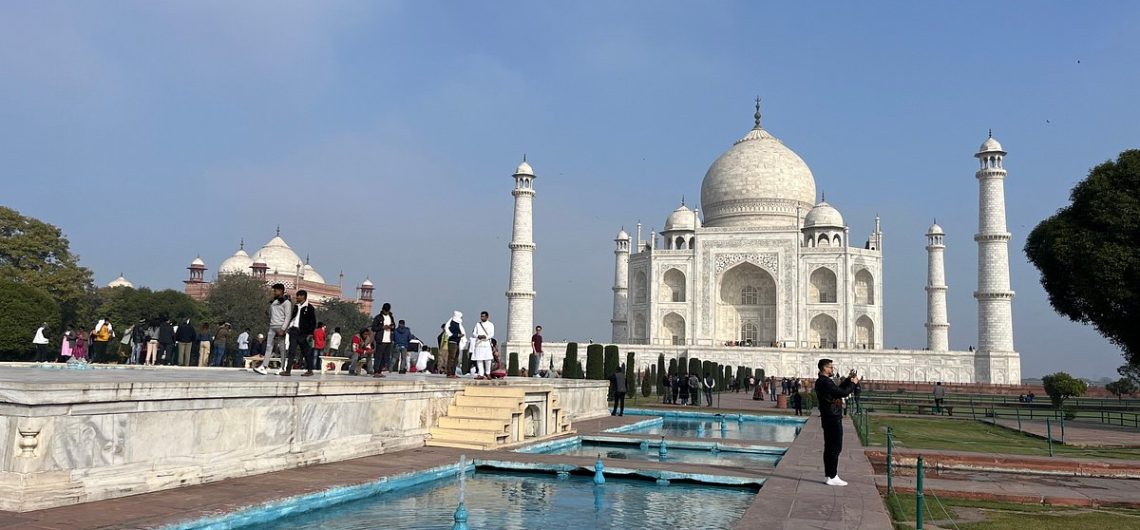
<p><strong>Taj Mahal</strong> The main event, best experienced at sunrise when the light is soft and the crowds are thinnest. Recognized as a <a href="https://whc.unesco.org/en/list/252/">Taj Mahal UNESCO World Heritage Site</a>, it holds a level of global significance that goes beyond any single description of it. The marble inlay work up close is worth slowing down for, rather than rushing through for photos alone.</p>
<!-- /wp:paragraph -->
<!-- wp:paragraph -->
<p><strong>Agra Fort</strong> A UNESCO World Heritage Site in its own right, this red sandstone fortress is a highlight of any Agra Fort Guided Tour, offering a view of the Taj Mahal from across the river and telling the political history behind the monument's construction.</p>
<!-- /wp:paragraph -->
<!-- wp:paragraph -->
<p><strong>Mehtab Bagh</strong> A quiet garden directly across the Yamuna River from the Taj Mahal. This is the spot for the classic reflection photograph, and it is dramatically less crowded than the main complex.</p>
<!-- /wp:paragraph -->
<!-- wp:paragraph -->
<p><strong>Itmad-ud-Daulah</strong> Often called the "Baby Taj," this smaller marble tomb predates the Taj Mahal and features similarly intricate inlay work, without the crowds. It is a favorite among travelers who appreciate architectural detail over grandeur alone.</p>
<!-- /wp:paragraph -->
<!-- wp:paragraph -->
<p>A premium tour itinerary is built to fit all four into a single day comfortably, which is nearly impossible without efficient transport and skip-the-line access.</p>
<!-- /wp:paragraph -->
<!-- wp:heading -->
<h2 class="wp-block-heading">Why Skip-the-Line Tickets Save Time</h2>
<!-- /wp:heading -->
<!-- wp:paragraph -->
<p>Ticket queues at the Taj Mahal can stretch well past an hour during peak season, particularly for the general entry line. For a day trip with a fixed return time to Delhi, that hour is not a minor inconvenience. It can mean the difference between seeing all four major sites or cutting the day short. Entry rules and monument access at the Taj Mahal are managed by the Archaeological Survey of India, which is the official source for current visitor regulations.</p>
<!-- /wp:paragraph -->
<!-- wp:paragraph -->
<p>A <a href="https://www.tajadventureholidays.com/tours/from-delhi-day-trip-to-taj-mahal-and-agra-fort-by-car/">Skip the Line Taj Mahal Tour</a> uses pre-arranged entry passes and dedicated counters, allowing groups to walk in with minimal wait. This is especially valuable for the sunrise slot, when every extra minute inside the complex before the light shifts matters.</p>
<!-- /wp:paragraph -->
<!-- wp:paragraph -->
<p>Beyond time savings, skip-the-line access reduces physical strain. Standing in an unshaded queue during Agra's warmer months is genuinely exhausting, and starting the visit already tired affects how much travelers enjoy the rest of the day.</p>
<!-- /wp:paragraph -->
<!-- wp:heading -->
<h2 class="wp-block-heading">Best Time to Visit the Taj Mahal</h2>
<!-- /wp:heading -->
<!-- wp:paragraph -->
<p>The Taj Mahal can be visited year-round, but timing changes the experience significantly. Since Agra falls within Uttar Pradesh, the Uttar Pradesh Tourism board is a reliable source for regional seasonal advisories.</p>
<!-- /wp:paragraph -->
<!-- wp:paragraph -->
<p><strong>October to March</strong> offers the most comfortable weather, with cool mornings, clear skies, and excellent visibility for photography. This is peak season, so booking a Luxury Day Trip to Agra with guaranteed skip-the-line access matters even more during these months.</p>
<!-- /wp:paragraph -->
<!-- wp:paragraph -->
<p><strong>April to June</strong> brings intense heat, often exceeding 40°C by midday. A premium tour's air-conditioned vehicle becomes less of a comfort and more of a necessity during this stretch.</p>
<!-- /wp:paragraph -->
<!-- wp:paragraph -->
<p><strong>July to September</strong> is monsoon season. Rain can create dramatic skies and fewer crowds, but travelers should build flexibility into the schedule for weather delays.</p>
<!-- /wp:paragraph -->
<!-- wp:paragraph -->
<p>Within any season, <strong>sunrise entry</strong> consistently offers the best light, the mildest temperatures, and the smallest crowds. A premium tour is one of the few ways to reliably guarantee an early departure from Delhi that makes sunrise arrival realistic.</p>
<!-- /wp:paragraph -->
<!-- wp:heading -->
<h2 class="wp-block-heading">Who Should Choose a Premium Tour</h2>
<!-- /wp:heading -->
<!-- wp:paragraph -->
<p><strong>Couples</strong> Privacy and pacing matter for couples celebrating an anniversary or honeymoon. A premium tour allows unhurried time for photographs and a slower, more romantic pace through the gardens.</p>
<!-- /wp:paragraph -->
<!-- wp:paragraph -->
<p><strong>Families</strong> Traveling with children or elderly parents means unpredictable bathroom breaks, nap schedules, and varying walking speeds. A private vehicle accommodates all of this without disrupting other passengers.</p>
<!-- /wp:paragraph -->
<!-- wp:paragraph -->
<p><strong>Seniors</strong> Long queues and crowded shared transport are genuinely difficult for older travelers. Skip-the-line access and a comfortable, private vehicle make the day far more manageable.</p>
<!-- /wp:paragraph -->
<!-- wp:paragraph -->
<p><strong>Luxury Travelers</strong> For travelers already booking premium hotels and experiences elsewhere in India, a budget taxi day trip can feel like a jarring drop in quality. A Private Taj Mahal Tour keeps the standard consistent.</p>
<!-- /wp:paragraph -->
<!-- wp:paragraph -->
<p><strong>International Tourists</strong> First-time visitors to India often feel more comfortable with a dedicated English-speaking guide and driver who can navigate cultural norms, negotiate on their behalf if needed, and explain the history behind what they are seeing.</p>
<!-- /wp:paragraph -->
<!-- wp:heading -->
<h2 class="wp-block-heading">What Our Travelers Are Saying</h2>
<!-- /wp:heading -->
<!-- wp:paragraph -->
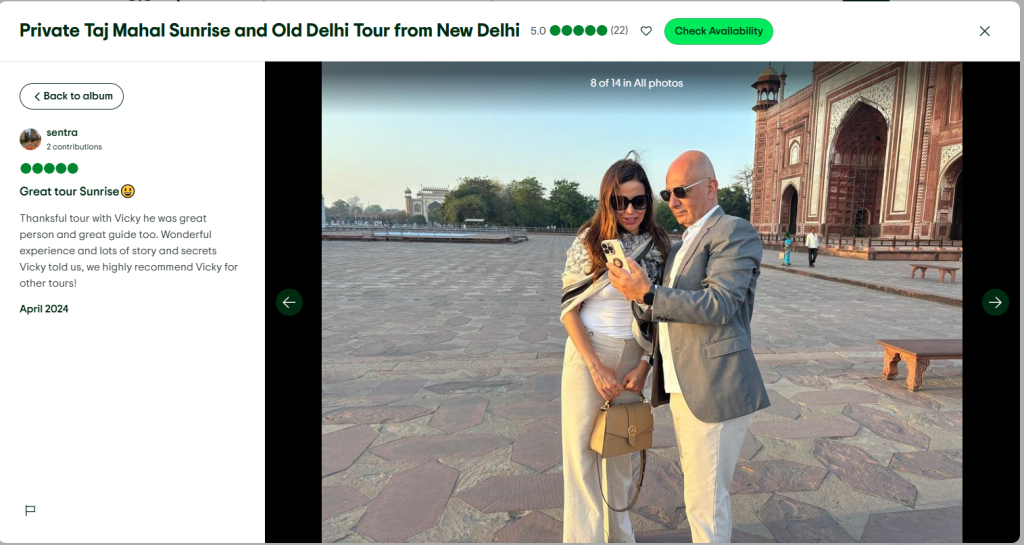
<p>Every trip we run is judged by the people who actually take it. Below is a verified experience shared directly by a traveler who booked with us — unedited, unfiltered, and posted on an independent review platform we don't control.</p>
<!-- /wp:paragraph -->
<!-- wp:image {"id":2183,"sizeSlug":"large","linkDestination":"none"} -->
<figure class="wp-block-image size-large"><img src="https://www.tajadventureholidays.com/wp-content/uploads/2026/07/image-1024x545.png" alt="" class="wp-image-2183"/></figure>
<!-- /wp:image -->
<!-- wp:paragraph -->
<p>★★★★★ <strong>5.0</strong></p>
<!-- /wp:paragraph -->
<!-- wp:paragraph -->
<p><strong>"Great Tour Sunrise" 😃</strong></p>
<!-- /wp:paragraph -->
<!-- wp:quote -->
<blockquote class="wp-block-quote"><!-- wp:paragraph -->
<p>Thankful tour with Vicky he was great person and great guide too. Wonderful experience and lots of story and secrets Vicky told us, we highly recommend Vicky for other tours!</p>
<!-- /wp:paragraph --></blockquote>
<!-- /wp:quote -->
<!-- wp:paragraph -->
<p><strong>— <a href="https://www.tripadvisor.in/Profile/udayveers2024">sentra</a></strong> 📅 April 2024 · ✅ Verified Traveler · 🌐 Reviewed on Tripadvisor</p>
<!-- /wp:paragraph -->
<!-- wp:paragraph -->
<p><strong>Why This Matters:</strong> A guide isn't just someone who drives the route — they're the difference between seeing a monument and understanding it. This review reflects exactly what we train every guide to deliver: genuine local storytelling, not a rehearsed script. </p>
<!-- /wp:paragraph -->
<!-- wp:heading -->
<h2 class="wp-block-heading">Why Travelers Trust Us</h2>
<!-- /wp:heading -->
<!-- wp:paragraph -->
<p>✔ Excellent verified reviews ✔ Professional local guides ✔ Private transportation ✔ Licensed tour guides ✔ Personalized experiences ✔ Transparent pricing ✔ Safe and comfortable travel ✔ Fast customer support</p>
<!-- /wp:paragraph -->
<!-- wp:heading -->
<h2 class="wp-block-heading">Our Commitment to Every Traveler</h2>
<!-- /wp:heading -->
<!-- wp:paragraph -->
<p>Every itinerary we run is shaped by years of hands-on experience guiding travelers through Delhi and Agra, not a template pulled from a brochure. Our guides live in these cities, know their history beyond the standard facts, and take real pride in sharing the stories that make a monument feel personal rather than just photographed. We believe a great tour is built on local expertise, honest pricing, and genuine care for how a guest actually feels at the end of the day. That commitment shows up in the reviews travelers choose to leave long after their trip ends — and it's the same standard we hold ourselves to on every tour we run.</p>
<!-- /wp:paragraph -->
<!-- wp:heading -->
<h2 class="wp-block-heading">Expert Travel Tips</h2>
<!-- /wp:heading -->
<!-- wp:paragraph -->
<p><strong>Departure time</strong> Leave Delhi between 5:00 and 5:30 AM to reach the Taj Mahal for sunrise. This single decision affects the quality of photographs and comfort more than any other choice in the itinerary.</p>
<!-- /wp:paragraph -->
<!-- wp:paragraph -->
<p><strong>Weather</strong> Check the forecast the night before. Winter mornings can be foggy, which occasionally delays sunrise visibility, so build in a small buffer.</p>
<!-- /wp:paragraph -->
<!-- wp:paragraph -->
<p><strong>Clothing</strong> Dress in light, breathable layers. Mornings can be cool even in warmer months, and shoulders should be covered as a sign of respect at the monument.</p>
<!-- /wp:paragraph -->
<!-- wp:paragraph -->
<p><strong>Photography</strong> Tripods are not permitted inside the main complex. The reflection pool in front of the main mausoleum offers the classic shot, but Mehtab Bagh across the river is better for a wider, uncrowded frame.</p>
<!-- /wp:paragraph -->
<!-- wp:paragraph -->
<p><strong>Entry rules</strong> Food, tobacco, and large bags are not allowed inside the Taj Mahal complex. Security screening is thorough, so arrive with only essentials.</p>
<!-- /wp:paragraph -->
<!-- wp:paragraph -->
<p><strong>Local etiquette</strong> Modest dress and quiet, respectful behavior are appreciated, as the Taj Mahal remains an active mausoleum, not just a tourist site.</p>
<!-- /wp:paragraph -->
<!-- wp:paragraph -->
<p><strong>Road conditions</strong> The Yamuna Expressway is well-maintained, but rest stops are limited. A premium tour driver will typically know the reliable stops for restrooms and food along the route.</p>
<!-- /wp:paragraph -->
<!-- wp:paragraph -->
<p><strong>Food recommendations</strong> Agra is known for its petha, a soft sugar-based sweet, and for a version of mughlai cuisine with rich, slow-cooked flavors. A knowledgeable guide can point toward reputable, hygienic spots rather than tourist-trap restaurants.</p>
<!-- /wp:paragraph -->
<!-- wp:heading -->
<h2 class="wp-block-heading">Frequently Asked Questions</h2>
<!-- /wp:heading -->
<!-- wp:yoast/faq-block {"questions":[{"id":"faq-question-1785325391605","question":"\u003cstrong\u003e1. How long does a premium Taj Mahal tour from Delhi take?\u003c/strong\u003e","answer":" Most premium day tours run between 12 and 14 hours round trip, including roughly 6 to 7 hours of driving and 5 to 6 hours for sightseeing in Agra.","jsonQuestion":"\u003cstrong\u003e1. How long does a premium Taj Mahal tour from Delhi take?\u003c/strong\u003e","jsonAnswer":" Most premium day tours run between 12 and 14 hours round trip, including roughly 6 to 7 hours of driving and 5 to 6 hours for sightseeing in Agra.","images":[]},{"id":"faq-question-1785325450819","question":"Is a premium car tour worth the extra cost compared to a regular taxi?","answer":"Yes, for most travelers. The added cost typically covers a better-maintained vehicle, an experienced guide, and a Taj Mahal Tour with Guide \u0026amp; Tickets that removes the entry queue entirely, all of which save time and reduce stress on a tightly scheduled day trip.","jsonQuestion":"Is a premium car tour worth the extra cost compared to a regular taxi?","jsonAnswer":"Yes, for most travelers. The added cost typically covers a better-maintained vehicle, an experienced guide, and a Taj Mahal Tour with Guide \u0026amp; Tickets that removes the entry queue entirely, all of which save time and reduce stress on a tightly scheduled day trip.","images":[]},{"id":"faq-question-1785325515975","question":"\u003cstrong\u003e3. Can a premium tour be customized to skip certain attractions?\u003c/strong\u003e","answer":"Yes. Private tours are flexible by design, and operators can adjust the itinerary to focus more time on the Taj Mahal and Agra Fort while skipping smaller stops if preferred.","jsonQuestion":"\u003cstrong\u003e3. Can a premium tour be customized to skip certain attractions?\u003c/strong\u003e","jsonAnswer":"Yes. Private tours are flexible by design, and operators can adjust the itinerary to focus more time on the Taj Mahal and Agra Fort while skipping smaller stops if preferred.","images":[]},{"id":"faq-question-1785325542013","question":"Is it possible to see the Taj Mahal at sunrise on a day trip from Delhi?","answer":"Yes, with an early departure between 5:00 and 5:30 AM. This is one of the main advantages of a premium tour, since the schedule is not tied to a shared group's timing.","jsonQuestion":"Is it possible to see the Taj Mahal at sunrise on a day trip from Delhi?","jsonAnswer":"Yes, with an early departure between 5:00 and 5:30 AM. This is one of the main advantages of a premium tour, since the schedule is not tied to a shared group's timing.","images":[]},{"id":"faq-question-1785325552027","question":"\u003cstrong\u003e5. Are skip-the-line tickets included in a premium tour package?\u003c/strong\u003e","answer":"Most premium tour packages include or offer skip-the-line ticket arrangements as part of the service, which significantly reduces waiting time at the entrance.\u003cbr\u003e","jsonQuestion":"\u003cstrong\u003e5. Are skip-the-line tickets included in a premium tour package?\u003c/strong\u003e","jsonAnswer":"Most premium tour packages include or offer skip-the-line ticket arrangements as part of the service, which significantly reduces waiting time at the entrance.\u003cbr\u003e","images":[]},{"id":"faq-question-1785325576510","question":"\u003cstrong\u003e6. Is the Yamuna Expressway safe for a day trip to Agra?\u003c/strong\u003e","answer":"Yes, it is a well-maintained, tolled expressway commonly used for tourist travel between Delhi and Agra, with regular service stations along the route.\u003cbr\u003e","jsonQuestion":"\u003cstrong\u003e6. Is the Yamuna Expressway safe for a day trip to Agra?\u003c/strong\u003e","jsonAnswer":"Yes, it is a well-maintained, tolled expressway commonly used for tourist travel between Delhi and Agra, with regular service stations along the route.\u003cbr\u003e","images":[]},{"id":"faq-question-1785325587190","question":"\u003cstrong\u003e7. What should first-time visitors know before visiting the Taj Mahal?\u003c/strong\u003e","answer":"Expect thorough security screening, restrictions on food and large bags, and dress modestly. Arriving early avoids both crowds and the day's heat.\u003cbr\u003e","jsonQuestion":"\u003cstrong\u003e7. What should first-time visitors know before visiting the Taj Mahal?\u003c/strong\u003e","jsonAnswer":"Expect thorough security screening, restrictions on food and large bags, and dress modestly. Arriving early avoids both crowds and the day's heat.\u003cbr\u003e","images":[]},{"id":"faq-question-1785325597468","question":"Can a premium tour accommodate elderly travelers or those with mobility concerns?","answer":"Yes. Private vehicles allow for a slower pace, closer parking access where permitted, and flexible breaks, which is generally more comfortable for elderly travelers than shared transport.\u003cbr\u003e","jsonQuestion":"Can a premium tour accommodate elderly travelers or those with mobility concerns?","jsonAnswer":"Yes. Private vehicles allow for a slower pace, closer parking access where permitted, and flexible breaks, which is generally more comfortable for elderly travelers than shared transport.\u003cbr\u003e","images":[]},{"id":"faq-question-1785325608850","question":"\u003cstrong\u003e9. Is it better to visit Agra Fort before or after the Taj Mahal?\u003c/strong\u003e","answer":"Most experienced guides recommend visiting the Taj Mahal first at sunrise, then Agra Fort mid-morning, since the fort's covered areas offer some relief from rising temperatures.\u003cbr\u003e","jsonQuestion":"\u003cstrong\u003e9. Is it better to visit Agra Fort before or after the Taj Mahal?\u003c/strong\u003e","jsonAnswer":"Most experienced guides recommend visiting the Taj Mahal first at sunrise, then Agra Fort mid-morning, since the fort's covered areas offer some relief from rising temperatures.\u003cbr\u003e","images":[]},{"id":"faq-question-1785325622103","question":"Do premium tours include a licensed guide?","answer":"Reputable premium tour operators include or offer an experienced, English-speaking guide to provide historical context and manage entry logistics, which adds significant value beyond just transportation.","jsonQuestion":"Do premium tours include a licensed guide?","jsonAnswer":"Reputable premium tour operators include or offer an experienced, English-speaking guide to provide historical context and manage entry logistics, which adds significant value beyond just transportation.","images":[]}]} -->
<div class="schema-faq wp-block-yoast-faq-block"><div class="schema-faq-section" id="faq-question-1785325391605"><strong class="schema-faq-question"><strong>1. How long does a premium Taj Mahal tour from Delhi take?</strong></strong> <p class="schema-faq-answer"> Most premium day tours run between 12 and 14 hours round trip, including roughly 6 to 7 hours of driving and 5 to 6 hours for sightseeing in Agra.</p> </div> <div class="schema-faq-section" id="faq-question-1785325450819"><strong class="schema-faq-question">Is a premium car tour worth the extra cost compared to a regular taxi?</strong> <p class="schema-faq-answer">Yes, for most travelers. The added cost typically covers a better-maintained vehicle, an experienced guide, and a Taj Mahal Tour with Guide & Tickets that removes the entry queue entirely, all of which save time and reduce stress on a tightly scheduled day trip.</p> </div> <div class="schema-faq-section" id="faq-question-1785325515975"><strong class="schema-faq-question"><strong>3. Can a premium tour be customized to skip certain attractions?</strong></strong> <p class="schema-faq-answer">Yes. Private tours are flexible by design, and operators can adjust the itinerary to focus more time on the Taj Mahal and Agra Fort while skipping smaller stops if preferred.</p> </div> <div class="schema-faq-section" id="faq-question-1785325542013"><strong class="schema-faq-question">Is it possible to see the Taj Mahal at sunrise on a day trip from Delhi?</strong> <p class="schema-faq-answer">Yes, with an early departure between 5:00 and 5:30 AM. This is one of the main advantages of a premium tour, since the schedule is not tied to a shared group's timing.</p> </div> <div class="schema-faq-section" id="faq-question-1785325552027"><strong class="schema-faq-question"><strong>5. Are skip-the-line tickets included in a premium tour package?</strong></strong> <p class="schema-faq-answer">Most premium tour packages include or offer skip-the-line ticket arrangements as part of the service, which significantly reduces waiting time at the entrance.<br></p> </div> <div class="schema-faq-section" id="faq-question-1785325576510"><strong class="schema-faq-question"><strong>6. Is the Yamuna Expressway safe for a day trip to Agra?</strong></strong> <p class="schema-faq-answer">Yes, it is a well-maintained, tolled expressway commonly used for tourist travel between Delhi and Agra, with regular service stations along the route.<br></p> </div> <div class="schema-faq-section" id="faq-question-1785325587190"><strong class="schema-faq-question"><strong>7. What should first-time visitors know before visiting the Taj Mahal?</strong></strong> <p class="schema-faq-answer">Expect thorough security screening, restrictions on food and large bags, and dress modestly. Arriving early avoids both crowds and the day's heat.<br></p> </div> <div class="schema-faq-section" id="faq-question-1785325597468"><strong class="schema-faq-question">Can a premium tour accommodate elderly travelers or those with mobility concerns?</strong> <p class="schema-faq-answer">Yes. Private vehicles allow for a slower pace, closer parking access where permitted, and flexible breaks, which is generally more comfortable for elderly travelers than shared transport.<br></p> </div> <div class="schema-faq-section" id="faq-question-1785325608850"><strong class="schema-faq-question"><strong>9. Is it better to visit Agra Fort before or after the Taj Mahal?</strong></strong> <p class="schema-faq-answer">Most experienced guides recommend visiting the Taj Mahal first at sunrise, then Agra Fort mid-morning, since the fort's covered areas offer some relief from rising temperatures.<br></p> </div> <div class="schema-faq-section" id="faq-question-1785325622103"><strong class="schema-faq-question">Do premium tours include a licensed guide?</strong> <p class="schema-faq-answer">Reputable premium tour operators include or offer an experienced, English-speaking guide to provide historical context and manage entry logistics, which adds significant value beyond just transportation.</p> </div> </div>
<!-- /wp:yoast/faq-block -->
<!-- wp:heading -->
<h2 class="wp-block-heading">Conclusion</h2>
<!-- /wp:heading -->
<!-- wp:paragraph -->
<p>A trip to the Taj Mahal is, for many travelers, a once-in-a-lifetime moment. The difference between an exhausting scramble and a genuinely memorable day often comes down to a handful of decisions made before departure: what time to leave, what kind of vehicle to book, and whether the entry logistics are handled in advance.</p>
<!-- /wp:paragraph -->
<!-- wp:paragraph -->
<p>A premium car tour addresses all three at once. It protects the sunrise window, removes the physical toll of queues and cramped transport, and leaves enough energy to properly enjoy Agra Fort, Mehtab Bagh, and Itmad-ud-Daulah rather than rushing past them.</p>
<!-- /wp:paragraph -->
<!-- wp:paragraph -->
<p>For travelers who want to experience the Taj Mahal the way it deserves to be seen, unhurried, well-timed, and comfortable, a <a href="https://www.tajadventureholidays.com/tours/taj-mahal-and-agra-tour-by-premium-cars-from-delhi/">Premium Taj Mahal Tour</a> from Delhi remains the smartest way to make that happen. Travelers planning to explore beyond Agra can also find broader trip planning support on the <a href="https://www.incredibleindia.gov.in/">Official India Tourism Portal</a>.</p>
<!-- /wp:paragraph -->
<!-- wp:heading {"level":3} -->
<h3 class="wp-block-heading">Our Editorial Process</h3>
<!-- /wp:heading -->
<!-- wp:paragraph -->
<p>Every article on this site starts with research into the destination, the route, and the practical details travelers actually need. Facts about distances, timing, and site information are checked against reliable sources before publishing. Where relevant, destination details are verified by our local guides and travel team based on firsthand knowledge of the route. Government travel advisories and entry regulations are reviewed periodically, since these can change. Articles are updated whenever we find outdated information or when official guidance shifts, so travelers can rely on what they read here.</p>
<!-- /wp:paragraph -->
<!-- wp:heading -->
<h2 class="wp-block-heading">About the Author</h2>
<!-- /wp:heading -->
<!-- wp:paragraph -->
<p><strong>Team Taj Adventure Holidays</strong> <em>Taj Mahal & Golden Triangle Travel Specialists</em></p>
<!-- /wp:paragraph -->
<!-- wp:paragraph -->
<p>This article was prepared by the travel team at Taj Adventure Holidays, a Delhi-based operator focused on Taj Mahal tours, Agra day trips, Delhi sightseeing, Golden Triangle itineraries, Rajasthan tours, and luxury India travel. Our team plans and runs these routes directly, working with local guides and drivers who know the roads, the monuments, and the small details that make a trip go smoothly.</p>
<!-- /wp:paragraph -->
<!-- wp:paragraph -->
<p>Every article we publish is reviewed by experienced members of our travel team before it goes live, and we revisit our content regularly to keep timing, pricing context, and travel advice accurate as conditions change.</p>
<!-- /wp:paragraph -->
Most first-time visitors imagine their Taj Mahal trip as effortless. The reality, for many, looks different. A shared taxi that runs late. A driver who does not speak much English. A ticket line that eats away the morning light. By the time travelers reach the marble dome, they are tired, hurried, and short on the one thing they came for: a calm, memorable moment in front of one of the world’s most photographed monuments.
This is exactly why more travelers are choosing a premium car tour for their Delhi to Agra journey.
A well-organized Premium Taj Mahal Tour is not about luxury for its own sake. It is about control. Control over departure time, over pace, over which sites get more attention, and over how the day actually feels. After organizing hundreds of Delhi-Agra trips, one pattern is consistent: the travelers who leave happiest are the ones who never had to think about logistics at all. For readers planning a wider India trip, the Ministry of Tourism, Government of India is a useful starting point for official national travel guidance.
Common mistakes on a standard Agra day trip include starting too late to catch sunrise, relying on a driver unfamiliar with skip-the-line counters, and underestimating how much a bumpy, shared vehicle can drain energy before the sightseeing even begins. Luxury transportation solves each of these problems directly, and it does so at a price point that is far more accessible than most people expect.
This guide walks through exactly why a premium car tour outperforms every other way to see the Taj Mahal from Delhi, what to expect on the road, which attractions deserve a place on the itinerary, and how to plan the day like someone who has done it before.
Why Premium Travel Creates a Better Taj Mahal Experience
The Taj Mahal rewards patience and timing. Its marble changes color through the day, from a soft pink at dawn to a warm gold at sunset. Seeing that shift, or even just catching the monument at its best hour, requires a schedule that bends around the traveler rather than the other way around.
A Luxury Taj Mahal Tour creates that flexibility in three ways.
First, the vehicle departs when the traveler is ready, not when a shared group fills up. Second, the driver and guide are dedicated to one group for the entire day, so there is no rushing between waiting passengers. Third, premium vehicles are maintained for long highway drives, meaning fewer breakdowns, better air conditioning, and a smoother ride on the Yamuna Expressway.
None of this is about status. It is about protecting the parts of the day that actually matter: the light at sunrise, the energy to enjoy Agra Fort afterward, and the freedom to linger at Mehtab Bagh for one more photograph.
Benefits of Traveling from Delhi to Agra by Luxury Car
The 233-kilometer stretch between Delhi and Agra takes roughly three to three and a half hours by road, largely along the well-built Yamuna Expressway, whose official authority publishes route and toll information directly. That drive time is the same whether the vehicle is a shared van or a private sedan. What differs entirely is how that time is spent.
A Chauffeur-Driven Taj Mahal Tour typically includes a clean, air-conditioned vehicle with reclining seats, bottled water, and a driver trained specifically for tourist routes. Many travelers use the drive itself to rest before a long day of walking, something that is far harder to do in a crowded shared taxi.
There is also a safety dimension. Professional operators vet their drivers, maintain their vehicles regularly, and carry proper permits for interstate tourist transport. For international visitors and solo travelers especially, this reduces a real source of anxiety around unfamiliar roads and unregulated local taxis.
Finally, private vehicles allow spontaneous stops. A roadside dhaba for breakfast, a quick photo stop, or an early arrival because the group is ready to go, none of this is possible on a fixed shared schedule.
Premium Cars vs Standard Taxi Services
Standard taxi services are not inherently bad. Many are reliable and affordable. But there is a meaningful gap between a standard taxi and a genuinely premium tour, and it shows up in several places.
Standard taxis are often booked through local stands with limited vetting, meaning vehicle quality and driver experience can vary widely from one booking to the next. A Premium Agra Tour uses pre-inspected vehicles and drivers who specialize in the Delhi-Agra tourist corridor, often with years of experience guiding first-time visitors.
Communication is another gap. A standard taxi driver may have limited English, which becomes a real obstacle when navigating ticket counters, security checks, or last-minute itinerary changes. Premium tour drivers and accompanying guides are typically fluent in English and trained in hospitality, not just driving.
Then there is accountability. A premium tour operator manages the entire day as a single service, including tickets, timing, and any issues that arise. With an independent taxi, the traveler is often the one solving problems that come up mid-trip.
The price difference between the two options is usually smaller than people assume, especially when split across a couple or family, which makes the upgrade an easy decision once the comparison is laid out clearly.
Why Private Tours Offer Better Value
Value is not the same as the lowest price. A private tour removes hidden costs that group tours or budget taxis often carry.
Group tours frequently include unnecessary stops at commission-paying shops, extending the day without adding value. Budget taxis may not include entry tickets, monument guide fees, or waiting charges, all of which add up by the end of the trip.
A well-structured Skip the Line Taj Mahal Tour bundles transport, guide, and entry logistics into one transparent package. Travelers know the full cost upfront, with no surprise stops or pressure to shop.
There is also the value of time itself. A family that saves ninety minutes by skipping ticket lines gains an entire extra stop at Mehtab Bagh or Itmad-ud-Daulah, sites that are just as memorable but far less crowded than the Taj Mahal itself.
Must Visit Attractions
A day trip to Agra should never be limited to just the Taj Mahal, even though it is rightly the centerpiece.
Taj Mahal The main event, best experienced at sunrise when the light is soft and the crowds are thinnest. Recognized as a Taj Mahal UNESCO World Heritage Site, it holds a level of global significance that goes beyond any single description of it. The marble inlay work up close is worth slowing down for, rather than rushing through for photos alone.
Agra Fort A UNESCO World Heritage Site in its own right, this red sandstone fortress is a highlight of any Agra Fort Guided Tour, offering a view of the Taj Mahal from across the river and telling the political history behind the monument’s construction.
Mehtab Bagh A quiet garden directly across the Yamuna River from the Taj Mahal. This is the spot for the classic reflection photograph, and it is dramatically less crowded than the main complex.
Itmad-ud-Daulah Often called the “Baby Taj,” this smaller marble tomb predates the Taj Mahal and features similarly intricate inlay work, without the crowds. It is a favorite among travelers who appreciate architectural detail over grandeur alone.
A premium tour itinerary is built to fit all four into a single day comfortably, which is nearly impossible without efficient transport and skip-the-line access.
Why Skip-the-Line Tickets Save Time
Ticket queues at the Taj Mahal can stretch well past an hour during peak season, particularly for the general entry line. For a day trip with a fixed return time to Delhi, that hour is not a minor inconvenience. It can mean the difference between seeing all four major sites or cutting the day short. Entry rules and monument access at the Taj Mahal are managed by the Archaeological Survey of India, which is the official source for current visitor regulations.
A Skip the Line Taj Mahal Tour uses pre-arranged entry passes and dedicated counters, allowing groups to walk in with minimal wait. This is especially valuable for the sunrise slot, when every extra minute inside the complex before the light shifts matters.
Beyond time savings, skip-the-line access reduces physical strain. Standing in an unshaded queue during Agra’s warmer months is genuinely exhausting, and starting the visit already tired affects how much travelers enjoy the rest of the day.
Best Time to Visit the Taj Mahal
The Taj Mahal can be visited year-round, but timing changes the experience significantly. Since Agra falls within Uttar Pradesh, the Uttar Pradesh Tourism board is a reliable source for regional seasonal advisories.
October to March offers the most comfortable weather, with cool mornings, clear skies, and excellent visibility for photography. This is peak season, so booking a Luxury Day Trip to Agra with guaranteed skip-the-line access matters even more during these months.
April to June brings intense heat, often exceeding 40°C by midday. A premium tour’s air-conditioned vehicle becomes less of a comfort and more of a necessity during this stretch.
July to September is monsoon season. Rain can create dramatic skies and fewer crowds, but travelers should build flexibility into the schedule for weather delays.
Within any season, sunrise entry consistently offers the best light, the mildest temperatures, and the smallest crowds. A premium tour is one of the few ways to reliably guarantee an early departure from Delhi that makes sunrise arrival realistic.
Who Should Choose a Premium Tour
Couples Privacy and pacing matter for couples celebrating an anniversary or honeymoon. A premium tour allows unhurried time for photographs and a slower, more romantic pace through the gardens.
Families Traveling with children or elderly parents means unpredictable bathroom breaks, nap schedules, and varying walking speeds. A private vehicle accommodates all of this without disrupting other passengers.
Seniors Long queues and crowded shared transport are genuinely difficult for older travelers. Skip-the-line access and a comfortable, private vehicle make the day far more manageable.
Luxury Travelers For travelers already booking premium hotels and experiences elsewhere in India, a budget taxi day trip can feel like a jarring drop in quality. A Private Taj Mahal Tour keeps the standard consistent.
International Tourists First-time visitors to India often feel more comfortable with a dedicated English-speaking guide and driver who can navigate cultural norms, negotiate on their behalf if needed, and explain the history behind what they are seeing.
What Our Travelers Are Saying
Every trip we run is judged by the people who actually take it. Below is a verified experience shared directly by a traveler who booked with us — unedited, unfiltered, and posted on an independent review platform we don’t control.
★★★★★ 5.0
“Great Tour Sunrise” 😃
Thankful tour with Vicky he was great person and great guide too. Wonderful experience and lots of story and secrets Vicky told us, we highly recommend Vicky for other tours!
— sentra 📅 April 2024 · ✅ Verified Traveler · 🌐 Reviewed on Tripadvisor
Why This Matters: A guide isn’t just someone who drives the route — they’re the difference between seeing a monument and understanding it. This review reflects exactly what we train every guide to deliver: genuine local storytelling, not a rehearsed script.
Why Travelers Trust Us
✔ Excellent verified reviews ✔ Professional local guides ✔ Private transportation ✔ Licensed tour guides ✔ Personalized experiences ✔ Transparent pricing ✔ Safe and comfortable travel ✔ Fast customer support
Our Commitment to Every Traveler
Every itinerary we run is shaped by years of hands-on experience guiding travelers through Delhi and Agra, not a template pulled from a brochure. Our guides live in these cities, know their history beyond the standard facts, and take real pride in sharing the stories that make a monument feel personal rather than just photographed. We believe a great tour is built on local expertise, honest pricing, and genuine care for how a guest actually feels at the end of the day. That commitment shows up in the reviews travelers choose to leave long after their trip ends — and it’s the same standard we hold ourselves to on every tour we run.
Expert Travel Tips
Departure time Leave Delhi between 5:00 and 5:30 AM to reach the Taj Mahal for sunrise. This single decision affects the quality of photographs and comfort more than any other choice in the itinerary.
Weather Check the forecast the night before. Winter mornings can be foggy, which occasionally delays sunrise visibility, so build in a small buffer.
Clothing Dress in light, breathable layers. Mornings can be cool even in warmer months, and shoulders should be covered as a sign of respect at the monument.
Photography Tripods are not permitted inside the main complex. The reflection pool in front of the main mausoleum offers the classic shot, but Mehtab Bagh across the river is better for a wider, uncrowded frame.
Entry rules Food, tobacco, and large bags are not allowed inside the Taj Mahal complex. Security screening is thorough, so arrive with only essentials.
Local etiquette Modest dress and quiet, respectful behavior are appreciated, as the Taj Mahal remains an active mausoleum, not just a tourist site.
Road conditions The Yamuna Expressway is well-maintained, but rest stops are limited. A premium tour driver will typically know the reliable stops for restrooms and food along the route.
Food recommendations Agra is known for its petha, a soft sugar-based sweet, and for a version of mughlai cuisine with rich, slow-cooked flavors. A knowledgeable guide can point toward reputable, hygienic spots rather than tourist-trap restaurants.
Frequently Asked Questions
1. How long does a premium Taj Mahal tour from Delhi take?
Most premium day tours run between 12 and 14 hours round trip, including roughly 6 to 7 hours of driving and 5 to 6 hours for sightseeing in Agra.
Is a premium car tour worth the extra cost compared to a regular taxi?
Yes, for most travelers. The added cost typically covers a better-maintained vehicle, an experienced guide, and a Taj Mahal Tour with Guide & Tickets that removes the entry queue entirely, all of which save time and reduce stress on a tightly scheduled day trip.
3. Can a premium tour be customized to skip certain attractions?
Yes. Private tours are flexible by design, and operators can adjust the itinerary to focus more time on the Taj Mahal and Agra Fort while skipping smaller stops if preferred.
Is it possible to see the Taj Mahal at sunrise on a day trip from Delhi?
Yes, with an early departure between 5:00 and 5:30 AM. This is one of the main advantages of a premium tour, since the schedule is not tied to a shared group’s timing.
5. Are skip-the-line tickets included in a premium tour package?
Most premium tour packages include or offer skip-the-line ticket arrangements as part of the service, which significantly reduces waiting time at the entrance.
6. Is the Yamuna Expressway safe for a day trip to Agra?
Yes, it is a well-maintained, tolled expressway commonly used for tourist travel between Delhi and Agra, with regular service stations along the route.
7. What should first-time visitors know before visiting the Taj Mahal?
Expect thorough security screening, restrictions on food and large bags, and dress modestly. Arriving early avoids both crowds and the day’s heat.
Can a premium tour accommodate elderly travelers or those with mobility concerns?
Yes. Private vehicles allow for a slower pace, closer parking access where permitted, and flexible breaks, which is generally more comfortable for elderly travelers than shared transport.
9. Is it better to visit Agra Fort before or after the Taj Mahal?
Most experienced guides recommend visiting the Taj Mahal first at sunrise, then Agra Fort mid-morning, since the fort’s covered areas offer some relief from rising temperatures.
Do premium tours include a licensed guide?
Reputable premium tour operators include or offer an experienced, English-speaking guide to provide historical context and manage entry logistics, which adds significant value beyond just transportation.
Conclusion
A trip to the Taj Mahal is, for many travelers, a once-in-a-lifetime moment. The difference between an exhausting scramble and a genuinely memorable day often comes down to a handful of decisions made before departure: what time to leave, what kind of vehicle to book, and whether the entry logistics are handled in advance.
A premium car tour addresses all three at once. It protects the sunrise window, removes the physical toll of queues and cramped transport, and leaves enough energy to properly enjoy Agra Fort, Mehtab Bagh, and Itmad-ud-Daulah rather than rushing past them.
For travelers who want to experience the Taj Mahal the way it deserves to be seen, unhurried, well-timed, and comfortable, a Premium Taj Mahal Tour from Delhi remains the smartest way to make that happen. Travelers planning to explore beyond Agra can also find broader trip planning support on the Official India Tourism Portal.
Our Editorial Process
Every article on this site starts with research into the destination, the route, and the practical details travelers actually need. Facts about distances, timing, and site information are checked against reliable sources before publishing. Where relevant, destination details are verified by our local guides and travel team based on firsthand knowledge of the route. Government travel advisories and entry regulations are reviewed periodically, since these can change. Articles are updated whenever we find outdated information or when official guidance shifts, so travelers can rely on what they read here.
About the Author
Team Taj Adventure HolidaysTaj Mahal & Golden Triangle Travel Specialists
This article was prepared by the travel team at Taj Adventure Holidays, a Delhi-based operator focused on Taj Mahal tours, Agra day trips, Delhi sightseeing, Golden Triangle itineraries, Rajasthan tours, and luxury India travel. Our team plans and runs these routes directly, working with local guides and drivers who know the roads, the monuments, and the small details that make a trip go smoothly.
Every article we publish is reviewed by experienced members of our travel team before it goes live, and we revisit our content regularly to keep timing, pricing context, and travel advice accurate as conditions change.
<!-- wp:paragraph -->
<p>Delhi is home to temples, gurdwaras, and spiritual landmarks spread across different parts of the city. Visiting them may look simple on a map, but the way you travel can change the entire experience.</p>
<!-- /wp:paragraph -->
<!-- wp:paragraph -->
<p>A <strong>Delhi Temple Tour by Car</strong> offers direct transfers and greater flexibility, while the Delhi Metro can be faster and more affordable for certain routes. The real difference becomes clear when you consider walking, Metro interchanges, last-mile transport, road traffic, weather, and the location of each spiritual site.</p>
<!-- /wp:paragraph -->
<!-- wp:paragraph -->
<p>So, which option is actually better?</p>
<!-- /wp:paragraph -->
<!-- wp:paragraph -->
<p>The answer depends on the temples you want to visit, who you are travelling with, and how much of <a href="https://www.tajadventureholidays.com/tours/delhi-temples-and-spiritual-tour-by-car/">Delhi you want to cover in one day</a>. This guide compares both options using practical routes and real travel situations, helping you choose the transport that best fits your temple tour.</p>
<!-- /wp:paragraph -->
<!-- wp:heading -->
<h2 class="wp-block-heading">Quick Answer: Is a Car or Metro Better for a Delhi Temple Tour?</h2>
<!-- /wp:heading -->
<!-- wp:paragraph -->
<p>The Metro is usually the better choice for solo travellers, budget visitors, and anyone planning to visit one or two spiritual sites close to convenient stations. It avoids road congestion and provides predictable station-to-station travel.</p>
<!-- /wp:paragraph -->
<!-- wp:paragraph -->
<p>A private car generally works better for families, senior travellers, and visitors <a href="https://www.tajadventureholidays.com/tours/delhi-temples-and-spiritual-tour-by-car/">planning a multi-stop temple itinerary</a> across different parts of Delhi. It reduces transport changes and provides direct travel between stops.</p>
<!-- /wp:paragraph -->
<!-- wp:paragraph -->
<p>However, neither option is always better.</p>
<!-- /wp:paragraph -->
<!-- wp:paragraph -->
<p>A Metro route can be easier for visiting a well-connected South Delhi cluster, while a <strong>Delhi Temple Tour by Car</strong> may be more practical when the itinerary crosses Central, South, and East Delhi.</p>
<!-- /wp:paragraph -->
<!-- wp:paragraph -->
<p>The number of temples matters less than where those temples are located.</p>
<!-- /wp:paragraph -->
<!-- wp:heading -->
<h2 class="wp-block-heading">Why Transport Choice Matters on a Delhi Temple Tour</h2>
<!-- /wp:heading -->
<!-- wp:paragraph -->
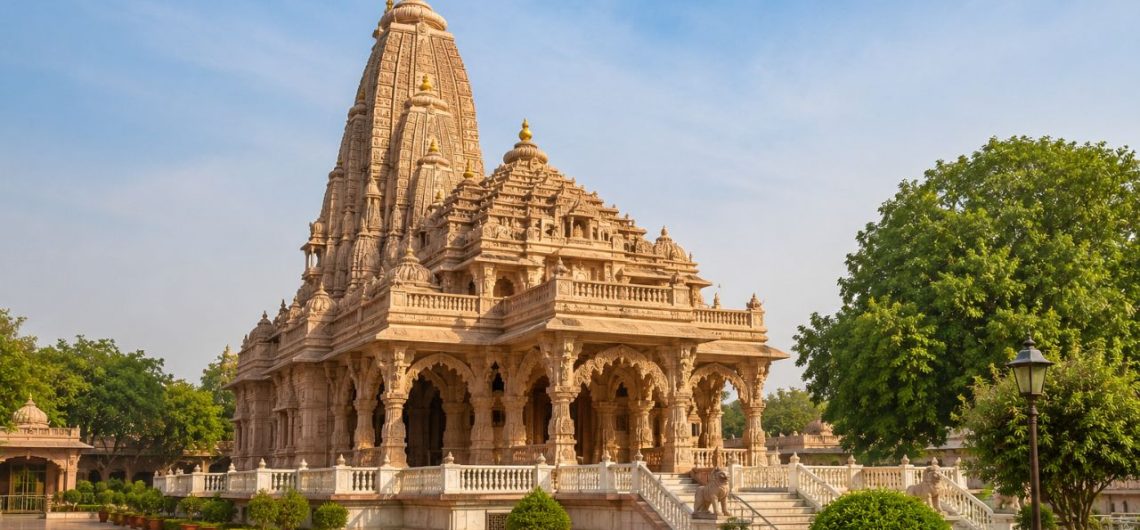
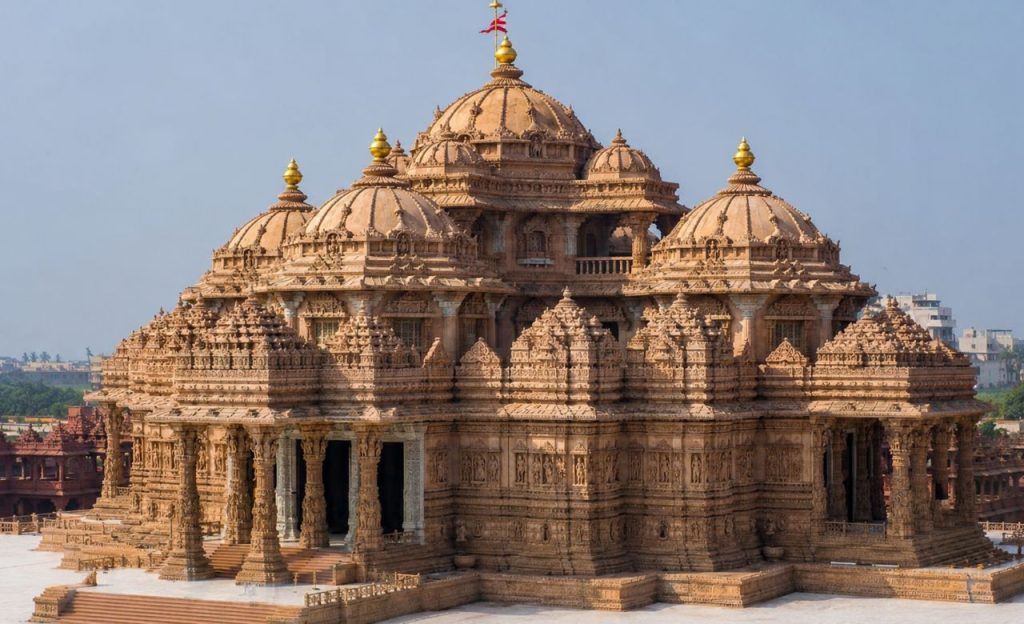
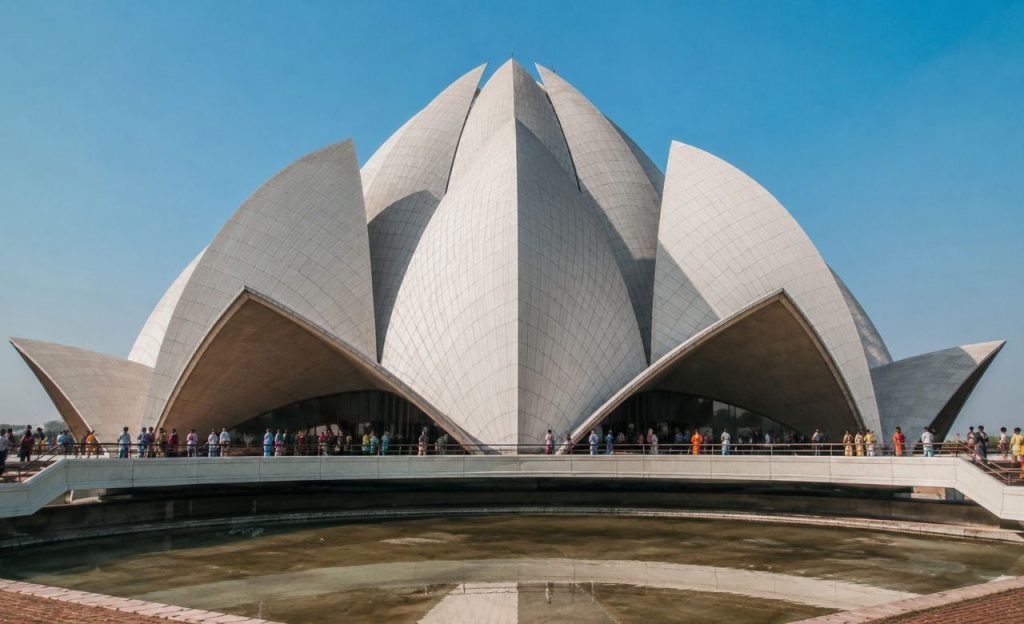
<p>Delhi’s famous spiritual places are not concentrated in one neighbourhood. Gurudwara Bangla Sahib and Birla Mandir are in Central Delhi, while the Lotus Temple, ISKCON Temple, and Chhatarpur Temple are in or around South Delhi. Akshardham lies in another direction.</p>
<!-- /wp:paragraph -->
<!-- wp:paragraph -->
<p>This geography creates the real transport challenge.</p>
<!-- /wp:paragraph -->
<!-- wp:paragraph -->
<p>When travelling by Metro, journey time includes more than the minutes spent on a train. You also need to consider reaching the station, security checks, waiting, line changes, finding the right exit, and travelling from the station to the temple entrance.</p>
<!-- /wp:paragraph -->
<!-- wp:paragraph -->
<p>A car has different challenges. Road congestion, peak-hour traffic, and parking or drop-off arrangements can slow the journey.</p>
<!-- /wp:paragraph -->
<!-- wp:paragraph -->
<p>That is why station-to-station time and temple-to-temple time are not the same thing. A good Delhi temple itinerary must consider the complete journey rather than only the distance shown on a map.</p>
<!-- /wp:paragraph -->
<!-- wp:heading -->
<h2 class="wp-block-heading">Delhi Temple Tour by Car: What Is the Real Experience?</h2>
<!-- /wp:heading -->
<!-- wp:image {"id":2152,"sizeSlug":"large","linkDestination":"none"} -->
<figure class="wp-block-image size-large"><img src="https://www.tajadventureholidays.com/wp-content/uploads/2026/07/Delhi-Temple-Tour-by-Car-vs-Metro-Which-Is-Better-2-1024x624.jpg" alt="Delhi Temple Tour by Car vs Metro: Which Is Better?" class="wp-image-2152"/></figure>
<!-- /wp:image -->
<!-- wp:paragraph -->
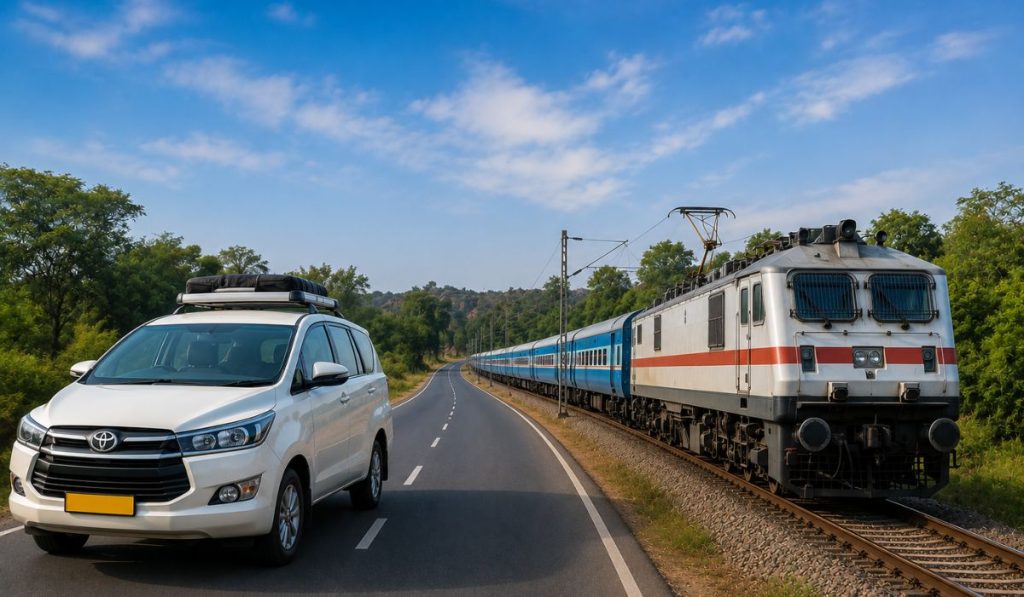
<p>The biggest advantage of a <strong>Delhi Temple Tour by Car</strong> is the ability to travel directly between spiritual sites without returning to a Metro station after every visit.</p>
<!-- /wp:paragraph -->
<!-- wp:paragraph -->
<p>For a multi-stop itinerary, this can make the day feel less fragmented.</p>
<!-- /wp:paragraph -->
<!-- wp:heading {"level":3} -->
<h3 class="wp-block-heading">Direct Travel Between Different Spiritual Sites</h3>
<!-- /wp:heading -->
<!-- wp:paragraph -->
<p>With a private car, you can leave your hotel and travel towards the first temple before continuing directly to the next stop.</p>
<!-- /wp:paragraph -->
<!-- wp:paragraph -->
<p>This becomes useful when the itinerary includes spiritual places in different areas. Instead of walking back to a station, passing through security, changing lines, and arranging last-mile transport, you continue towards the next destination.</p>
<!-- /wp:paragraph -->
<!-- wp:paragraph -->
<p>For travellers who want to see spiritual landmarks as part of a broader exploration of the capital, a <a href="https://www.tajadventureholidays.com/tours/full-day-new-and-old-delhi-city-tour/"><strong>Full Day New and Old Delhi City Tour</strong> </a>can also provide a wider view of Delhi’s religious, historical, and cultural character.</p>
<!-- /wp:paragraph -->
<!-- wp:heading {"level":3} -->
<h3 class="wp-block-heading">More Flexibility During the Day</h3>
<!-- /wp:heading -->
<!-- wp:paragraph -->
<p>A private vehicle also makes it easier to adjust the itinerary.</p>
<!-- /wp:paragraph -->
<!-- wp:paragraph -->
<p>You may want to spend longer at a peaceful spiritual site, take a meal break, skip a crowded stop, or change the route because of traffic. A flexible itinerary can be particularly useful when travelling with children or older family members.</p>
<!-- /wp:paragraph -->
<!-- wp:paragraph -->
<p>There are disadvantages too.</p>
<!-- /wp:paragraph -->
<!-- wp:paragraph -->
<p>Delhi traffic can be unpredictable, especially during busy hours. Some religious sites may have restricted vehicle access or require a short walk from the drop-off point. A private car also costs more than using public transport.</p>
<!-- /wp:paragraph -->
<!-- wp:paragraph -->
<p>The car is therefore not automatically faster. Its main advantage is convenience between multiple stops.</p>
<!-- /wp:paragraph -->
<!-- wp:heading -->
<h2 class="wp-block-heading">Visiting Delhi Temples by Metro: What Is the Real Experience?</h2>
<!-- /wp:heading -->
<!-- wp:paragraph -->
<p>The Delhi Metro is one of the most practical ways to move around the capital, particularly for independent travellers.</p>
<!-- /wp:paragraph -->
<!-- wp:paragraph -->
<p>It is affordable, avoids much of the road congestion, and works especially well when a spiritual site is close to a convenient station. Delhi Tourism’s official Metro itinerary connects stations with several religious attractions, including Bangla Sahib, Laxmi Narayan Mandir, Chhatarpur Temple, ISKCON Temple, Kalkaji Temple, and the Lotus Temple.</p>
<!-- /wp:paragraph -->
<!-- wp:heading {"level":3} -->
<h3 class="wp-block-heading">Where the Delhi Metro Works Well</h3>
<!-- /wp:heading -->
<!-- wp:paragraph -->
<p>The Metro is a strong choice when you are travelling alone, watching your budget, or visiting only a few places.</p>
<!-- /wp:paragraph -->
<!-- wp:paragraph -->
<p>It can also work well when the temples are located within the same general area. South Delhi is a good example because several important spiritual places can be grouped into one route.</p>
<!-- /wp:paragraph -->
<!-- wp:paragraph -->
<p>For travellers comfortable with public transport, walking, and navigating interchanges, the Metro can provide considerable independence.</p>
<!-- /wp:paragraph -->
<!-- wp:heading {"level":3} -->
<h3 class="wp-block-heading">The Problem with Multiple Metro Changes</h3>
<!-- /wp:heading -->
<!-- wp:paragraph -->
<p>The experience becomes less simple when a temple itinerary spreads across Delhi.</p>
<!-- /wp:paragraph -->
<!-- wp:paragraph -->
<p>A typical journey may involve walking to the station, passing through security, waiting for a train, changing lines, finding the correct exit, and then walking or taking an auto-rickshaw to the final destination.</p>
<!-- /wp:paragraph -->
<!-- wp:paragraph -->
<p>None of these steps is necessarily difficult on its own. Repeating them several times in one day, however, can take more time and energy than expected.</p>
<!-- /wp:paragraph -->
<!-- wp:heading -->
<h2 class="wp-block-heading">The Hidden Difference: Last-Mile Travel</h2>
<!-- /wp:heading -->
<!-- wp:paragraph -->
<p>One of the biggest mistakes in planning a temple tour is assuming that “near a Metro station” means “at the Metro station.”</p>
<!-- /wp:paragraph -->
<!-- wp:paragraph -->
<p>The last mile matters.</p>
<!-- /wp:paragraph -->
<!-- wp:paragraph -->
<p>After leaving a station, a visitor may still need to find the correct exit, walk to the entrance, cross a busy road, or take a short auto-rickshaw ride. The same process begins again after the temple visit when it is time to reach the next stop.</p>
<!-- /wp:paragraph -->
<!-- wp:paragraph -->
<p>This can be easy in pleasant winter weather. It may feel very different during the intense heat of May or June, heavy monsoon rain, or a day spent travelling with young children.</p>
<!-- /wp:paragraph -->
<!-- wp:paragraph -->
<p>A Metro journey may look like this:</p>
<!-- /wp:paragraph -->
<!-- wp:paragraph -->
<p>Hotel → station → security → train → interchange → station exit → walk or auto → temple</p>
<!-- /wp:paragraph -->
<!-- wp:paragraph -->
<p>A car journey is generally more direct:</p>
<!-- /wp:paragraph -->
<!-- wp:paragraph -->
<p>Hotel → temple drop-off area</p>
<!-- /wp:paragraph -->
<!-- wp:paragraph -->
<p>Still, the Metro can win when the connection is straightforward and road congestion is severe. The real question is not whether a station exists nearby, but how much effort the complete door-to-door journey requires.</p>
<!-- /wp:paragraph -->
<!-- wp:heading -->
<h2 class="wp-block-heading">Car vs Metro for a Delhi Temple Tour: Key Differences</h2>
<!-- /wp:heading -->
<!-- wp:paragraph -->
<p>Choosing between a car and the Metro becomes easier when you focus on the type of journey you are planning.</p>
<!-- /wp:paragraph -->
<!-- wp:paragraph -->
<p><strong>Best for the lowest travel cost: Metro</strong></p>
<!-- /wp:paragraph -->
<!-- wp:paragraph -->
<p>Public transport is generally the more economical option, especially for solo travellers.</p>
<!-- /wp:paragraph -->
<!-- wp:paragraph -->
<p><strong>Best for comfort: Car</strong></p>
<!-- /wp:paragraph -->
<!-- wp:paragraph -->
<p>A private vehicle reduces repeated walking and transport changes between spiritual sites.</p>
<!-- /wp:paragraph -->
<!-- wp:paragraph -->
<p><strong>Best for solo travellers: Metro</strong></p>
<!-- /wp:paragraph -->
<!-- wp:paragraph -->
<p>Independent visitors can explore at their own pace without paying for a full-day vehicle.</p>
<!-- /wp:paragraph -->
<!-- wp:paragraph -->
<p><strong>Best for families: Car</strong></p>
<!-- /wp:paragraph -->
<!-- wp:paragraph -->
<p>Direct transfers are often easier when travelling with children or senior family members.</p>
<!-- /wp:paragraph -->
<!-- wp:paragraph -->
<p><strong>Best for avoiding road congestion: Metro</strong></p>
<!-- /wp:paragraph -->
<!-- wp:paragraph -->
<p>Metro travel is not affected by surface traffic in the same way as road transport.</p>
<!-- /wp:paragraph -->
<!-- wp:paragraph -->
<p><strong>Best for distant temple stops: Car</strong></p>
<!-- /wp:paragraph -->
<!-- wp:paragraph -->
<p>A <strong>Delhi Temple Tour by Car</strong> becomes more useful when the route crosses several parts of the city.</p>
<!-- /wp:paragraph -->
<!-- wp:paragraph -->
<p><strong>Best for flexibility: Car</strong></p>
<!-- /wp:paragraph -->
<!-- wp:paragraph -->
<p>Changing the order of stops or adding a break is generally easier with private transport.</p>
<!-- /wp:paragraph -->
<!-- wp:heading -->
<h2 class="wp-block-heading">Temple-by-Temple Comparison: Car or Metro?</h2>
<!-- /wp:heading -->
<!-- wp:paragraph -->
<p>The best transport option changes from one spiritual site to another. Instead of choosing one mode for the entire city, it is more useful to look at how each temple fits into the day.</p>
<!-- /wp:paragraph -->
<!-- wp:heading {"level":3} -->
<h3 class="wp-block-heading">Akshardham: Car or Metro?</h3>
<!-- /wp:heading -->
<!-- wp:paragraph -->
<p>Akshardham is one of the easier major spiritual landmarks to approach by Metro because it has a station serving the area. For travellers visiting Akshardham as a single destination, public transport can be a sensible option.</p>
<!-- /wp:paragraph -->
<!-- wp:paragraph -->
<p>The situation changes when Akshardham is combined with Central or South Delhi.</p>
<!-- /wp:paragraph -->
<!-- wp:paragraph -->
<p>A visitor travelling from one distant spiritual cluster to another must consider the complete transfer, including line changes, walking, and the journey after leaving the next station.</p>
<!-- /wp:paragraph -->
<!-- wp:paragraph -->
<p>A car may therefore be more practical when Akshardham is one stop in a wider multi-area itinerary.</p>
<!-- /wp:paragraph -->
<!-- wp:paragraph -->
<p><strong>Best option for:</strong> Metro for a focused visit; car for a broader cross-Delhi route.</p>
<!-- /wp:paragraph -->
<!-- wp:heading {"level":3} -->
<h3 class="wp-block-heading">Lotus Temple and ISKCON Temple: Car or Metro?</h3>
<!-- /wp:heading -->
<!-- wp:paragraph -->
<p>The Lotus Temple and ISKCON Temple are among the strongest candidates for a Metro-based spiritual route.</p>
<!-- /wp:paragraph -->
<!-- wp:paragraph -->
<p>The Kalkaji Mandir and Nehru Place areas provide access to several nearby spiritual attractions, making this part of South Delhi easier to explore as a cluster.</p>
<!-- /wp:paragraph -->
<!-- wp:paragraph -->
<p>This is an important example of why route geography matters.</p>
<!-- /wp:paragraph -->
<!-- wp:paragraph -->
<p>If you only want to explore the Lotus Temple, ISKCON Temple, and nearby spiritual places, the Metro can work well. If your day continues towards Central Delhi or Akshardham, direct road transport may become more convenient.</p>
<!-- /wp:paragraph -->
<!-- wp:paragraph -->
<p>Weather also matters. A manageable walk in January can feel very different in peak summer.</p>
<!-- /wp:paragraph -->
<!-- wp:paragraph -->
<p><strong>Best option for:</strong> Metro for a South Delhi cluster; car for a longer multi-area itinerary.</p>
<!-- /wp:paragraph -->
<!-- wp:heading {"level":3} -->
<h3 class="wp-block-heading">Chhatarpur Temple: Car or Metro?</h3>
<!-- /wp:heading -->
<!-- wp:paragraph -->
<p>Chhatarpur Temple is another spiritual site with Metro accessibility. It can work well for independent travellers who are comfortable using public transport.</p>
<!-- /wp:paragraph -->
<!-- wp:paragraph -->
<p>However, the temple complex itself and the wider route should be considered when planning the day. If Chhatarpur is combined with other South Delhi stops, both Metro and car can be practical depending on the exact itinerary.</p>
<!-- /wp:paragraph -->
<!-- wp:paragraph -->
<p>A car becomes more useful when the route continues across distant parts of Delhi or when reducing walking is a priority.</p>
<!-- /wp:paragraph -->
<!-- wp:paragraph -->
<p><strong>Best option for:</strong> Either option for a focused South Delhi route.</p>
<!-- /wp:paragraph -->
<!-- wp:heading {"level":3} -->
<h3 class="wp-block-heading">Gurudwara Bangla Sahib and Birla Mandir: Car or Metro?</h3>
<!-- /wp:heading -->
<!-- wp:paragraph -->
<p>These two important spiritual places fit naturally into a Central Delhi itinerary.</p>
<!-- /wp:paragraph -->
<!-- wp:paragraph -->
<p>Delhi Tourism’s official Metro itinerary lists both Bangla Sahib and Laxmi Narayan Mandir among attractions accessible from the central Metro network. This makes public transport a realistic choice for independent visitors.</p>
<!-- /wp:paragraph -->
<!-- wp:paragraph -->
<p>A car, however, can be easier when these sites form the beginning of a longer route towards South or East Delhi.</p>
<!-- /wp:paragraph -->
<!-- wp:paragraph -->
<p><strong>Best option for:</strong> Metro for Central Delhi only; car for a wider multi-stop route.</p>
<!-- /wp:paragraph -->
<!-- wp:heading -->
<h2 class="wp-block-heading">Which Delhi Temples Can Be Combined in One Route?</h2>
<!-- /wp:heading -->
<!-- wp:image {"id":2153,"sizeSlug":"large","linkDestination":"none"} -->
<figure class="wp-block-image size-large"><img src="https://www.tajadventureholidays.com/wp-content/uploads/2026/07/Delhi-Temple-Tour-by-Car-vs-Metro-Which-Is-Better-1-1024x624.jpg" alt="Delhi Temple Tour by Car vs Metro: Which Is Better?" class="wp-image-2153"/></figure>
<!-- /wp:image -->
<!-- wp:paragraph -->
<p>A smart temple itinerary should be built around geography rather than a random list of famous places.</p>
<!-- /wp:paragraph -->
<!-- wp:heading {"level":3} -->
<h3 class="wp-block-heading">South Delhi Spiritual Route</h3>
<!-- /wp:heading -->
<!-- wp:paragraph -->
<p>A practical South Delhi cluster can include:</p>
<!-- /wp:paragraph -->
<!-- wp:list -->
<ul class="wp-block-list"><!-- wp:list-item -->
<li>Lotus Temple</li>
<!-- /wp:list-item -->
<!-- wp:list-item -->
<li>ISKCON Temple</li>
<!-- /wp:list-item -->
<!-- wp:list-item -->
<li>Kalkaji Temple</li>
<!-- /wp:list-item --></ul>
<!-- /wp:list -->
<!-- wp:paragraph -->
<p>These sites are located in the same broader part of the city and can be easier to combine than temples scattered across Delhi.</p>
<!-- /wp:paragraph -->
<!-- wp:paragraph -->
<p>For a visitor comfortable with walking and public transport, this can be one of the better Metro-based temple routes.</p>
<!-- /wp:paragraph -->
<!-- wp:heading {"level":3} -->
<h3 class="wp-block-heading">Central Delhi Spiritual Route</h3>
<!-- /wp:heading -->
<!-- wp:paragraph -->
<p>A Central Delhi spiritual route can include:</p>
<!-- /wp:paragraph -->
<!-- wp:list -->
<ul class="wp-block-list"><!-- wp:list-item -->
<li>Gurudwara Bangla Sahib</li>
<!-- /wp:list-item -->
<!-- wp:list-item -->
<li>Birla Mandir</li>
<!-- /wp:list-item -->
<!-- wp:list-item -->
<li>Other nearby religious or cultural landmarks</li>
<!-- /wp:list-item --></ul>
<!-- /wp:list -->
<!-- wp:paragraph -->
<p>Because the route stays within the central part of the city, both Metro and car can work.</p>
<!-- /wp:paragraph -->
<!-- wp:paragraph -->
<p>Travellers who want to combine spiritual stops with heritage landmarks, markets, and historic neighbourhoods may also find a <strong>Full Day New and Old Delhi City Tour</strong> more suitable than a temple-only itinerary.</p>
<!-- /wp:paragraph -->
<!-- wp:heading {"level":3} -->
<h3 class="wp-block-heading">Cross-Delhi Spiritual Route</h3>
<!-- /wp:heading -->
<!-- wp:paragraph -->
<p>A more ambitious itinerary may move from:</p>
<!-- /wp:paragraph -->
<!-- wp:paragraph -->
<p>Central Delhi → South Delhi → East Delhi</p>
<!-- /wp:paragraph -->
<!-- wp:paragraph -->
<p>This is where transport choice becomes more important.</p>
<!-- /wp:paragraph -->
<!-- wp:paragraph -->
<p>The Metro remains possible, but the number of transfers, walks, and last-mile connections increases. A private car may provide a more continuous experience, although road traffic must still be considered.</p>
<!-- /wp:paragraph -->
<!-- wp:heading -->
<h2 class="wp-block-heading">Where Does Your Time Actually Go?</h2>
<!-- /wp:heading -->
<!-- wp:paragraph -->
<p>Travel apps often show only the main journey time. A temple tour includes much more.</p>
<!-- /wp:paragraph -->
<!-- wp:paragraph -->
<p>For Metro travel, the complete transfer may include:</p>
<!-- /wp:paragraph -->
<!-- wp:list -->
<ul class="wp-block-list"><!-- wp:list-item -->
<li>Walking to the station</li>
<!-- /wp:list-item -->
<!-- wp:list-item -->
<li>Station security</li>
<!-- /wp:list-item -->
<!-- wp:list-item -->
<li>Waiting for the train</li>
<!-- /wp:list-item -->
<!-- wp:list-item -->
<li>Changing Metro lines</li>
<!-- /wp:list-item -->
<!-- wp:list-item -->
<li>Finding the correct exit</li>
<!-- /wp:list-item -->
<!-- wp:list-item -->
<li>Walking or taking an auto-rickshaw</li>
<!-- /wp:list-item -->
<!-- wp:list-item -->
<li>Returning to public transport after the visit</li>
<!-- /wp:list-item --></ul>
<!-- /wp:list -->
<!-- wp:paragraph -->
<p>For car travel, time may be spent on:</p>
<!-- /wp:paragraph -->
<!-- wp:list -->
<ul class="wp-block-list"><!-- wp:list-item -->
<li>Road congestion</li>
<!-- /wp:list-item -->
<!-- wp:list-item -->
<li>Traffic signals</li>
<!-- /wp:list-item -->
<!-- wp:list-item -->
<li>Reaching the appropriate drop-off point</li>
<!-- /wp:list-item -->
<!-- wp:list-item -->
<li>Short walks where direct vehicle access is limited</li>
<!-- /wp:list-item --></ul>
<!-- /wp:list -->
<!-- wp:paragraph -->
<p>This is why a 25-minute train journey does not necessarily mean a 25-minute temple transfer.</p>
<!-- /wp:paragraph -->
<!-- wp:paragraph -->
<p>The most useful comparison is door to door, not train time against driving time. A well-planned <strong>Delhi Temple Tour by Car</strong> should also account for peak traffic rather than assuming every road transfer will be quick.</p>
<!-- /wp:paragraph -->
<!-- wp:heading -->
<h2 class="wp-block-heading">The Same Delhi Temple Itinerary by Car vs Metro</h2>
<!-- /wp:heading -->
<!-- wp:paragraph -->
<p>Consider a sample route:</p>
<!-- /wp:paragraph -->
<!-- wp:paragraph -->
<p><strong>Gurudwara Bangla Sahib → Birla Mandir → Lotus Temple → ISKCON Temple</strong></p>
<!-- /wp:paragraph -->
<!-- wp:paragraph -->
<p>This route begins in Central Delhi and then moves south.</p>
<!-- /wp:paragraph -->
<!-- wp:heading {"level":3} -->
<h3 class="wp-block-heading">How the Route Works by Metro</h3>
<!-- /wp:heading -->
<!-- wp:paragraph -->
<p>The Metro can handle much of the longer-distance travel, but the day also includes reaching stations, passing through security, navigating the network, and walking between transport points and spiritual sites.</p>
<!-- /wp:paragraph -->
<!-- wp:paragraph -->
<p>The South Delhi part becomes easier because the Lotus Temple and ISKCON Temple are within the same broader cluster.</p>
<!-- /wp:paragraph -->
<!-- wp:paragraph -->
<p>This option suits travellers who want to keep costs low and do not mind a more active day.</p>
<!-- /wp:paragraph -->
<!-- wp:heading {"level":3} -->
<h3 class="wp-block-heading">How the Same Route Works by Car</h3>
<!-- /wp:heading -->
<!-- wp:paragraph -->
<p>A car provides direct movement from one stop towards the next. There is no need to return to a Metro station after every visit, and breaks can be added more easily.</p>
<!-- /wp:paragraph -->
<!-- wp:paragraph -->
<p>The disadvantage is traffic. A badly timed road transfer during busy hours can reduce the time saved by avoiding Metro changes.</p>
<!-- /wp:paragraph -->
<!-- wp:paragraph -->
<p>For travellers who prefer direct transfers, the <a href="https://www.tajadventureholidays.com/tours/delhi-temples-and-spiritual-tour-by-car/">Delhi Temples and Spiritual Tour by Car</a> is the most relevant option for exploring this type of multi-stop route without planning every individual transport connection.</p>
<!-- /wp:paragraph -->
<!-- wp:heading {"level":3} -->
<h3 class="wp-block-heading">Which Option Wins for This Route?</h3>
<!-- /wp:heading -->
<!-- wp:paragraph -->
<p>For a solo budget traveller, the Metro can be the better choice.</p>
<!-- /wp:paragraph -->
<!-- wp:paragraph -->
<p>For a family, a senior traveller, or someone visiting Delhi for the first time, a car may offer a simpler experience.</p>
<!-- /wp:paragraph -->
<!-- wp:paragraph -->
<p>The route itself does not change. The better transport choice changes with the traveller.</p>
<!-- /wp:paragraph -->
<!-- wp:heading -->
<h2 class="wp-block-heading">Is Metro Plus Auto a Better Third Option?</h2>
<!-- /wp:heading -->
<!-- wp:paragraph -->
<p>The choice is not always limited to Metro or private car.</p>
<!-- /wp:paragraph -->
<!-- wp:paragraph -->
<p>A combination of Metro and auto-rickshaw can work well for many independent visitors. The Metro handles longer journeys, while an auto can help with the last mile between a station and a temple entrance.</p>
<!-- /wp:paragraph -->
<!-- wp:paragraph -->
<p>This approach is particularly useful for solo travellers who want to control costs without walking every part of the route.</p>
<!-- /wp:paragraph -->
<!-- wp:paragraph -->
<p>However, it still requires more planning than a private vehicle. You may need to arrange several short rides, explain destinations, wait for transport, and repeat the process throughout the day.</p>
<!-- /wp:paragraph -->
<!-- wp:paragraph -->
<p>For two or three well-connected spiritual sites, Metro plus auto can be an excellent middle option. For a full-day itinerary across several parts of Delhi, repeated transfers may become tiring.</p>
<!-- /wp:paragraph -->
<!-- wp:heading -->
<h2 class="wp-block-heading">Which Option (Delhi Temple Tour by Car vs Metro) Is Better for Your Type of Trip?</h2>
<!-- /wp:heading -->
<!-- wp:paragraph -->
<p>Different travellers experience the same route differently.</p>
<!-- /wp:paragraph -->
<!-- wp:heading {"level":3} -->
<h3 class="wp-block-heading">Solo Travellers</h3>
<!-- /wp:heading -->
<!-- wp:paragraph -->
<p>The Metro is usually the strongest choice for independent budget travellers. It keeps transport costs low and provides freedom to spend as much time as desired at each stop.</p>
<!-- /wp:paragraph -->
<!-- wp:heading {"level":3} -->
<h3 class="wp-block-heading">Couples</h3>
<!-- /wp:heading -->
<!-- wp:paragraph -->
<p>For two people visiting a small spiritual cluster, the Metro can work well. A car becomes more attractive when comfort, weather, or a longer list of distant temples is important.</p>
<!-- /wp:paragraph -->
<!-- wp:heading {"level":3} -->
<h3 class="wp-block-heading">Families with Children</h3>
<!-- /wp:heading -->
<!-- wp:paragraph -->
<p>Families may find direct transfers easier. Repeated station changes, walking, and last-mile journeys can become tiring over a full day.</p>
<!-- /wp:paragraph -->
<!-- wp:heading {"level":3} -->
<h3 class="wp-block-heading">Senior Travellers</h3>
<!-- /wp:heading -->
<!-- wp:paragraph -->
<p>The amount of walking should be considered carefully. A private vehicle can reduce transport changes, although some walking may still be necessary at large religious complexes.</p>
<!-- /wp:paragraph -->
<!-- wp:heading {"level":3} -->
<h3 class="wp-block-heading">First-Time Foreign Visitors</h3>
<!-- /wp:heading -->
<!-- wp:paragraph -->
<p>The best choice depends on confidence with local public transport and the number of stops planned.</p>
<!-- /wp:paragraph -->
<!-- wp:paragraph -->
<p>Many first-time international travellers visit Delhi as part of <strong>India Golden Triangle Tour Packages</strong>, often with limited sightseeing time before continuing to Agra and Jaipur. For them, route efficiency may matter more than choosing the cheapest transport.</p>
<!-- /wp:paragraph -->
<!-- wp:heading -->
<h2 class="wp-block-heading">Does the Best Option Change by Season?</h2>
<!-- /wp:heading -->
<!-- wp:paragraph -->
<p>Yes. Delhi’s weather can significantly change the experience of using public transport or travelling by road.</p>
<!-- /wp:paragraph -->
<!-- wp:heading {"level":3} -->
<h3 class="wp-block-heading">October to March</h3>
<!-- /wp:heading -->
<!-- wp:paragraph -->
<p>Cooler weather makes walking and last-mile travel more comfortable. The Metro can be a particularly practical option during these months.</p>
<!-- /wp:paragraph -->
<!-- wp:heading {"level":3} -->
<h3 class="wp-block-heading">April to June</h3>
<!-- /wp:heading -->
<!-- wp:paragraph -->
<p>High temperatures can make repeated walks between stations and temple entrances tiring. An air-conditioned car may be more comfortable for a full-day itinerary.</p>
<!-- /wp:paragraph -->
<!-- wp:heading {"level":3} -->
<h3 class="wp-block-heading">July to September</h3>
<!-- /wp:heading -->
<!-- wp:paragraph -->
<p>Rain can complicate walking and short outdoor transfers. Direct vehicle travel can be useful, although monsoon conditions may also slow road traffic.</p>
<!-- /wp:paragraph -->
<!-- wp:paragraph -->
<p>Season alone should not decide the transport. It should be considered together with route length, traveller age, and the number of stops.</p>
<!-- /wp:paragraph -->
<!-- wp:heading -->
<h2 class="wp-block-heading">When Is the Metro Actually the Better Choice?</h2>
<!-- /wp:heading -->
<!-- wp:paragraph -->
<p>Choose the Metro when:</p>
<!-- /wp:paragraph -->
<!-- wp:list -->
<ul class="wp-block-list"><!-- wp:list-item -->
<li>You are travelling alone</li>
<!-- /wp:list-item -->
<!-- wp:list-item -->
<li>Budget is your main priority</li>
<!-- /wp:list-item -->
<!-- wp:list-item -->
<li>You plan to visit only one or two temples</li>
<!-- /wp:list-item -->
<!-- wp:list-item -->
<li>Your chosen spiritual sites form a convenient cluster</li>
<!-- /wp:list-item -->
<!-- wp:list-item -->
<li>You are comfortable walking</li>
<!-- /wp:list-item -->
<!-- wp:list-item -->
<li>You prefer independent sightseeing</li>
<!-- /wp:list-item -->
<!-- wp:list-item -->
<li>Heavy road congestion is expected</li>
<!-- /wp:list-item --></ul>
<!-- /wp:list -->
<!-- wp:paragraph -->
<p>For a simple route, using a private vehicle may add cost without adding much convenience.</p>
<!-- /wp:paragraph -->
<!-- wp:paragraph -->
<p>The Metro is particularly strong when the entire itinerary stays within one well-connected part of Delhi.</p>
<!-- /wp:paragraph -->
<!-- wp:heading -->
<h2 class="wp-block-heading">When Does a Car Make More Sense?</h2>
<!-- /wp:heading -->
<!-- wp:paragraph -->
<p>A <strong>Delhi Temple Tour by Car</strong> generally makes more sense when the day includes spiritual places spread across several areas.</p>
<!-- /wp:paragraph -->
<!-- wp:paragraph -->
<p>It may also suit:</p>
<!-- /wp:paragraph -->
<!-- wp:list -->
<ul class="wp-block-list"><!-- wp:list-item -->
<li>Families with young children</li>
<!-- /wp:list-item -->
<!-- wp:list-item -->
<li>Senior travellers</li>
<!-- /wp:list-item -->
<!-- wp:list-item -->
<li>Visitors who want hotel pickup</li>
<!-- /wp:list-item -->
<!-- wp:list-item -->
<li>Travellers carrying personal belongings</li>
<!-- /wp:list-item -->
<!-- wp:list-item -->
<li>People visiting during very hot or rainy weather</li>
<!-- /wp:list-item -->
<!-- wp:list-item -->
<li>Anyone who wants to adjust the itinerary during the day</li>
<!-- /wp:list-item --></ul>
<!-- /wp:list -->
<!-- wp:paragraph -->
<p>The strongest reason to choose a car is not luxury. It is continuity.</p>
<!-- /wp:paragraph -->
<!-- wp:paragraph -->
<p>Instead of planning every station, interchange, exit, walk, and last-mile connection, you move directly towards the next stop. Travellers who prefer this approach can consider a <strong>private Delhi temple tour by car</strong> when planning a multi-stop spiritual day.</p>
<!-- /wp:paragraph -->
<!-- wp:heading -->
<h2 class="wp-block-heading">Practical Tips for Delhi Temple Tour by Car vs Metro</h2>
<!-- /wp:heading -->
<!-- wp:paragraph -->
<p>Whichever transport you choose, good planning will improve the experience.</p>
<!-- /wp:paragraph -->
<!-- wp:paragraph -->
<p>Start early when possible. Morning travel can help you avoid some of the busiest road conditions and gives you more flexibility later in the day.</p>
<!-- /wp:paragraph -->
<!-- wp:paragraph -->
<p>Check current opening days and visiting hours before departure. Religious sites may have different schedules, special prayer periods, weekly closures, or temporary access changes.</p>
<!-- /wp:paragraph -->
<!-- wp:paragraph -->
<p>Dress respectfully and follow the rules at each place of worship. Footwear may need to be removed, and photography restrictions can vary.</p>
<!-- /wp:paragraph -->
<!-- wp:paragraph -->
<p>Allow extra time for security checks. Major spiritual attractions can have screening procedures, especially during busy periods or festivals.</p>
<!-- /wp:paragraph -->
<!-- wp:paragraph -->
<p>Do not try to visit too many places. Four meaningful stops often create a better experience than rushing through seven or eight.</p>
<!-- /wp:paragraph -->
<!-- wp:paragraph -->
<p>Check the weather before deciding how much walking is realistic, and avoid planning long road transfers during the busiest traffic periods where possible.</p>
<!-- /wp:paragraph -->
<!-- wp:paragraph -->
<p>Most importantly, build the route around location. Nearby spiritual sites should be grouped together before adding a distant temple simply because it is famous.</p>
<!-- /wp:paragraph -->
<!-- wp:heading -->
<h2 class="wp-block-heading">Final Verdict: Delhi Temple Tour by Car vs Metro?</h2>
<!-- /wp:heading -->
<!-- wp:paragraph -->
<p>There is no single winner for every traveller.</p>
<!-- /wp:paragraph -->
<!-- wp:paragraph -->
<p>The Metro is usually better for solo visitors, budget-conscious travellers, and simple routes built around one or two well-connected spiritual sites. It is affordable and can avoid delays caused by road congestion.</p>
<!-- /wp:paragraph -->
<!-- wp:paragraph -->
<p>A car is generally more practical for families, senior travellers, and itineraries that move across several parts of Delhi. It reduces repeated transport changes and makes the day easier to adjust.</p>
<!-- /wp:paragraph -->
<!-- wp:paragraph -->
<p>Metro plus auto-rickshaw offers a useful middle option for independent travellers.</p>
<!-- /wp:paragraph -->
<!-- wp:paragraph -->
<p>In the end, the best way to choose is to map the exact temples first. If they form one compact cluster, use the Metro. If the route crosses Central, South, and East Delhi, a <strong>Delhi Temple Tour by Car</strong> can provide a more convenient and continuous way to experience the city’s spiritual side.</p>
<!-- /wp:paragraph -->
<!-- wp:heading -->
<h2 class="wp-block-heading">FAQa -Delhi Temple Tour by Car vs Metro</h2>
<!-- /wp:heading -->
<!-- wp:heading {"level":3} -->
<h3 class="wp-block-heading">1. Is a Delhi Temple Tour by Car better than using the Metro?</h3>
<!-- /wp:heading -->
<!-- wp:paragraph -->
<p>A Delhi Temple Tour by Car is generally more convenient for families, senior travellers, and visitors covering spiritual sites across different parts of the city. The Metro may be better for solo or budget travellers visiting one or two well-connected temples. The right choice depends mainly on the route, weather, and number of stops.</p>
<!-- /wp:paragraph -->
<!-- wp:heading {"level":3} -->
<h3 class="wp-block-heading">2. Can I visit the major temples in Delhi in one day?</h3>
<!-- /wp:heading -->
<!-- wp:paragraph -->
<p>Yes, you can visit several major temples in one day, but trying to cover every famous spiritual site is unrealistic. A well-planned route usually focuses on three to five places in the same area or along a practical travel direction. Starting early and checking current opening hours can help you use the day more efficiently.</p>
<!-- /wp:paragraph -->
<!-- wp:heading {"level":3} -->
<h3 class="wp-block-heading">3. Which Delhi temples are easiest to visit by Metro?</h3>
<!-- /wp:heading -->
<!-- wp:paragraph -->
<p>The Lotus Temple, ISKCON Temple, Kalkaji Temple, Chhatarpur Temple, and Akshardham are among the spiritual sites with useful Metro access. However, the nearest station may not always be directly at the entrance, so visitors should also consider walking distance, station exits, and possible last-mile transport.</p>
<!-- /wp:paragraph -->
<!-- wp:heading {"level":3} -->
<h3 class="wp-block-heading">4. Is the Delhi Metro suitable for senior travellers visiting temples?</h3>
<!-- /wp:heading -->
<!-- wp:paragraph -->
<p>The Delhi Metro can work for senior travellers who are comfortable walking and changing lines. However, a multi-stop temple itinerary may involve station transfers, security checks, stairs or long corridors, and walking between stations and entrances. For several widely separated sites, direct car travel may be easier.</p>
<!-- /wp:paragraph -->
<!-- wp:heading {"level":3} -->
<h3 class="wp-block-heading">5. How many temples can I realistically visit in Delhi in one day?</h3>
<!-- /wp:heading -->
<!-- wp:paragraph -->
<p>Most travellers can comfortably visit around three to five spiritual sites in one day, depending on their locations and the time spent at each place. Temples in the same geographic cluster are easier to combine. Traffic, Metro interchanges, security checks, prayer times, and meal breaks should also be included in the schedule.</p>
<!-- /wp:paragraph -->
<!-- wp:heading {"level":3} -->
<h3 class="wp-block-heading">6. Is Metro plus auto-rickshaw a good option for a Delhi temple tour?</h3>
<!-- /wp:heading -->
<!-- wp:paragraph -->
<p>Yes. Combining the Metro with auto-rickshaws can be a practical middle option, especially for solo and budget travellers. The Metro handles longer distances, while an auto can help with the last mile. However, arranging several short rides throughout the day may become less convenient on a large multi-stop route.</p>
<!-- /wp:paragraph -->
<!-- wp:heading {"level":3} -->
<h3 class="wp-block-heading">7. What is the best time of year for a Delhi temple tour?</h3>
<!-- /wp:heading -->
<!-- wp:paragraph -->
<p>October to March generally offers more comfortable weather for walking and outdoor transfers. During the hotter months from April to June, a private car may be more comfortable for a full-day route. Monsoon rain can also affect walking and last-mile travel, so transport choice should reflect seasonal conditions.</p>
<!-- /wp:paragraph -->
<!-- wp:heading {"level":3} -->
<h3 class="wp-block-heading">8. Should I book a private car for a first-time Delhi temple tour?</h3>
<!-- /wp:heading -->
<!-- wp:paragraph -->
<p>A private car can be useful for first-time visitors who want to see temples in different areas without planning multiple Metro journeys and last-mile connections. It is particularly practical for families and time-limited travellers. However, independent visitors following a simple, well-connected route may find the Metro sufficient.</p>
<!-- /wp:paragraph -->
<!-- wp:paragraph -->
<p></p>
<!-- /wp:paragraph -->
Delhi is home to temples, gurdwaras, and spiritual landmarks spread across different parts of the city. Visiting them may look simple on a map, but the way you travel can change the entire experience.
A Delhi Temple Tour by Car offers direct transfers and greater flexibility, while the Delhi Metro can be faster and more affordable for certain routes. The real difference becomes clear when you consider walking, Metro interchanges, last-mile transport, road traffic, weather, and the location of each spiritual site.
So, which option is actually better?
The answer depends on the temples you want to visit, who you are travelling with, and how much of Delhi you want to cover in one day. This guide compares both options using practical routes and real travel situations, helping you choose the transport that best fits your temple tour.
Quick Answer: Is a Car or Metro Better for a Delhi Temple Tour?
The Metro is usually the better choice for solo travellers, budget visitors, and anyone planning to visit one or two spiritual sites close to convenient stations. It avoids road congestion and provides predictable station-to-station travel.
A private car generally works better for families, senior travellers, and visitors planning a multi-stop temple itinerary across different parts of Delhi. It reduces transport changes and provides direct travel between stops.
However, neither option is always better.
A Metro route can be easier for visiting a well-connected South Delhi cluster, while a Delhi Temple Tour by Car may be more practical when the itinerary crosses Central, South, and East Delhi.
The number of temples matters less than where those temples are located.
Why Transport Choice Matters on a Delhi Temple Tour
Delhi’s famous spiritual places are not concentrated in one neighbourhood. Gurudwara Bangla Sahib and Birla Mandir are in Central Delhi, while the Lotus Temple, ISKCON Temple, and Chhatarpur Temple are in or around South Delhi. Akshardham lies in another direction.
This geography creates the real transport challenge.
When travelling by Metro, journey time includes more than the minutes spent on a train. You also need to consider reaching the station, security checks, waiting, line changes, finding the right exit, and travelling from the station to the temple entrance.
A car has different challenges. Road congestion, peak-hour traffic, and parking or drop-off arrangements can slow the journey.
That is why station-to-station time and temple-to-temple time are not the same thing. A good Delhi temple itinerary must consider the complete journey rather than only the distance shown on a map.
Delhi Temple Tour by Car: What Is the Real Experience?
The biggest advantage of a Delhi Temple Tour by Car is the ability to travel directly between spiritual sites without returning to a Metro station after every visit.
For a multi-stop itinerary, this can make the day feel less fragmented.
Direct Travel Between Different Spiritual Sites
With a private car, you can leave your hotel and travel towards the first temple before continuing directly to the next stop.
This becomes useful when the itinerary includes spiritual places in different areas. Instead of walking back to a station, passing through security, changing lines, and arranging last-mile transport, you continue towards the next destination.
For travellers who want to see spiritual landmarks as part of a broader exploration of the capital, a Full Day New and Old Delhi City Tourcan also provide a wider view of Delhi’s religious, historical, and cultural character.
More Flexibility During the Day
A private vehicle also makes it easier to adjust the itinerary.
You may want to spend longer at a peaceful spiritual site, take a meal break, skip a crowded stop, or change the route because of traffic. A flexible itinerary can be particularly useful when travelling with children or older family members.
There are disadvantages too.
Delhi traffic can be unpredictable, especially during busy hours. Some religious sites may have restricted vehicle access or require a short walk from the drop-off point. A private car also costs more than using public transport.
The car is therefore not automatically faster. Its main advantage is convenience between multiple stops.
Visiting Delhi Temples by Metro: What Is the Real Experience?
The Delhi Metro is one of the most practical ways to move around the capital, particularly for independent travellers.
It is affordable, avoids much of the road congestion, and works especially well when a spiritual site is close to a convenient station. Delhi Tourism’s official Metro itinerary connects stations with several religious attractions, including Bangla Sahib, Laxmi Narayan Mandir, Chhatarpur Temple, ISKCON Temple, Kalkaji Temple, and the Lotus Temple.
Where the Delhi Metro Works Well
The Metro is a strong choice when you are travelling alone, watching your budget, or visiting only a few places.
It can also work well when the temples are located within the same general area. South Delhi is a good example because several important spiritual places can be grouped into one route.
For travellers comfortable with public transport, walking, and navigating interchanges, the Metro can provide considerable independence.
The Problem with Multiple Metro Changes
The experience becomes less simple when a temple itinerary spreads across Delhi.
A typical journey may involve walking to the station, passing through security, waiting for a train, changing lines, finding the correct exit, and then walking or taking an auto-rickshaw to the final destination.
None of these steps is necessarily difficult on its own. Repeating them several times in one day, however, can take more time and energy than expected.
The Hidden Difference: Last-Mile Travel
One of the biggest mistakes in planning a temple tour is assuming that “near a Metro station” means “at the Metro station.”
The last mile matters.
After leaving a station, a visitor may still need to find the correct exit, walk to the entrance, cross a busy road, or take a short auto-rickshaw ride. The same process begins again after the temple visit when it is time to reach the next stop.
This can be easy in pleasant winter weather. It may feel very different during the intense heat of May or June, heavy monsoon rain, or a day spent travelling with young children.
A Metro journey may look like this:
Hotel → station → security → train → interchange → station exit → walk or auto → temple
A car journey is generally more direct:
Hotel → temple drop-off area
Still, the Metro can win when the connection is straightforward and road congestion is severe. The real question is not whether a station exists nearby, but how much effort the complete door-to-door journey requires.
Car vs Metro for a Delhi Temple Tour: Key Differences
Choosing between a car and the Metro becomes easier when you focus on the type of journey you are planning.
Best for the lowest travel cost: Metro
Public transport is generally the more economical option, especially for solo travellers.
Best for comfort: Car
A private vehicle reduces repeated walking and transport changes between spiritual sites.
Best for solo travellers: Metro
Independent visitors can explore at their own pace without paying for a full-day vehicle.
Best for families: Car
Direct transfers are often easier when travelling with children or senior family members.
Best for avoiding road congestion: Metro
Metro travel is not affected by surface traffic in the same way as road transport.
Best for distant temple stops: Car
A Delhi Temple Tour by Car becomes more useful when the route crosses several parts of the city.
Best for flexibility: Car
Changing the order of stops or adding a break is generally easier with private transport.
Temple-by-Temple Comparison: Car or Metro?
The best transport option changes from one spiritual site to another. Instead of choosing one mode for the entire city, it is more useful to look at how each temple fits into the day.
Akshardham: Car or Metro?
Akshardham is one of the easier major spiritual landmarks to approach by Metro because it has a station serving the area. For travellers visiting Akshardham as a single destination, public transport can be a sensible option.
The situation changes when Akshardham is combined with Central or South Delhi.
A visitor travelling from one distant spiritual cluster to another must consider the complete transfer, including line changes, walking, and the journey after leaving the next station.
A car may therefore be more practical when Akshardham is one stop in a wider multi-area itinerary.
Best option for: Metro for a focused visit; car for a broader cross-Delhi route.
Lotus Temple and ISKCON Temple: Car or Metro?
The Lotus Temple and ISKCON Temple are among the strongest candidates for a Metro-based spiritual route.
The Kalkaji Mandir and Nehru Place areas provide access to several nearby spiritual attractions, making this part of South Delhi easier to explore as a cluster.
This is an important example of why route geography matters.
If you only want to explore the Lotus Temple, ISKCON Temple, and nearby spiritual places, the Metro can work well. If your day continues towards Central Delhi or Akshardham, direct road transport may become more convenient.
Weather also matters. A manageable walk in January can feel very different in peak summer.
Best option for: Metro for a South Delhi cluster; car for a longer multi-area itinerary.
Chhatarpur Temple: Car or Metro?
Chhatarpur Temple is another spiritual site with Metro accessibility. It can work well for independent travellers who are comfortable using public transport.
However, the temple complex itself and the wider route should be considered when planning the day. If Chhatarpur is combined with other South Delhi stops, both Metro and car can be practical depending on the exact itinerary.
A car becomes more useful when the route continues across distant parts of Delhi or when reducing walking is a priority.
Best option for: Either option for a focused South Delhi route.
Gurudwara Bangla Sahib and Birla Mandir: Car or Metro?
These two important spiritual places fit naturally into a Central Delhi itinerary.
Delhi Tourism’s official Metro itinerary lists both Bangla Sahib and Laxmi Narayan Mandir among attractions accessible from the central Metro network. This makes public transport a realistic choice for independent visitors.
A car, however, can be easier when these sites form the beginning of a longer route towards South or East Delhi.
Best option for: Metro for Central Delhi only; car for a wider multi-stop route.
Which Delhi Temples Can Be Combined in One Route?
A smart temple itinerary should be built around geography rather than a random list of famous places.
South Delhi Spiritual Route
A practical South Delhi cluster can include:
Lotus Temple
ISKCON Temple
Kalkaji Temple
These sites are located in the same broader part of the city and can be easier to combine than temples scattered across Delhi.
For a visitor comfortable with walking and public transport, this can be one of the better Metro-based temple routes.
Central Delhi Spiritual Route
A Central Delhi spiritual route can include:
Gurudwara Bangla Sahib
Birla Mandir
Other nearby religious or cultural landmarks
Because the route stays within the central part of the city, both Metro and car can work.
Travellers who want to combine spiritual stops with heritage landmarks, markets, and historic neighbourhoods may also find a Full Day New and Old Delhi City Tour more suitable than a temple-only itinerary.
Cross-Delhi Spiritual Route
A more ambitious itinerary may move from:
Central Delhi → South Delhi → East Delhi
This is where transport choice becomes more important.
The Metro remains possible, but the number of transfers, walks, and last-mile connections increases. A private car may provide a more continuous experience, although road traffic must still be considered.
Where Does Your Time Actually Go?
Travel apps often show only the main journey time. A temple tour includes much more.
For Metro travel, the complete transfer may include:
Walking to the station
Station security
Waiting for the train
Changing Metro lines
Finding the correct exit
Walking or taking an auto-rickshaw
Returning to public transport after the visit
For car travel, time may be spent on:
Road congestion
Traffic signals
Reaching the appropriate drop-off point
Short walks where direct vehicle access is limited
This is why a 25-minute train journey does not necessarily mean a 25-minute temple transfer.
The most useful comparison is door to door, not train time against driving time. A well-planned Delhi Temple Tour by Car should also account for peak traffic rather than assuming every road transfer will be quick.
The Same Delhi Temple Itinerary by Car vs Metro
Consider a sample route:
Gurudwara Bangla Sahib → Birla Mandir → Lotus Temple → ISKCON Temple
This route begins in Central Delhi and then moves south.
How the Route Works by Metro
The Metro can handle much of the longer-distance travel, but the day also includes reaching stations, passing through security, navigating the network, and walking between transport points and spiritual sites.
The South Delhi part becomes easier because the Lotus Temple and ISKCON Temple are within the same broader cluster.
This option suits travellers who want to keep costs low and do not mind a more active day.
How the Same Route Works by Car
A car provides direct movement from one stop towards the next. There is no need to return to a Metro station after every visit, and breaks can be added more easily.
The disadvantage is traffic. A badly timed road transfer during busy hours can reduce the time saved by avoiding Metro changes.
For travellers who prefer direct transfers, the Delhi Temples and Spiritual Tour by Car is the most relevant option for exploring this type of multi-stop route without planning every individual transport connection.
Which Option Wins for This Route?
For a solo budget traveller, the Metro can be the better choice.
For a family, a senior traveller, or someone visiting Delhi for the first time, a car may offer a simpler experience.
The route itself does not change. The better transport choice changes with the traveller.
Is Metro Plus Auto a Better Third Option?
The choice is not always limited to Metro or private car.
A combination of Metro and auto-rickshaw can work well for many independent visitors. The Metro handles longer journeys, while an auto can help with the last mile between a station and a temple entrance.
This approach is particularly useful for solo travellers who want to control costs without walking every part of the route.
However, it still requires more planning than a private vehicle. You may need to arrange several short rides, explain destinations, wait for transport, and repeat the process throughout the day.
For two or three well-connected spiritual sites, Metro plus auto can be an excellent middle option. For a full-day itinerary across several parts of Delhi, repeated transfers may become tiring.
Which Option (Delhi Temple Tour by Car vs Metro) Is Better for Your Type of Trip?
Different travellers experience the same route differently.
Solo Travellers
The Metro is usually the strongest choice for independent budget travellers. It keeps transport costs low and provides freedom to spend as much time as desired at each stop.
Couples
For two people visiting a small spiritual cluster, the Metro can work well. A car becomes more attractive when comfort, weather, or a longer list of distant temples is important.
Families with Children
Families may find direct transfers easier. Repeated station changes, walking, and last-mile journeys can become tiring over a full day.
Senior Travellers
The amount of walking should be considered carefully. A private vehicle can reduce transport changes, although some walking may still be necessary at large religious complexes.
First-Time Foreign Visitors
The best choice depends on confidence with local public transport and the number of stops planned.
Many first-time international travellers visit Delhi as part of India Golden Triangle Tour Packages, often with limited sightseeing time before continuing to Agra and Jaipur. For them, route efficiency may matter more than choosing the cheapest transport.
Does the Best Option Change by Season?
Yes. Delhi’s weather can significantly change the experience of using public transport or travelling by road.
October to March
Cooler weather makes walking and last-mile travel more comfortable. The Metro can be a particularly practical option during these months.
April to June
High temperatures can make repeated walks between stations and temple entrances tiring. An air-conditioned car may be more comfortable for a full-day itinerary.
July to September
Rain can complicate walking and short outdoor transfers. Direct vehicle travel can be useful, although monsoon conditions may also slow road traffic.
Season alone should not decide the transport. It should be considered together with route length, traveller age, and the number of stops.
When Is the Metro Actually the Better Choice?
Choose the Metro when:
You are travelling alone
Budget is your main priority
You plan to visit only one or two temples
Your chosen spiritual sites form a convenient cluster
You are comfortable walking
You prefer independent sightseeing
Heavy road congestion is expected
For a simple route, using a private vehicle may add cost without adding much convenience.
The Metro is particularly strong when the entire itinerary stays within one well-connected part of Delhi.
When Does a Car Make More Sense?
A Delhi Temple Tour by Car generally makes more sense when the day includes spiritual places spread across several areas.
It may also suit:
Families with young children
Senior travellers
Visitors who want hotel pickup
Travellers carrying personal belongings
People visiting during very hot or rainy weather
Anyone who wants to adjust the itinerary during the day
The strongest reason to choose a car is not luxury. It is continuity.
Instead of planning every station, interchange, exit, walk, and last-mile connection, you move directly towards the next stop. Travellers who prefer this approach can consider a private Delhi temple tour by car when planning a multi-stop spiritual day.
Practical Tips for Delhi Temple Tour by Car vs Metro
Whichever transport you choose, good planning will improve the experience.
Start early when possible. Morning travel can help you avoid some of the busiest road conditions and gives you more flexibility later in the day.
Check current opening days and visiting hours before departure. Religious sites may have different schedules, special prayer periods, weekly closures, or temporary access changes.
Dress respectfully and follow the rules at each place of worship. Footwear may need to be removed, and photography restrictions can vary.
Allow extra time for security checks. Major spiritual attractions can have screening procedures, especially during busy periods or festivals.
Do not try to visit too many places. Four meaningful stops often create a better experience than rushing through seven or eight.
Check the weather before deciding how much walking is realistic, and avoid planning long road transfers during the busiest traffic periods where possible.
Most importantly, build the route around location. Nearby spiritual sites should be grouped together before adding a distant temple simply because it is famous.
Final Verdict: Delhi Temple Tour by Car vs Metro?
There is no single winner for every traveller.
The Metro is usually better for solo visitors, budget-conscious travellers, and simple routes built around one or two well-connected spiritual sites. It is affordable and can avoid delays caused by road congestion.
A car is generally more practical for families, senior travellers, and itineraries that move across several parts of Delhi. It reduces repeated transport changes and makes the day easier to adjust.
Metro plus auto-rickshaw offers a useful middle option for independent travellers.
In the end, the best way to choose is to map the exact temples first. If they form one compact cluster, use the Metro. If the route crosses Central, South, and East Delhi, a Delhi Temple Tour by Car can provide a more convenient and continuous way to experience the city’s spiritual side.
FAQa -Delhi Temple Tour by Car vs Metro
1. Is a Delhi Temple Tour by Car better than using the Metro?
A Delhi Temple Tour by Car is generally more convenient for families, senior travellers, and visitors covering spiritual sites across different parts of the city. The Metro may be better for solo or budget travellers visiting one or two well-connected temples. The right choice depends mainly on the route, weather, and number of stops.
2. Can I visit the major temples in Delhi in one day?
Yes, you can visit several major temples in one day, but trying to cover every famous spiritual site is unrealistic. A well-planned route usually focuses on three to five places in the same area or along a practical travel direction. Starting early and checking current opening hours can help you use the day more efficiently.
3. Which Delhi temples are easiest to visit by Metro?
The Lotus Temple, ISKCON Temple, Kalkaji Temple, Chhatarpur Temple, and Akshardham are among the spiritual sites with useful Metro access. However, the nearest station may not always be directly at the entrance, so visitors should also consider walking distance, station exits, and possible last-mile transport.
4. Is the Delhi Metro suitable for senior travellers visiting temples?
The Delhi Metro can work for senior travellers who are comfortable walking and changing lines. However, a multi-stop temple itinerary may involve station transfers, security checks, stairs or long corridors, and walking between stations and entrances. For several widely separated sites, direct car travel may be easier.
5. How many temples can I realistically visit in Delhi in one day?
Most travellers can comfortably visit around three to five spiritual sites in one day, depending on their locations and the time spent at each place. Temples in the same geographic cluster are easier to combine. Traffic, Metro interchanges, security checks, prayer times, and meal breaks should also be included in the schedule.
6. Is Metro plus auto-rickshaw a good option for a Delhi temple tour?
Yes. Combining the Metro with auto-rickshaws can be a practical middle option, especially for solo and budget travellers. The Metro handles longer distances, while an auto can help with the last mile. However, arranging several short rides throughout the day may become less convenient on a large multi-stop route.
7. What is the best time of year for a Delhi temple tour?
October to March generally offers more comfortable weather for walking and outdoor transfers. During the hotter months from April to June, a private car may be more comfortable for a full-day route. Monsoon rain can also affect walking and last-mile travel, so transport choice should reflect seasonal conditions.
8. Should I book a private car for a first-time Delhi temple tour?
A private car can be useful for first-time visitors who want to see temples in different areas without planning multiple Metro journeys and last-mile connections. It is particularly practical for families and time-limited travellers. However, independent visitors following a simple, well-connected route may find the Metro sufficient.
<!-- wp:paragraph -->
<p>Planning a first trip to India can feel exciting and overwhelming at the same time. The country is vast, travel times can be difficult to judge, and choosing where to begin is not always easy. <strong>Golden Triangle India for First-Time Visitors</strong> offers a practical introduction through three of the country’s best-known destinations: <a href="https://www.tajadventureholidays.com/india-golden-triangle-tour-packages/">Delhi, Agra and Jaipur.</a></p>
<!-- /wp:paragraph -->
<!-- wp:paragraph -->
<p>Travellers with limited time often consider a <strong><a href="https://www.tajadventureholidays.com/tours/delhi-agra-and-jaipur-tour-by-car-3n4d/">Delhi, Agra and Jaipur Tour by Car</a></strong> to experience the three cities in a planned four-day journey. But before deciding how to travel, it helps to understand what each destination offers, how many days you really need and what first-time visitors should expect along the way.</p>
<!-- /wp:paragraph -->
<!-- wp:paragraph -->
<p>This guide covers the route, ideal trip length, transport choices, a sample itinerary, practical tips and common mistakes to avoid.</p>
<!-- /wp:paragraph -->
<!-- wp:heading -->
<h2 class="wp-block-heading">What Is the Golden Triangle in India?</h2>
<!-- /wp:heading -->
<!-- wp:paragraph -->
<p>India’s Golden Triangle is a popular travel route connecting Delhi, Agra and Jaipur. Together, these three cities offer a mix of historic neighbourhoods, Mughal monuments, forts, palaces, markets and modern city life.</p>
<!-- /wp:paragraph -->
<!-- wp:paragraph -->
<p>The route is called a “triangle” because the three cities form a roughly triangular shape on the map. Most journeys begin in Delhi, continue south to Agra and then travel west to Jaipur before returning to Delhi or continuing elsewhere in India.</p>
<!-- /wp:paragraph -->
<!-- wp:paragraph -->
<p>For anyone researching <strong>Golden Triangle India for First-Time Visitors</strong>, the appeal is easy to understand. Delhi introduces both the old and modern sides of the country, Agra is home to the Taj Mahal and major Mughal heritage, while Jaipur brings the forts, palaces and traditions of Rajasthan into the journey.</p>
<!-- /wp:paragraph -->
<!-- wp:paragraph -->
<p>The cities are different enough to make each stop feel new, yet close enough to combine in one relatively compact itinerary.</p>
<!-- /wp:paragraph -->
<!-- wp:heading -->
<h2 class="wp-block-heading">Why Is the Golden Triangle Good for First-Time Visitors?</h2>
<!-- /wp:heading -->
<!-- wp:paragraph -->
<p>The Golden Triangle is a good choice for a first trip because it combines some of India’s most recognised landmarks with different cultural experiences in one established travel route.</p>
<!-- /wp:paragraph -->
<!-- wp:paragraph -->
<p>For many people, <strong>Golden Triangle India for First-Time Visitors</strong> works because it removes one of the hardest parts of planning a first journey: deciding which destinations to combine. Instead of trying to cover distant regions, travellers can focus on three cities with well-established road and rail connections.</p>
<!-- /wp:paragraph -->
<!-- wp:paragraph -->
<p>The journey can include UNESCO-listed monuments, historic forts, local bazaars, traditional crafts, different regional foods and contrasting city environments. It also allows visitors to see how quickly the atmosphere changes from one destination to another.</p>
<!-- /wp:paragraph -->
<!-- wp:paragraph -->
<p>However, first-time travellers should also have realistic expectations. Delhi can feel busy, traffic may affect travel times, major monuments can be crowded and a tightly packed itinerary may become tiring.</p>
<!-- /wp:paragraph -->
<!-- wp:paragraph -->
<p>The route is most enjoyable when enough time is allowed for both sightseeing and travel between cities.</p>
<!-- /wp:paragraph -->
<!-- wp:heading -->
<h2 class="wp-block-heading">What to Expect in Delhi, Agra and Jaipur</h2>
<!-- /wp:heading -->
<!-- wp:paragraph -->
<p>Each city plays a different role in the journey. Understanding these differences helps first-time visitors plan their time more realistically.</p>
<!-- /wp:paragraph -->
<!-- wp:heading {"level":3} -->
<h3 class="wp-block-heading">Delhi: Your Introduction to India</h3>
<!-- /wp:heading -->
<!-- wp:paragraph -->
<p>Delhi is often the starting point because many international visitors arrive here by air. It is also the most intense of the three destinations and can provide a memorable introduction to the contrasts of India.</p>
<!-- /wp:paragraph -->
<!-- wp:paragraph -->
<p>Old Delhi is known for historic streets, busy markets, religious sites and a fast-moving atmosphere. New Delhi feels different, with broad avenues, government buildings, gardens and major monuments spread across a much larger area.</p>
<!-- /wp:paragraph -->
<!-- wp:paragraph -->
<p>First-time visitors should avoid trying to see everything in one day. Traffic and distance between attractions can make an overloaded sightseeing plan exhausting.</p>
<!-- /wp:paragraph -->
<!-- wp:paragraph -->
<p>A good Delhi experience is not only about ticking monuments off a list. It is also about noticing the contrast between old neighbourhoods and modern districts, quiet historic sites and busy streets.</p>
<!-- /wp:paragraph -->
<!-- wp:heading {"level":3} -->
<h3 class="wp-block-heading">Agra: The Taj Mahal and Mughal Heritage</h3>
<!-- /wp:heading -->
<!-- wp:paragraph -->
<p>Agra is usually the shortest major stop on the route, but it should not be treated only as a place for a quick Taj Mahal photograph.</p>
<!-- /wp:paragraph -->
<!-- wp:paragraph -->
<p>The Taj Mahal is the main reason most visitors come, and an early visit can offer a different experience from the busier hours later in the day. Agra Fort also adds important context to the city’s Mughal history and deserves time in the itinerary.</p>
<!-- /wp:paragraph -->
<!-- wp:paragraph -->
<p>Many rushed trips arrive, visit one or two monuments and leave immediately. Staying overnight can provide more flexibility, particularly for travellers who want to visit the Taj Mahal early in the morning.</p>
<!-- /wp:paragraph -->
<!-- wp:paragraph -->
<p>Agra can also be a useful point to slow down between the larger cities of Delhi and Jaipur.</p>
<!-- /wp:paragraph -->
<!-- wp:heading {"level":3} -->
<h3 class="wp-block-heading">Jaipur: Forts, Palaces and Rajasthan</h3>
<!-- /wp:heading -->
<!-- wp:paragraph -->
<p>Jaipur brings another change of atmosphere. Its forts, palaces, historic gateways and markets introduce visitors to Rajasthan.</p>
<!-- /wp:paragraph -->
<!-- wp:paragraph -->
<p>Amber Fort is one of the major highlights, while the City Palace and Hawa Mahal are central to many sightseeing plans. Markets selling textiles, jewellery and handicrafts add another side to the experience.</p>
<!-- /wp:paragraph -->
<!-- wp:paragraph -->
<p>Jaipur generally needs more time than visitors first expect because some attractions are spread out and major sites can take several hours to explore properly.</p>
<!-- /wp:paragraph -->
<!-- wp:paragraph -->
<p>This variety is one reason <strong>Golden Triangle India for First-Time Visitors</strong> remains such a popular first journey. Delhi introduces the complexity of historic and modern India, Agra centres on Mughal heritage, and Jaipur brings the forts and royal traditions of Rajasthan into the trip.</p>
<!-- /wp:paragraph -->
<!-- wp:heading -->
<h2 class="wp-block-heading">How Many Days Do First-Time Visitors Need?</h2>
<!-- /wp:heading -->
<!-- wp:image {"id":2144,"sizeSlug":"large","linkDestination":"none"} -->
<figure class="wp-block-image size-large"><img src="https://www.tajadventureholidays.com/wp-content/uploads/2026/07/Half-Day-Trip-in-Delhi-How-to-Plan-the-Perfect-4–6-Hour-Trip-2-1024x597.jpg" alt="Golden Triangle India for First-Time Visitors: Complete Travel Guide" class="wp-image-2144"/></figure>
<!-- /wp:image -->
<!-- wp:paragraph -->
<p>For most first-time visitors, four to five days provides a better balance between sightseeing and travel. Three days is possible, but the journey will be fast-paced.</p>
<!-- /wp:paragraph -->
<!-- wp:paragraph -->
<p>When planning <strong>Golden Triangle India for First-Time Visitors</strong>, the right trip length depends on available holiday time, travel style and how comfortable you are with early starts and frequent city changes.</p>
<!-- /wp:paragraph -->
<!-- wp:heading {"level":3} -->
<h3 class="wp-block-heading">3 Days: Fast-Paced but Possible</h3>
<!-- /wp:heading -->
<!-- wp:paragraph -->
<p>A three-day trip usually focuses on the major highlights. There is little time for relaxed exploration, long meals or unplanned stops.</p>
<!-- /wp:paragraph -->
<!-- wp:paragraph -->
<p>This option can work for travellers with a very limited schedule who mainly want to see the most famous attractions in each city. A <strong><a href="https://www.tajadventureholidays.com/tours/delhi-agra-and-jaipur-tour-by-car-2n3d/">3-day Delhi Agra Jaipur tour</a></strong> is best approached with realistic expectations because travel time will take up a significant part of the journey.</p>
<!-- /wp:paragraph -->
<!-- wp:paragraph -->
<p>It is not the best option for everyone, but it can work when time is the main limitation.</p>
<!-- /wp:paragraph -->
<!-- wp:heading {"level":3} -->
<h3 class="wp-block-heading">4 Days: A More Balanced Introduction</h3>
<!-- /wp:heading -->
<!-- wp:paragraph -->
<p>Four days allows slightly more breathing room. Travellers can spend time in Delhi, visit the main sights of Agra and continue to Jaipur without compressing everything into an extremely short schedule.</p>
<!-- /wp:paragraph -->
<!-- wp:paragraph -->
<p>There will still be full sightseeing days, but the overall journey can feel more manageable.</p>
<!-- /wp:paragraph -->
<!-- wp:heading {"level":3} -->
<h3 class="wp-block-heading">5 Days: Better for a Slower First Trip</h3>
<!-- /wp:heading -->
<!-- wp:paragraph -->
<p>Five days is a strong option for travellers who want to see the main attractions without making every day feel like a race.</p>
<!-- /wp:paragraph -->
<!-- wp:paragraph -->
<p>The additional time can be used for a more complete Delhi experience, an overnight stay in Agra or a better-paced visit to Jaipur. It also provides more flexibility if traffic or sightseeing takes longer than expected.</p>
<!-- /wp:paragraph -->
<!-- wp:paragraph -->
<p>For most first-time international visitors, <strong>four to five days offers the best balance between sightseeing and travel time</strong>.</p>
<!-- /wp:paragraph -->
<!-- wp:heading -->
<h2 class="wp-block-heading">What Is the Best Way to Travel the Golden Triangle?</h2>
<!-- /wp:heading -->
<!-- wp:paragraph -->
<p>For most first-time visitors, a private car is the simplest option for the complete route. Trains can also work well for independent travellers who are comfortable arranging station transfers and local transport.</p>
<!-- /wp:paragraph -->
<!-- wp:paragraph -->
<p>Choosing transport is an important part of planning <strong>Golden Triangle India for First-Time Visitors</strong> because the experience changes depending on how the journey is organised.</p>
<!-- /wp:paragraph -->
<!-- wp:heading {"level":3} -->
<h3 class="wp-block-heading">Private Car and Driver</h3>
<!-- /wp:heading -->
<!-- wp:paragraph -->
<p>A private car provides door-to-door travel between hotels and cities. Luggage stays with the traveller, departure times can be more flexible and there is no need to arrange separate transfers to and from railway stations.</p>
<!-- /wp:paragraph -->
<!-- wp:paragraph -->
<p>Road travel also makes it easier to include suitable stops between destinations.</p>
<!-- /wp:paragraph -->
<!-- wp:paragraph -->
<p>The disadvantage is that road journeys can be affected by traffic, so travel times should never be planned too tightly.</p>
<!-- /wp:paragraph -->
<!-- wp:heading {"level":3} -->
<h3 class="wp-block-heading">Train</h3>
<!-- /wp:heading -->
<!-- wp:paragraph -->
<p>Trains can be useful for travellers who enjoy independent travel and are comfortable managing bookings, luggage and local transfers.</p>
<!-- /wp:paragraph -->
<!-- wp:paragraph -->
<p>A train journey may reduce some road travel, but visitors still need transport between hotels, railway stations and sightseeing locations.</p>
<!-- /wp:paragraph -->
<!-- wp:heading {"level":3} -->
<h3 class="wp-block-heading">Group Tour</h3>
<!-- /wp:heading -->
<!-- wp:paragraph -->
<p>Group tours can suit people who prefer a fixed itinerary and enjoy travelling with others. The main limitation is flexibility because departure times and sightseeing schedules are usually shared with the group.</p>
<!-- /wp:paragraph -->
<!-- wp:paragraph -->
<p>There is no single transport option that is best for everyone. The right choice depends on budget, independence, comfort and the amount of planning a traveller wants to handle personally.</p>
<!-- /wp:paragraph -->
<!-- wp:heading -->
<h2 class="wp-block-heading">A Simple 5-Day Golden Triangle Itinerary for First-Time Visitors</h2>
<!-- /wp:heading -->
<!-- wp:paragraph -->
<p>A five-day itinerary gives travellers enough time to understand the route without turning the journey into a long holiday.</p>
<!-- /wp:paragraph -->
<!-- wp:paragraph -->
<p>This sample plan shows how <strong>Golden Triangle India for First-Time Visitors</strong> can be organised at a manageable pace.</p>
<!-- /wp:paragraph -->
<!-- wp:heading {"level":3} -->
<h3 class="wp-block-heading">Day 1: Arrive and Explore Delhi</h3>
<!-- /wp:heading -->
<!-- wp:paragraph -->
<p>Use the first day for arrival and light sightseeing. Travellers arriving after a long international flight should avoid planning a full day of monuments immediately.</p>
<!-- /wp:paragraph -->
<!-- wp:paragraph -->
<p>Depending on arrival time, the day can include a relaxed drive, one or two nearby attractions or simply time to recover.</p>
<!-- /wp:paragraph -->
<!-- wp:heading {"level":3} -->
<h3 class="wp-block-heading">Day 2: Explore Old and New Delhi</h3>
<!-- /wp:heading -->
<!-- wp:paragraph -->
<p>Spend a full day seeing the contrasting sides of the capital. Rather than trying to cover every attraction, select a realistic combination of historic sites, neighbourhoods and major landmarks.</p>
<!-- /wp:paragraph -->
<!-- wp:heading {"level":3} -->
<h3 class="wp-block-heading">Day 3: Travel from Delhi to Agra</h3>
<!-- /wp:heading -->
<!-- wp:paragraph -->
<p>Travel to Agra and visit key Mughal sites. Depending on arrival time and personal preference, the Taj Mahal can be planned for this day or early the following morning.</p>
<!-- /wp:paragraph -->
<!-- wp:heading {"level":3} -->
<h3 class="wp-block-heading">Day 4: Visit the Taj Mahal and Continue to Jaipur</h3>
<!-- /wp:heading -->
<!-- wp:paragraph -->
<p>An early Taj Mahal visit can be followed by breakfast and the journey towards Jaipur. Keep enough time for rest after arrival.</p>
<!-- /wp:paragraph -->
<!-- wp:heading {"level":3} -->
<h3 class="wp-block-heading">Day 5: Explore Jaipur</h3>
<!-- /wp:heading -->
<!-- wp:paragraph -->
<p>Visit the main forts and palaces, but avoid placing too many large attractions into a single day.</p>
<!-- /wp:paragraph -->
<!-- wp:paragraph -->
<p>Travellers who prefer this slower pace can compare it with a <strong><a href="https://www.tajadventureholidays.com/tours/delhi-agra-and-jaipur-tour-by-car-4n5d/">5-day Delhi Agra Jaipur tour</a></strong> before deciding whether the schedule matches their travel style.</p>
<!-- /wp:paragraph -->
<!-- wp:heading -->
<h2 class="wp-block-heading">Best Time to Visit the Golden Triangle for the First Time</h2>
<!-- /wp:heading -->
<!-- wp:paragraph -->
<p>October to March is generally the most comfortable period for sightseeing because temperatures are usually more suitable for spending long hours outdoors than during the hottest summer months.</p>
<!-- /wp:paragraph -->
<!-- wp:paragraph -->
<p>From October onwards, conditions become more comfortable for walking around forts, monuments and markets. December and January can bring cold mornings and reduced visibility on some days, so warm layers may be useful.</p>
<!-- /wp:paragraph -->
<!-- wp:paragraph -->
<p>April to June is much hotter. Sightseeing is still possible, but early starts, breaks and careful planning become more important.</p>
<!-- /wp:paragraph -->
<!-- wp:paragraph -->
<p>July to September is the monsoon period. Rain may affect outdoor plans, although the route can be less crowded than during the main winter travel season.</p>
<!-- /wp:paragraph -->
<!-- wp:paragraph -->
<p>The best time ultimately depends on personal comfort, budget and tolerance for heat, crowds or rain.</p>
<!-- /wp:paragraph -->
<!-- wp:heading -->
<h2 class="wp-block-heading">Essential Tips for Your First Golden Triangle Trip</h2>
<!-- /wp:heading -->
<!-- wp:paragraph -->
<p>Good planning can make <strong>Golden Triangle India for First-Time Visitors</strong> much easier and more enjoyable. The biggest improvement often comes from creating a realistic schedule rather than trying to see as much as possible.</p>
<!-- /wp:paragraph -->
<!-- wp:paragraph -->
<p>Keep these points in mind:</p>
<!-- /wp:paragraph -->
<!-- wp:list -->
<ul class="wp-block-list"><!-- wp:list-item -->
<li>Start major sightseeing early when possible.</li>
<!-- /wp:list-item -->
<!-- wp:list-item -->
<li>Do not plan too many large monuments on the same day.</li>
<!-- /wp:list-item -->
<!-- wp:list-item -->
<li>Allow extra time for traffic and city transfers.</li>
<!-- /wp:list-item -->
<!-- wp:list-item -->
<li>Check monument opening days before finalising the itinerary.</li>
<!-- /wp:list-item -->
<!-- wp:list-item -->
<li>Remember that the Taj Mahal is closed to general visitors on Fridays.</li>
<!-- /wp:list-item -->
<!-- wp:list-item -->
<li>Dress respectfully when visiting religious places.</li>
<!-- /wp:list-item -->
<!-- wp:list-item -->
<li>Carry some cash for smaller expenses, but avoid carrying unnecessary amounts.</li>
<!-- /wp:list-item -->
<!-- wp:list-item -->
<li>Keep passports and important travel documents secure.</li>
<!-- /wp:list-item -->
<!-- wp:list-item -->
<li>Confirm exactly what is included before booking transport or a tour.</li>
<!-- /wp:list-item -->
<!-- wp:list-item -->
<li>Leave some free time for rest, meals and unexpected delays.</li>
<!-- /wp:list-item --></ul>
<!-- /wp:list -->
<!-- wp:paragraph -->
<p>A first trip often becomes tiring because travellers underestimate distances and overestimate how much sightseeing they can comfortably complete in one day.</p>
<!-- /wp:paragraph -->
<!-- wp:heading -->
<h2 class="wp-block-heading">Common Mistakes First-Time Visitors Should Avoid</h2>
<!-- /wp:heading -->
<!-- wp:paragraph -->
<p>The most common mistake is trying to complete the entire route too quickly. A short itinerary may look efficient on paper, but road travel, hotel check-ins, meals and sightseeing all require time.</p>
<!-- /wp:paragraph -->
<!-- wp:paragraph -->
<p>Another mistake is planning attractions without checking weekly closure days. This can lead to disappointment, especially when a major monument is central to the trip.</p>
<!-- /wp:paragraph -->
<!-- wp:paragraph -->
<p>First-time visitors should also avoid:</p>
<!-- /wp:paragraph -->
<!-- wp:list -->
<ul class="wp-block-list"><!-- wp:list-item -->
<li>assuming road journeys will always take the minimum estimated time;</li>
<!-- /wp:list-item -->
<!-- wp:list-item -->
<li>scheduling too many major attractions in one day;</li>
<!-- /wp:list-item -->
<!-- wp:list-item -->
<li>choosing hotels only because they have the lowest price;</li>
<!-- /wp:list-item -->
<!-- wp:list-item -->
<li>leaving no time to rest after long journeys;</li>
<!-- /wp:list-item -->
<!-- wp:list-item -->
<li>carrying an unnecessarily large amount of luggage;</li>
<!-- /wp:list-item -->
<!-- wp:list-item -->
<li>assuming every tour or transport service includes the same things.</li>
<!-- /wp:list-item --></ul>
<!-- /wp:list -->
<!-- wp:paragraph -->
<p>It is also worth checking the location of a hotel before booking. A cheaper property far from planned sightseeing areas may add more travel time each day.</p>
<!-- /wp:paragraph -->
<!-- wp:paragraph -->
<p>A flexible itinerary with fewer rushed stops usually creates a better experience than a longer list of places visited only briefly.</p>
<!-- /wp:paragraph -->
<!-- wp:heading -->
<h2 class="wp-block-heading">Can You Add Ranthambore to Your First Golden Triangle Trip?</h2>
<!-- /wp:heading -->
<!-- wp:image {"id":2145,"sizeSlug":"large","linkDestination":"none"} -->
<figure class="wp-block-image size-large"><img src="https://www.tajadventureholidays.com/wp-content/uploads/2026/07/Half-Day-Trip-in-Delhi-How-to-Plan-the-Perfect-4–6-Hour-Trip-3-1024x597.jpg" alt="Golden Triangle India for First-Time Visitors: Complete Travel Guide" class="wp-image-2145"/></figure>
<!-- /wp:image -->
<!-- wp:paragraph -->
<p>Yes, Ranthambore can be added to the route, but it is better for travellers who specifically want a wildlife experience and are comfortable with additional travel.</p>
<!-- /wp:paragraph -->
<!-- wp:paragraph -->
<p>Adding Ranthambore changes the character of the journey. Instead of focusing entirely on cities, monuments and cultural attractions, visitors also get the chance to experience a different landscape and plan a wildlife safari.</p>
<!-- /wp:paragraph -->
<!-- wp:paragraph -->
<p>For people researching <strong>Golden Triangle India for First-Time Visitors</strong>, the main question is whether there is enough time. Adding another destination to a short itinerary can make the journey much faster-paced.</p>
<!-- /wp:paragraph -->
<!-- wp:paragraph -->
<p>Travellers interested in combining heritage with wildlife can consider a <strong>Golden Triangle tour with Ranthambore</strong>, but should compare the travel time carefully before deciding.</p>
<!-- /wp:paragraph -->
<!-- wp:paragraph -->
<p>Those who want a slower introduction to India may prefer to keep their first journey focused only on Delhi, Agra and Jaipur.</p>
<!-- /wp:paragraph -->
<!-- wp:heading -->
<h2 class="wp-block-heading">Is the Golden Triangle Right for Your First India Trip?</h2>
<!-- /wp:heading -->
<!-- wp:paragraph -->
<p>The Golden Triangle is well suited to travellers who want to experience several different sides of northern India within one journey. It can work particularly well for history lovers, couples, families, photographers and visitors with around four to seven days available.</p>
<!-- /wp:paragraph -->
<!-- wp:paragraph -->
<p>However, it may not suit travellers looking only for beaches, a very slow rural holiday or a trip with minimal city changes.</p>
<!-- /wp:paragraph -->
<!-- wp:paragraph -->
<p>The key to enjoying <strong>Golden Triangle India for First-Time Visitors</strong> is choosing a realistic pace. Once you know how many days you have, how much sightseeing you enjoy and how you prefer to travel, the route becomes much easier to plan.</p>
<!-- /wp:paragraph -->
<!-- wp:paragraph -->
<p>The next step is to compare <strong>India Golden Triangle Tour Packages</strong> and choose an itinerary that matches your available time and preferred travel style rather than simply selecting the shortest option.</p>
<!-- /wp:paragraph -->
<!-- wp:heading -->
<h2 class="wp-block-heading">Frequently Asked Questions</h2>
<!-- /wp:heading -->
<!-- wp:heading {"level":3} -->
<h3 class="wp-block-heading">1. Is the Golden Triangle good for first-time visitors to India?</h3>
<!-- /wp:heading -->
<!-- wp:paragraph -->
<p>Yes. The Golden Triangle is one of the most practical routes for a first trip because it connects three well-known destinations with different experiences. Delhi offers historic and modern city life, Agra is known for Mughal heritage and the Taj Mahal, while Jaipur introduces travellers to the forts and palaces of Rajasthan.</p>
<!-- /wp:paragraph -->
<!-- wp:heading {"level":3} -->
<h3 class="wp-block-heading">2. How many days are enough for the Golden Triangle?</h3>
<!-- /wp:heading -->
<!-- wp:paragraph -->
<p>Four to five days is enough for most first-time visitors to see the major highlights of Delhi, Agra and Jaipur. A three-day trip is possible but fast-paced, while six or seven days provides more time for relaxed sightseeing, local experiences and rest between longer travel days.</p>
<!-- /wp:paragraph -->
<!-- wp:heading {"level":3} -->
<h3 class="wp-block-heading">3. Which city should I start the Golden Triangle from?</h3>
<!-- /wp:heading -->
<!-- wp:paragraph -->
<p>Most travellers start in Delhi because it is a major international arrival point and provides a logical route towards Agra and then Jaipur. However, the journey can also be completed in reverse depending on flight plans, hotel arrangements and any additional destinations included before or after the trip.</p>
<!-- /wp:paragraph -->
<!-- wp:heading {"level":3} -->
<h3 class="wp-block-heading">4. Is it better to travel the Golden Triangle by car or train?</h3>
<!-- /wp:heading -->
<!-- wp:paragraph -->
<p>A private car is often more convenient for first-time visitors because it provides door-to-door travel and greater flexibility. Trains can work well for independent travellers, but separate transfers are still needed between railway stations, hotels and attractions. The best choice depends on comfort, budget and travel style.</p>
<!-- /wp:paragraph -->
<!-- wp:heading {"level":3} -->
<h3 class="wp-block-heading">5. What is the best month for a first Golden Triangle trip?</h3>
<!-- /wp:heading -->
<!-- wp:paragraph -->
<p>The period from October to March is generally preferred for comfortable sightseeing. November and February can be particularly pleasant, although conditions vary from year to year. December and January may have cold mornings, while April to June can be very hot for long days of outdoor sightseeing.</p>
<!-- /wp:paragraph -->
<!-- wp:heading {"level":3} -->
<h3 class="wp-block-heading">6. Can I include Ranthambore in a Golden Triangle itinerary?</h3>
<!-- /wp:heading -->
<!-- wp:paragraph -->
<p>Yes. Ranthambore can be added for travellers who want to combine historic cities with a wildlife experience. However, the extension adds more travel time, so it works best when the itinerary is planned carefully. Visitors who prefer a slower first trip may want to focus only on Delhi, Agra and Jaipur.</p>
<!-- /wp:paragraph -->
<!-- wp:paragraph -->
<p></p>
<!-- /wp:paragraph -->
Planning a first trip to India can feel exciting and overwhelming at the same time. The country is vast, travel times can be difficult to judge, and choosing where to begin is not always easy. Golden Triangle India for First-Time Visitors offers a practical introduction through three of the country’s best-known destinations: Delhi, Agra and Jaipur.
Travellers with limited time often consider a Delhi, Agra and Jaipur Tour by Car to experience the three cities in a planned four-day journey. But before deciding how to travel, it helps to understand what each destination offers, how many days you really need and what first-time visitors should expect along the way.
This guide covers the route, ideal trip length, transport choices, a sample itinerary, practical tips and common mistakes to avoid.
What Is the Golden Triangle in India?
India’s Golden Triangle is a popular travel route connecting Delhi, Agra and Jaipur. Together, these three cities offer a mix of historic neighbourhoods, Mughal monuments, forts, palaces, markets and modern city life.
The route is called a “triangle” because the three cities form a roughly triangular shape on the map. Most journeys begin in Delhi, continue south to Agra and then travel west to Jaipur before returning to Delhi or continuing elsewhere in India.
For anyone researching Golden Triangle India for First-Time Visitors, the appeal is easy to understand. Delhi introduces both the old and modern sides of the country, Agra is home to the Taj Mahal and major Mughal heritage, while Jaipur brings the forts, palaces and traditions of Rajasthan into the journey.
The cities are different enough to make each stop feel new, yet close enough to combine in one relatively compact itinerary.
Why Is the Golden Triangle Good for First-Time Visitors?
The Golden Triangle is a good choice for a first trip because it combines some of India’s most recognised landmarks with different cultural experiences in one established travel route.
For many people, Golden Triangle India for First-Time Visitors works because it removes one of the hardest parts of planning a first journey: deciding which destinations to combine. Instead of trying to cover distant regions, travellers can focus on three cities with well-established road and rail connections.
The journey can include UNESCO-listed monuments, historic forts, local bazaars, traditional crafts, different regional foods and contrasting city environments. It also allows visitors to see how quickly the atmosphere changes from one destination to another.
However, first-time travellers should also have realistic expectations. Delhi can feel busy, traffic may affect travel times, major monuments can be crowded and a tightly packed itinerary may become tiring.
The route is most enjoyable when enough time is allowed for both sightseeing and travel between cities.
What to Expect in Delhi, Agra and Jaipur
Each city plays a different role in the journey. Understanding these differences helps first-time visitors plan their time more realistically.
Delhi: Your Introduction to India
Delhi is often the starting point because many international visitors arrive here by air. It is also the most intense of the three destinations and can provide a memorable introduction to the contrasts of India.
Old Delhi is known for historic streets, busy markets, religious sites and a fast-moving atmosphere. New Delhi feels different, with broad avenues, government buildings, gardens and major monuments spread across a much larger area.
First-time visitors should avoid trying to see everything in one day. Traffic and distance between attractions can make an overloaded sightseeing plan exhausting.
A good Delhi experience is not only about ticking monuments off a list. It is also about noticing the contrast between old neighbourhoods and modern districts, quiet historic sites and busy streets.
Agra: The Taj Mahal and Mughal Heritage
Agra is usually the shortest major stop on the route, but it should not be treated only as a place for a quick Taj Mahal photograph.
The Taj Mahal is the main reason most visitors come, and an early visit can offer a different experience from the busier hours later in the day. Agra Fort also adds important context to the city’s Mughal history and deserves time in the itinerary.
Many rushed trips arrive, visit one or two monuments and leave immediately. Staying overnight can provide more flexibility, particularly for travellers who want to visit the Taj Mahal early in the morning.
Agra can also be a useful point to slow down between the larger cities of Delhi and Jaipur.
Jaipur: Forts, Palaces and Rajasthan
Jaipur brings another change of atmosphere. Its forts, palaces, historic gateways and markets introduce visitors to Rajasthan.
Amber Fort is one of the major highlights, while the City Palace and Hawa Mahal are central to many sightseeing plans. Markets selling textiles, jewellery and handicrafts add another side to the experience.
Jaipur generally needs more time than visitors first expect because some attractions are spread out and major sites can take several hours to explore properly.
This variety is one reason Golden Triangle India for First-Time Visitors remains such a popular first journey. Delhi introduces the complexity of historic and modern India, Agra centres on Mughal heritage, and Jaipur brings the forts and royal traditions of Rajasthan into the trip.
How Many Days Do First-Time Visitors Need?
For most first-time visitors, four to five days provides a better balance between sightseeing and travel. Three days is possible, but the journey will be fast-paced.
When planning Golden Triangle India for First-Time Visitors, the right trip length depends on available holiday time, travel style and how comfortable you are with early starts and frequent city changes.
3 Days: Fast-Paced but Possible
A three-day trip usually focuses on the major highlights. There is little time for relaxed exploration, long meals or unplanned stops.
This option can work for travellers with a very limited schedule who mainly want to see the most famous attractions in each city. A 3-day Delhi Agra Jaipur tour is best approached with realistic expectations because travel time will take up a significant part of the journey.
It is not the best option for everyone, but it can work when time is the main limitation.
4 Days: A More Balanced Introduction
Four days allows slightly more breathing room. Travellers can spend time in Delhi, visit the main sights of Agra and continue to Jaipur without compressing everything into an extremely short schedule.
There will still be full sightseeing days, but the overall journey can feel more manageable.
5 Days: Better for a Slower First Trip
Five days is a strong option for travellers who want to see the main attractions without making every day feel like a race.
The additional time can be used for a more complete Delhi experience, an overnight stay in Agra or a better-paced visit to Jaipur. It also provides more flexibility if traffic or sightseeing takes longer than expected.
For most first-time international visitors, four to five days offers the best balance between sightseeing and travel time.
What Is the Best Way to Travel the Golden Triangle?
For most first-time visitors, a private car is the simplest option for the complete route. Trains can also work well for independent travellers who are comfortable arranging station transfers and local transport.
Choosing transport is an important part of planning Golden Triangle India for First-Time Visitors because the experience changes depending on how the journey is organised.
Private Car and Driver
A private car provides door-to-door travel between hotels and cities. Luggage stays with the traveller, departure times can be more flexible and there is no need to arrange separate transfers to and from railway stations.
Road travel also makes it easier to include suitable stops between destinations.
The disadvantage is that road journeys can be affected by traffic, so travel times should never be planned too tightly.
Train
Trains can be useful for travellers who enjoy independent travel and are comfortable managing bookings, luggage and local transfers.
A train journey may reduce some road travel, but visitors still need transport between hotels, railway stations and sightseeing locations.
Group Tour
Group tours can suit people who prefer a fixed itinerary and enjoy travelling with others. The main limitation is flexibility because departure times and sightseeing schedules are usually shared with the group.
There is no single transport option that is best for everyone. The right choice depends on budget, independence, comfort and the amount of planning a traveller wants to handle personally.
A Simple 5-Day Golden Triangle Itinerary for First-Time Visitors
A five-day itinerary gives travellers enough time to understand the route without turning the journey into a long holiday.
This sample plan shows how Golden Triangle India for First-Time Visitors can be organised at a manageable pace.
Day 1: Arrive and Explore Delhi
Use the first day for arrival and light sightseeing. Travellers arriving after a long international flight should avoid planning a full day of monuments immediately.
Depending on arrival time, the day can include a relaxed drive, one or two nearby attractions or simply time to recover.
Day 2: Explore Old and New Delhi
Spend a full day seeing the contrasting sides of the capital. Rather than trying to cover every attraction, select a realistic combination of historic sites, neighbourhoods and major landmarks.
Day 3: Travel from Delhi to Agra
Travel to Agra and visit key Mughal sites. Depending on arrival time and personal preference, the Taj Mahal can be planned for this day or early the following morning.
Day 4: Visit the Taj Mahal and Continue to Jaipur
An early Taj Mahal visit can be followed by breakfast and the journey towards Jaipur. Keep enough time for rest after arrival.
Day 5: Explore Jaipur
Visit the main forts and palaces, but avoid placing too many large attractions into a single day.
Travellers who prefer this slower pace can compare it with a 5-day Delhi Agra Jaipur tour before deciding whether the schedule matches their travel style.
Best Time to Visit the Golden Triangle for the First Time
October to March is generally the most comfortable period for sightseeing because temperatures are usually more suitable for spending long hours outdoors than during the hottest summer months.
From October onwards, conditions become more comfortable for walking around forts, monuments and markets. December and January can bring cold mornings and reduced visibility on some days, so warm layers may be useful.
April to June is much hotter. Sightseeing is still possible, but early starts, breaks and careful planning become more important.
July to September is the monsoon period. Rain may affect outdoor plans, although the route can be less crowded than during the main winter travel season.
The best time ultimately depends on personal comfort, budget and tolerance for heat, crowds or rain.
Essential Tips for Your First Golden Triangle Trip
Good planning can make Golden Triangle India for First-Time Visitors much easier and more enjoyable. The biggest improvement often comes from creating a realistic schedule rather than trying to see as much as possible.
Keep these points in mind:
Start major sightseeing early when possible.
Do not plan too many large monuments on the same day.
Allow extra time for traffic and city transfers.
Check monument opening days before finalising the itinerary.
Remember that the Taj Mahal is closed to general visitors on Fridays.
Dress respectfully when visiting religious places.
Carry some cash for smaller expenses, but avoid carrying unnecessary amounts.
Keep passports and important travel documents secure.
Confirm exactly what is included before booking transport or a tour.
Leave some free time for rest, meals and unexpected delays.
A first trip often becomes tiring because travellers underestimate distances and overestimate how much sightseeing they can comfortably complete in one day.
Common Mistakes First-Time Visitors Should Avoid
The most common mistake is trying to complete the entire route too quickly. A short itinerary may look efficient on paper, but road travel, hotel check-ins, meals and sightseeing all require time.
Another mistake is planning attractions without checking weekly closure days. This can lead to disappointment, especially when a major monument is central to the trip.
First-time visitors should also avoid:
assuming road journeys will always take the minimum estimated time;
scheduling too many major attractions in one day;
choosing hotels only because they have the lowest price;
leaving no time to rest after long journeys;
carrying an unnecessarily large amount of luggage;
assuming every tour or transport service includes the same things.
It is also worth checking the location of a hotel before booking. A cheaper property far from planned sightseeing areas may add more travel time each day.
A flexible itinerary with fewer rushed stops usually creates a better experience than a longer list of places visited only briefly.
Can You Add Ranthambore to Your First Golden Triangle Trip?
Yes, Ranthambore can be added to the route, but it is better for travellers who specifically want a wildlife experience and are comfortable with additional travel.
Adding Ranthambore changes the character of the journey. Instead of focusing entirely on cities, monuments and cultural attractions, visitors also get the chance to experience a different landscape and plan a wildlife safari.
For people researching Golden Triangle India for First-Time Visitors, the main question is whether there is enough time. Adding another destination to a short itinerary can make the journey much faster-paced.
Travellers interested in combining heritage with wildlife can consider a Golden Triangle tour with Ranthambore, but should compare the travel time carefully before deciding.
Those who want a slower introduction to India may prefer to keep their first journey focused only on Delhi, Agra and Jaipur.
Is the Golden Triangle Right for Your First India Trip?
The Golden Triangle is well suited to travellers who want to experience several different sides of northern India within one journey. It can work particularly well for history lovers, couples, families, photographers and visitors with around four to seven days available.
However, it may not suit travellers looking only for beaches, a very slow rural holiday or a trip with minimal city changes.
The key to enjoying Golden Triangle India for First-Time Visitors is choosing a realistic pace. Once you know how many days you have, how much sightseeing you enjoy and how you prefer to travel, the route becomes much easier to plan.
The next step is to compare India Golden Triangle Tour Packages and choose an itinerary that matches your available time and preferred travel style rather than simply selecting the shortest option.
Frequently Asked Questions
1. Is the Golden Triangle good for first-time visitors to India?
Yes. The Golden Triangle is one of the most practical routes for a first trip because it connects three well-known destinations with different experiences. Delhi offers historic and modern city life, Agra is known for Mughal heritage and the Taj Mahal, while Jaipur introduces travellers to the forts and palaces of Rajasthan.
2. How many days are enough for the Golden Triangle?
Four to five days is enough for most first-time visitors to see the major highlights of Delhi, Agra and Jaipur. A three-day trip is possible but fast-paced, while six or seven days provides more time for relaxed sightseeing, local experiences and rest between longer travel days.
3. Which city should I start the Golden Triangle from?
Most travellers start in Delhi because it is a major international arrival point and provides a logical route towards Agra and then Jaipur. However, the journey can also be completed in reverse depending on flight plans, hotel arrangements and any additional destinations included before or after the trip.
4. Is it better to travel the Golden Triangle by car or train?
A private car is often more convenient for first-time visitors because it provides door-to-door travel and greater flexibility. Trains can work well for independent travellers, but separate transfers are still needed between railway stations, hotels and attractions. The best choice depends on comfort, budget and travel style.
5. What is the best month for a first Golden Triangle trip?
The period from October to March is generally preferred for comfortable sightseeing. November and February can be particularly pleasant, although conditions vary from year to year. December and January may have cold mornings, while April to June can be very hot for long days of outdoor sightseeing.
6. Can I include Ranthambore in a Golden Triangle itinerary?
Yes. Ranthambore can be added for travellers who want to combine historic cities with a wildlife experience. However, the extension adds more travel time, so it works best when the itinerary is planned carefully. Visitors who prefer a slower first trip may want to focus only on Delhi, Agra and Jaipur.