
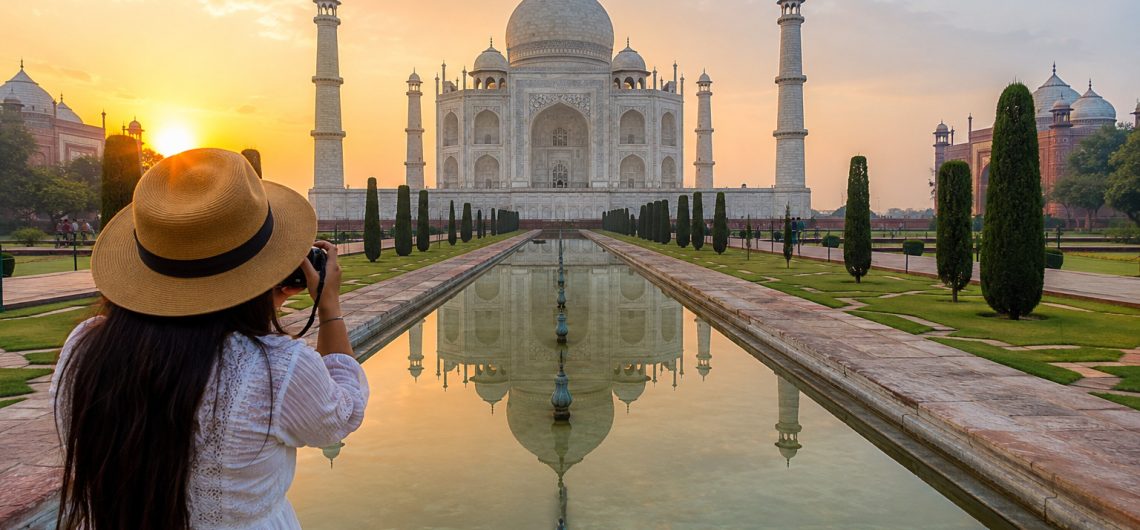
The Taj Mahal is one of the most photographed buildings on Earth — and for good reason. That white marble dome against a wide Agra sky is a scene that stops you in your tracks, every single time.
But here’s the thing most visitors discover too late: where you stand matters just as much as what you’re photographing. The same monument can look completely different depending on your angle, the time of day, and how you frame the shot. Simply standing in the centre and pointing your camera upward rarely produces the photograph you imagined.
This guide covers the best photography spots at the Taj Mahal — from the iconic reflecting pool to lesser-known side angles and locations outside the complex. You’ll also find practical advice on timing, camera settings, and common mistakes to avoid.
The best Taj Mahal photography spots include the Great Gate, reflecting pool, Charbagh gardens, side viewpoints, the Yamuna River side, and Mehtab Bagh, with sunrise generally offering the most beautiful light.
1. The Great Gate — Frame the Taj Mahal Through the Arch
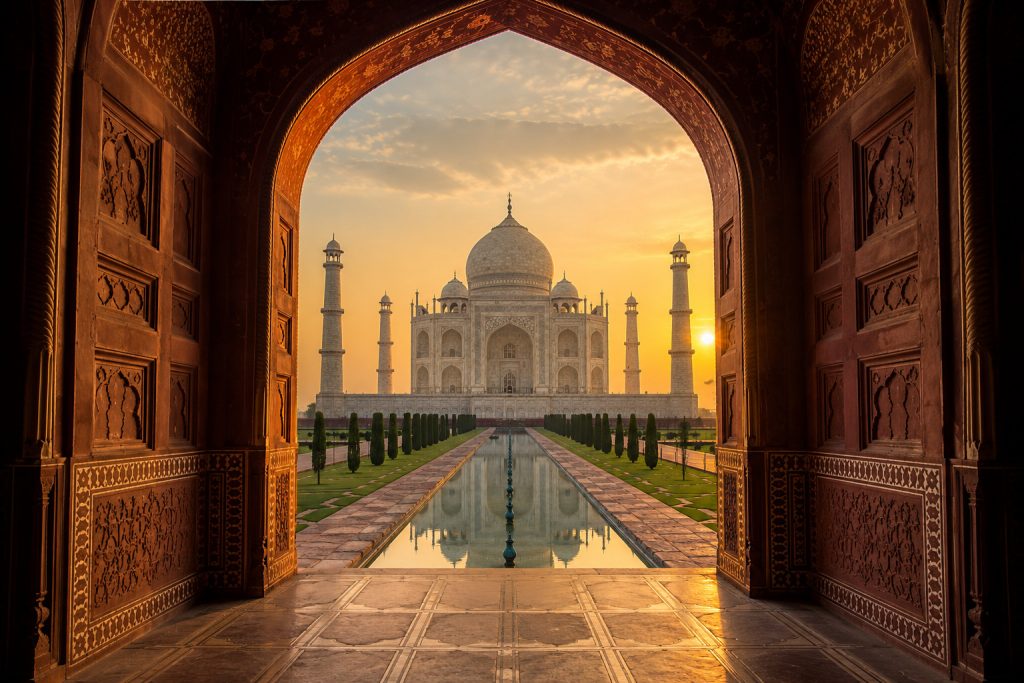
The Great Gate (Darwaza-i-Rauza) is the first place you see the Taj Mahal after entering the complex — and it’s one of the strongest compositions available to any photographer.
The large central arch creates a natural frame around the monument. The dome sits perfectly inside this opening, and the symmetry is immediate. You don’t need to do much to make this shot work — the Mughal architects did the composition for you, centuries ago.
Where to stand: Position yourself centrally, a few steps back from the archway. This lets you capture the full arch frame with the Taj Mahal visible through it.
Best time: Early morning, just after the gates open. The soft light falls on the marble while the arch stays slightly shaded, creating natural contrast.
Tip: Wait briefly for a gap in foot traffic. Even a few seconds of patience can give you a frame without distracting figures cutting across the archway.
Want More Time for the Perfect Taj Mahal Shot?
Planning an early visit to capture the Taj Mahal in the best light? Make your Delhi to Agra journey easier with a private sunrise tour by car, with sightseeing and local transfers arranged for you.
2. The Reflecting Pool — The Classic Taj Mahal Photograph
This is the shot most people picture when they think of the Taj Mahal. The long rectangular pool running through the centre of the Charbagh gardens reflects the dome in still water, creating a mirror image that’s both symmetrical and deeply satisfying.
To capture the reflection clearly, crouch low — bring the camera close to the water’s surface. The lower your angle, the more prominent the reflection becomes. On calm mornings, the water is usually still enough for a near-perfect mirror effect.
The pool also creates strong leading lines that draw the viewer’s eye directly toward the monument. Use this to your advantage in both landscape and portrait orientations.
Best time for reflections: Early morning, when the water is undisturbed and the light is soft. By mid-morning, wind and foot traffic near the pool edges can ripple the surface.
Smartphone tip: Use your phone’s grid lines to align the Taj Mahal’s dome with the top third of the frame, and the reflection with the bottom third. This simple adjustment makes a noticeable difference.
Pro Tip: If you’re visiting with a partner, have one person sit on the edge of the pool at a distance while the other photographs. The combination of the reflection, the Taj Mahal, and a human figure adds scale and story to the image.
3. The Princess Diana Bench — The Iconic Couple Photo
This bench, located along the central pathway in front of the reflecting pool, became famous after Princess Diana was photographed sitting here in 1992. It has since become one of the most popular Taj Mahal photo locations for couples and solo travelers alike.
The composition works because the bench places the subject in the foreground with the Taj Mahal rising in the background. For couples, sitting together on the bench with the monument behind creates a natural, relaxed portrait.
Portrait orientation works especially well here — it gives vertical space for both the seated subject and the full dome above. In landscape, make sure you don’t cut off the top of the minarets.
How to avoid a crowded look: This spot gets busy. Visit early, and be ready to take your photo quickly. A slightly zoomed-in frame can also help isolate your subject from others nearby.
4. Charbagh Gardens — Taj Mahal Surrounded by Mughal Gardens
The Charbagh — the formal Mughal-style garden divided into four quadrants — offers more flexibility than most visitors realize.
Walk along any of the garden pathways, and you’ll find that the greenery works as a beautiful foreground. Tree-lined paths create leading lines. Flower beds add colour. The Taj Mahal sits at the far end, anchoring every composition.
This is an excellent spot for full-body portraits, family photographs, and couple shots. The paths give you room to experiment — a few steps to the left or right can completely change what’s in the foreground.
Try shooting from a lower angle to let the garden dominate the bottom of the frame, with the Taj Mahal visible above the hedges. This perspective adds depth and avoids the flat, head-on look of the standard tourist photo.
5. Side Views of the Taj Mahal — A Less Common Perspective
Most visitors photograph the Taj Mahal from directly in front. But the monument has four nearly identical facades, and the side views offer compositions that feel fresh and uncrowded.
From the side, you can emphasize individual minarets, the curved dome, and the detailed marble arches in a way that isn’t possible from the central axis. The depth between the minarets and the main structure becomes more apparent, and the interplay of light and shadow across the marble surface is often more dramatic.
Practical advice: Walk to either side of the main platform. Use the minarets as framing elements — placing one in the foreground while the dome sits behind creates a sense of layered depth. A slightly wider lens helps capture the full scale.
These angles are also useful if you’re visiting during busier hours. The side areas tend to be less crowded than the front-facing viewpoint.
6. Taj Mahal Marble Details — Close-Up Photography
The Taj Mahal’s beauty isn’t only in its silhouette. Up close, the craftsmanship is extraordinary.
The pietra dura inlay work — semi-precious stones set into white marble in floral patterns — is incredibly detailed. Marble screens are carved so finely they look like lace. The arches feature geometric patterns and calligraphy from the Quran.
Close-up photography helps tell the architectural story that wide shots miss entirely. Use your camera’s macro mode or simply get close with a smartphone. Look for areas where the light rakes across the surface at an angle — this brings out the texture of the carving.
What to photograph:
- Floral inlay patterns on the exterior walls
- Carved marble screens (jali work)
- Calligraphy panels on the entrance arches
- Geometric patterns on the base platform
- Minaret detailing
Want More Time for the Perfect Taj Mahal Shot?
Planning an early visit to capture the Taj Mahal in the best light? Make your Delhi to Agra journey easier with a private sunrise tour by car, with sightseeing and local transfers arranged for you.
7. Yamuna River Side — A Different Perspective
The rear of the Taj Mahal faces the Yamuna River, and this side offers a very different view from what you see inside the complex. The monument appears wider, more grounded, and the river (or its sandy banks, depending on the season) creates a natural foreground.
This perspective is useful for wider landscape compositions and atmospheric photographs — especially on mornings when mist hangs low over the water.
Important: Access along the riverbank can be limited and may depend on water levels and local conditions. Do not attempt to reach restricted areas. If you’d like this perspective, Mehtab Bagh across the river is the established, accessible viewpoint.
8. Mehtab Bagh — A Famous Alternative View of the Taj Mahal
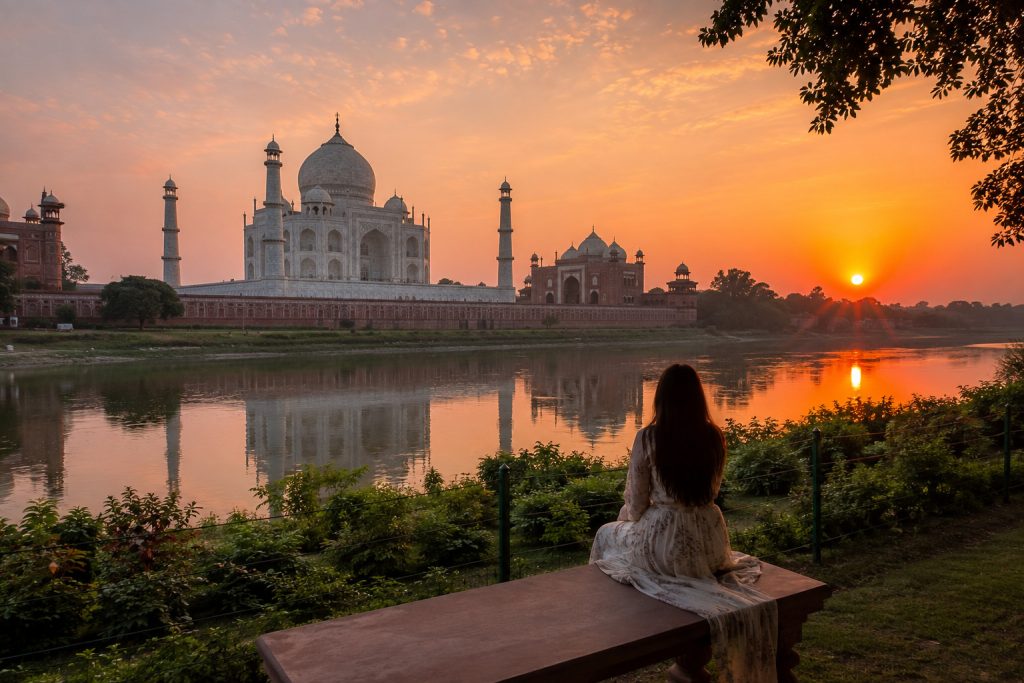
Mehtab Bagh (the “Moonlight Garden”) sits directly across the Yamuna River from the Taj Mahal and is one of the most popular photography spots in Agra outside the main complex.
The view from here is wide and unobstructed. You see the full monument reflected in the river (when water levels allow), flanked by its minarets, with no buildings interrupting the frame.
This is the go-to location for Taj Mahal sunset photography. As the sun drops behind you, the monument catches warm golden light, and the sky behind it often turns shades of orange and pink. Silhouette shots also work well from here once the sun is lower.
Mehtab Bagh has its own entry fee and is a separate site — plan for this as a second visit, not part of your main Taj Mahal ticket.
9. Taj Mahal at Sunrise — Best Light for Photography
Sunrise is widely considered the best time for Taj Mahal photography, and there’s a clear reason: the soft, warm light that spreads across the marble in the first hour after dawn is difficult to replicate at any other time.
The white marble takes on gentle pink and gold tones. Shadows are long and directional. The air tends to be clearer, and crowd levels at opening time are generally lower than later in the day.
Practical tips:
- Arrive at the gate before it opens to be among the first inside
- Head straight to the reflecting pool for the classic sunrise reflection
- Shoot from multiple positions as the light changes quickly
- Use a lower ISO and wider aperture to take advantage of the soft light
If you’re traveling from Delhi and want to photograph the Taj Mahal in early morning light, a sunrise Taj Mahal tour from Delhi by car can help you arrive at the gates on time — the drive from Delhi takes around 3–4 hours, so an early departure is essential.
10. Taj Mahal at Sunset — Warm and Dramatic Photos
Sunset brings a different mood. The light turns golden, then amber, and the marble surface seems to glow. If you’re at Mehtab Bagh during golden hour, the Taj Mahal is front-lit with warm tones while the sky behind deepens in colour.
Sunset vs. sunrise: Sunrise gives you softer, cooler tones and generally fewer visitors at the complex itself. Sunset offers warmer, more dramatic light but is best experienced from viewpoints like Mehtab Bagh rather than inside the Taj Mahal complex, where the light falls from behind the monument.
Note: Access hours inside the Taj Mahal complex may not extend to sunset depending on the season. Check current visiting times and rules before planning a late-afternoon visit.
Best Taj Mahal Photography Spots for Couples
Looking for romantic photo locations? These five spots work well for couple photographs:
- Princess Diana Bench — Sit together with the Taj Mahal behind you. Simple, elegant, and flattering in portrait orientation.
- Reflecting Pool — Sit side by side on the pool edge for a photograph that includes both the monument and its reflection.
- Great Gate Archway — Stand together inside the arch frame for a dramatic silhouette or backlit portrait.
- Charbagh Garden Pathways — Walk together along the paths for natural, candid-looking photographs.
- Mehtab Bagh at Sunset — A romantic wide-angle shot with the Taj Mahal glowing in warm light behind you.
Couple tip: Coordinate outfit colours. Solid, warm tones (deep red, burgundy, mustard) photograph beautifully against the white marble.
Smartphone Photography Tips for the Taj Mahal
You don’t need expensive equipment to take a beautiful Taj Mahal photograph. Modern smartphones handle this subject very well — if you use them thoughtfully.
- Turn on grid lines — Align the dome with the upper third intersection point
- Keep the horizon straight — Even slightly tilted horizons look off with a symmetrical monument
- Use 1x and 2x zoom — Avoid heavy digital zoom, which degrades quality
- Try HDR mode — Useful when the sky is bright and the monument is in shadow
- Clean your lens — A quick wipe removes smudges that cause hazy images
- Tap to focus on the dome, then adjust exposure by sliding your finger up or down
- Shoot in both portrait and landscape — Each orientation suits different spots
- Take multiple compositions — Move a few steps, crouch, shift your angle. Don’t just take one photo and walk away
Camera Settings for Taj Mahal Photography
Sunrise Photography
- ISO: 200–400 (light is low initially)
- Aperture: f/5.6–f/8 for a balance of sharpness and depth
- Shutter speed: Adjust based on light — start around 1/60s and increase as the sun rises
- White balance: Daylight or cloudy to preserve the warm morning tones
Architectural Photography
- ISO: 100–200
- Aperture: f/8–f/11 for maximum sharpness across the frame
- Shutter speed: 1/125s or faster in bright daylight
- Format: Shoot in RAW if your camera supports it — this gives more flexibility in post-processing
Sunset Photography
- ISO: 200–400
- Aperture: f/5.6–f/8
- Shutter speed: Slower speeds may be needed as light drops — brace your camera or use a stable surface
- White balance: Shade or cloudy to enhance the golden tones
These are starting points. Adjust based on the light you’re working with — no single setting works for every situation.
Taj Mahal Photography Rules You Should Know
- Photography is generally permitted in the outdoor areas of the Taj Mahal complex
- Photography inside the main mausoleum (tomb chamber) is not permitted — this is a place of respect
- Tripods may not be allowed inside the complex — check the latest visitor guidelines before carrying one
- Drones are strictly prohibited at the Taj Mahal and surrounding protected area
- Video cameras may require a separate fee or may face restrictions — verify current rules at the ticket counter
- Always follow instructions from security personnel and respect barriers
- Do not touch, lean on, or climb any part of the monument for a photograph
Rules can change. Before your visit, check the latest Taj Mahal entry and visitor information or confirm with your guide.
Common Taj Mahal Photography Mistakes to Avoid
- Arriving after mid-morning — The best light and lowest crowds are at opening time. By 10 a.m., the sun is harsh and queues are long.
- Taking only the standard front-facing shot — Explore side views, close-ups, and creative angles.
- Ignoring the reflecting pool — Many visitors walk past it. Crouch down and capture the reflection.
- Cutting off the dome or minarets — Always check the edges of your frame before pressing the shutter.
- Shooting everything from eye level — Crouch, kneel, or hold the camera higher. Different heights create different photographs.
- Ignoring the background — Watch for cranes, scaffolding, or distracting objects behind your subject.
- Overusing filters — The Taj Mahal’s natural colours are stunning. Heavy filters often take away more than they add.
- Forgetting portrait orientation — The vertical shape suits the Taj Mahal’s dome and minarets well.
- Not watching the light — Move around the complex as the light shifts. A spot that looked flat at 8 a.m. may be beautifully lit by 9 a.m.
- Blocking other visitors — Be aware of people around you. Take your shots efficiently and share the space.
Best Time of Day for Taj Mahal Photography
| Time | Light | Crowd Level | Best For |
|---|---|---|---|
| Sunrise | Soft, warm | Generally lower | Architecture, portraits, reflections |
| Morning (8–10 a.m.) | Soft to moderate | Moderate | General photography, gardens |
| Midday (11 a.m.–2 p.m.) | Harsh, overhead | Typically higher | Close-up details, textures |
| Afternoon (3–5 p.m.) | Improving | Moderate | Side-lit architecture |
| Sunset | Warm, golden | Depends on location | Dramatic shots, Mehtab Bagh |
Crowd levels can vary by season, day of the week, and holidays. These are general patterns, not guarantees.
How to Plan a Taj Mahal Photography Visit
- Check opening hours — The Taj Mahal opens at sunrise and closes before sunset. Confirm current timings for your travel dates.
- Check current visitor rules — Entry requirements, dress codes, and restrictions can change.
- Arrive early — Being at the gate 15–20 minutes before opening can make a real difference. Learn how to avoid long queues.
- Allow enough time — Two to three hours is reasonable for photography-focused visitors.
- Consider the weather — Haze, fog, and cloud cover all affect visibility and colour. Winter mornings often have mist that can create atmospheric shots — or obscure the monument entirely.
- Plan 3–5 key compositions — Decide which spots matter most to you and visit those first.
- Carry backup battery and storage — You’ll take more photos than you expect.
- Respect all photography restrictions — Protect the monument and follow security guidance.
A knowledgeable local guide can help you understand the history and architecture while pointing out viewpoints you might otherwise miss. This is especially useful for photographers who want context alongside their compositions.
Taj Mahal Tours for Photography Lovers
If you’re visiting from Delhi and want to make the most of your photography time at the Taj Mahal, these tours are designed with flexible scheduling and local knowledge:
- Sunrise Taj Mahal Tour from Delhi by Car — Depart Delhi before dawn and arrive at the Taj Mahal gates for opening. Ideal for photographers who want the best morning light.
- Taj Mahal and Agra Tour by Superfast Train — A comfortable same-day option that gives you a full morning at the Taj Mahal with time to explore Agra’s other photography-worthy sites.
- Skip the Line Taj Mahal and Agra Fort Tour by Car — Saves time on entry queues so you can spend more time behind the camera.
- Agra Overnight Tour from Delhi — Staying overnight gives you both sunrise and sunset opportunities — perfect if photography is a priority and you want to visit Mehtab Bagh in the evening.
Frequently Asked Questions
Where is the best place to photograph the Taj Mahal?
The reflecting pool along the central garden axis is the most iconic spot — it gives you the classic symmetrical composition with the Taj Mahal’s reflection in the water. For a different perspective, Mehtab Bagh across the Yamuna River offers wide, unobstructed views, especially at sunset.
What is the best time to photograph the Taj Mahal?
Sunrise is the best time. The soft morning light gives the white marble warm pink and gold tones, shadows add depth to the architecture, and the complex is generally less crowded at opening time. The first 60–90 minutes after gates open offer the most photogenic conditions.
Is sunrise or sunset better for Taj Mahal photography?
Sunrise is better if you’re photographing from inside the complex — the light is soft, the marble glows, and crowds are lower. Sunset is excellent from Mehtab Bagh, where you can capture the monument bathed in golden light with a colourful sky behind it.
Where can I take the Taj Mahal reflection photo?
The long reflecting pool in the centre of the Charbagh gardens is where you capture the classic reflection. Crouch low — bring your camera as close to the water’s surface as possible. Visit in the early morning when the water is still and the light is gentle.
Is Mehtab Bagh good for Taj Mahal photography?
Yes. Mehtab Bagh, located across the Yamuna River, offers one of the best wide views of the Taj Mahal. It’s especially popular for sunset photography. The distance gives you the full monument in frame, and the river adds a natural foreground element.
Can I take professional photos inside the Taj Mahal?
Photography is generally allowed in the outdoor areas of the complex. However, photography is not permitted inside the main tomb chamber. Professional equipment such as large tripods or lighting setups may face restrictions. Check the latest rules before your visit.
Can I use a tripod at the Taj Mahal?
Tripods may not be permitted inside the Taj Mahal complex. Policies on this can change, so check with officials at the entry gate. If tripods are restricted, use walls, railings, or a compact support to steady your camera for low-light shots.
What is the best camera lens for Taj Mahal photography?
A versatile zoom lens in the 24–70mm range covers most compositions — wide enough for the full monument and tight enough for architectural details. A wider lens (16–35mm) is useful at the Great Gate and in the gardens. A telephoto (70–200mm) works well for close-ups of the marble inlay work.
Can I take good Taj Mahal photos with a smartphone?
Absolutely. Modern smartphones produce excellent results at the Taj Mahal. Use grid lines for alignment, keep the horizon straight, tap to focus on the dome, and shoot in good light. Many stunning Taj Mahal photographs shared online were taken with smartphones.
Final Thoughts
The Taj Mahal is not a one-angle monument. From the framed archway of the Great Gate to the mirrored stillness of the reflecting pool, from the intimate marble details up close to the wide sunset panorama at Mehtab Bagh — every viewpoint tells a different story.
Sunrise remains the most rewarding time for most photographers. But the quality of your photographs depends far more on where you stand, how you compose, and how you work with the available light than on the camera in your hand.
Take your time. Move around. Explore the compositions that most visitors walk past.
If you’re planning a visit and want to arrive at the right time with local guidance, browse the Taj Mahal tour options from Delhi to find a trip that fits your schedule and photography goals.

Comments