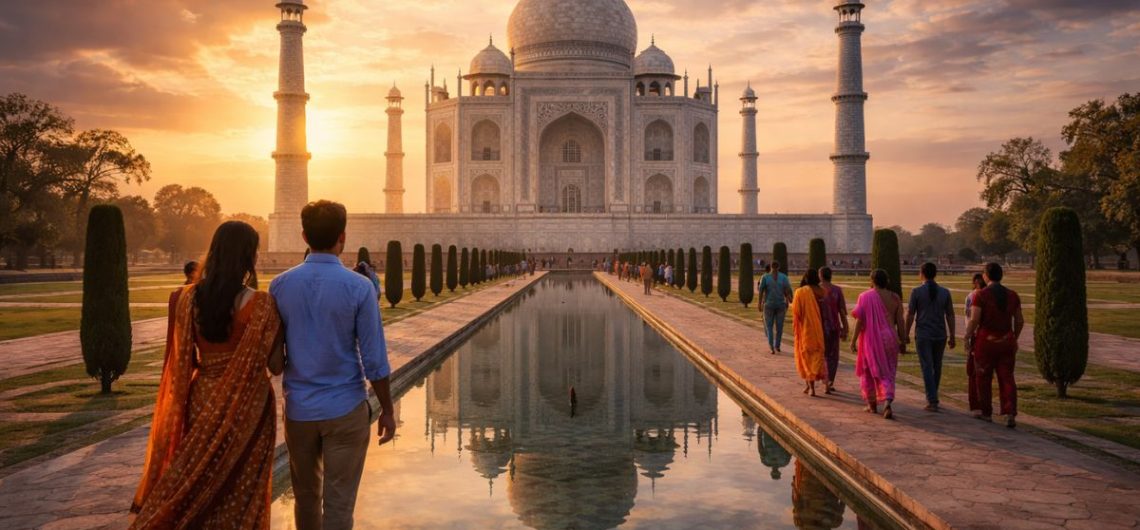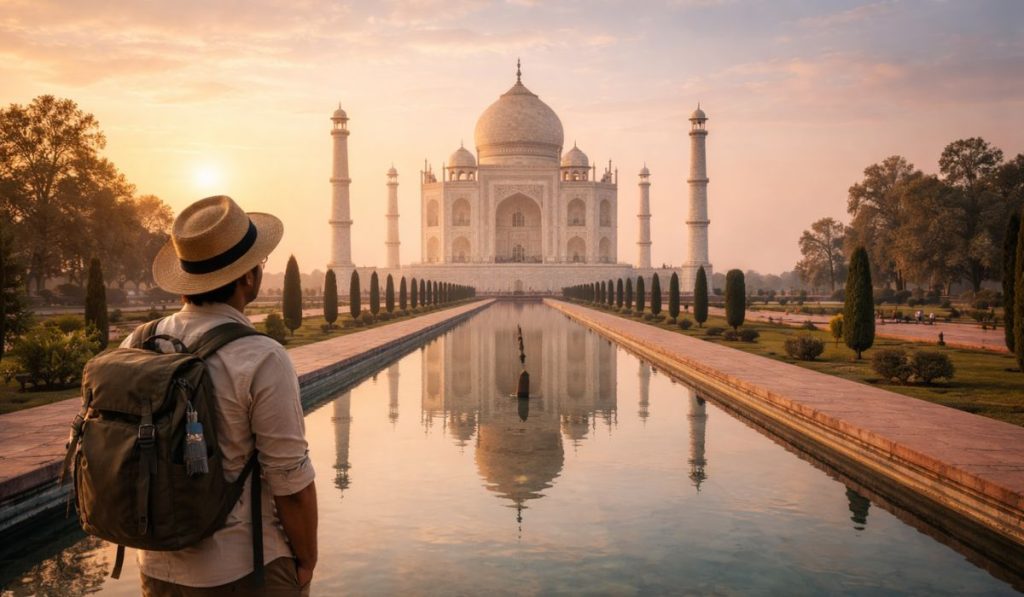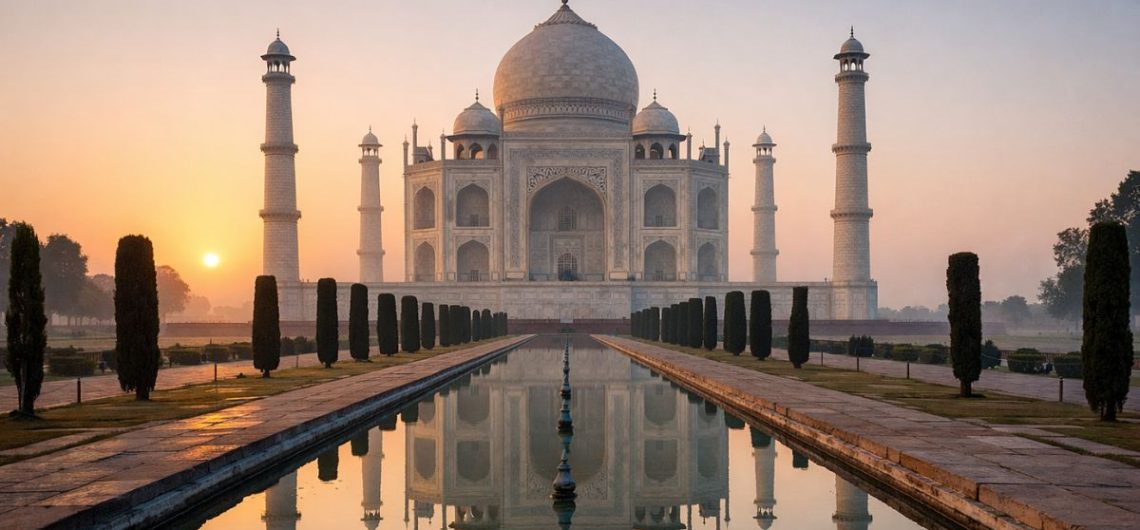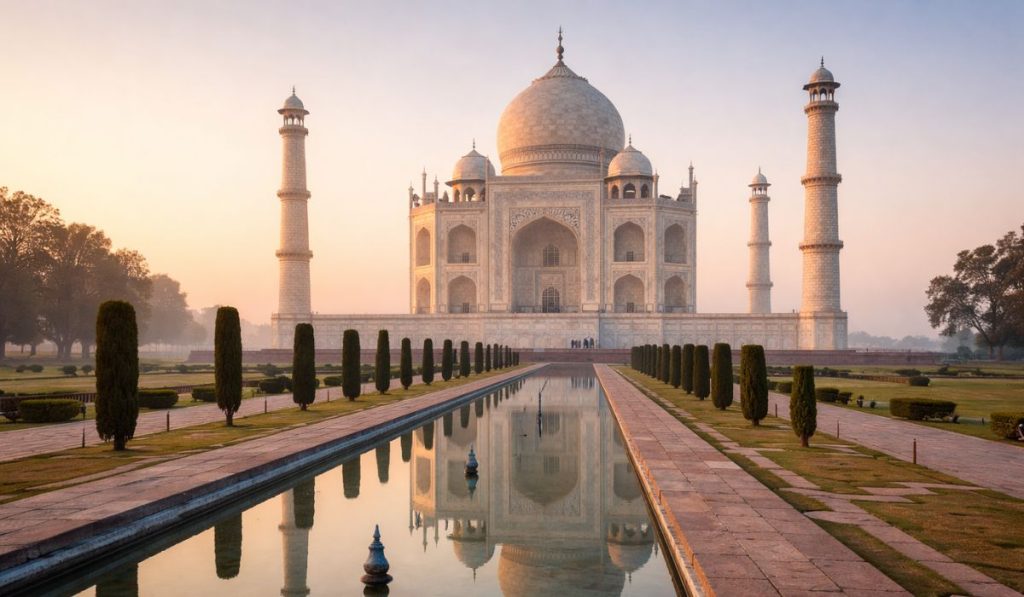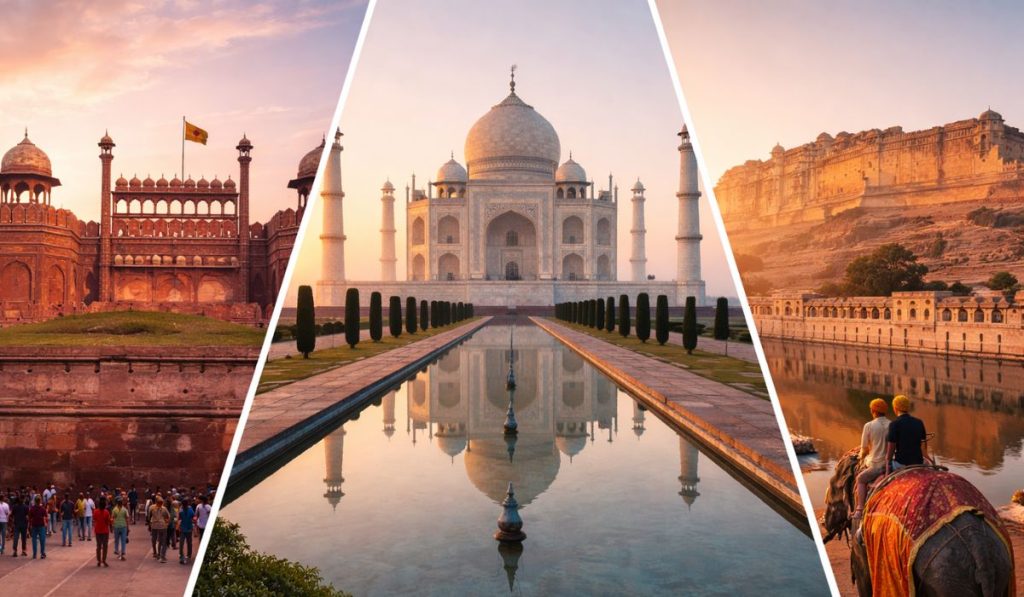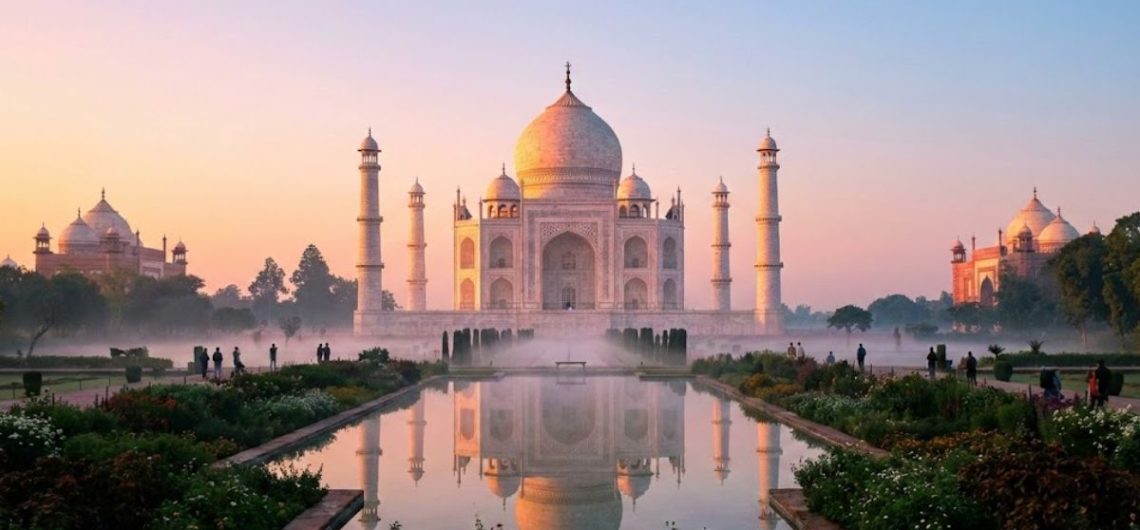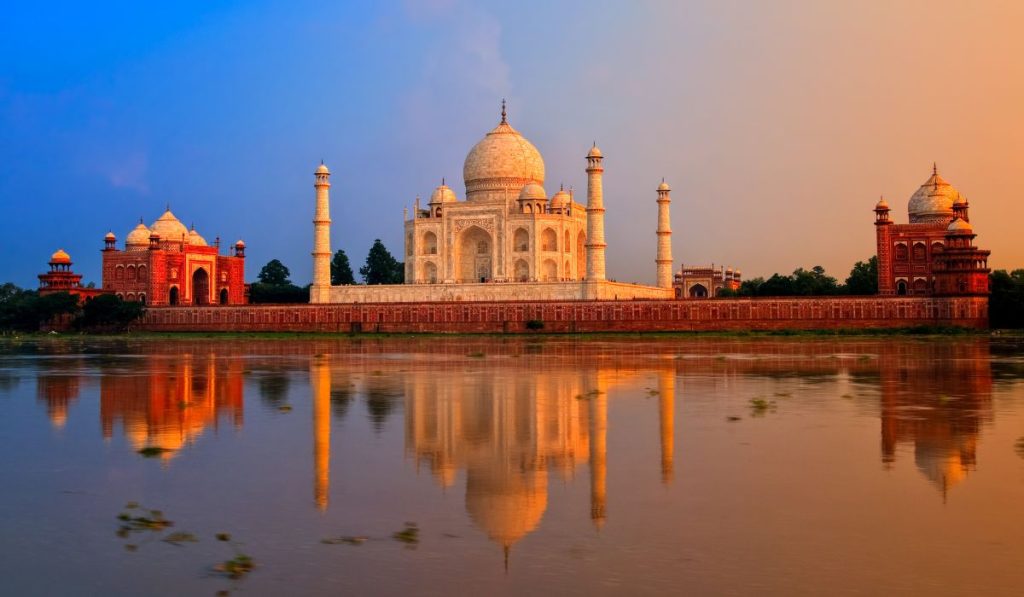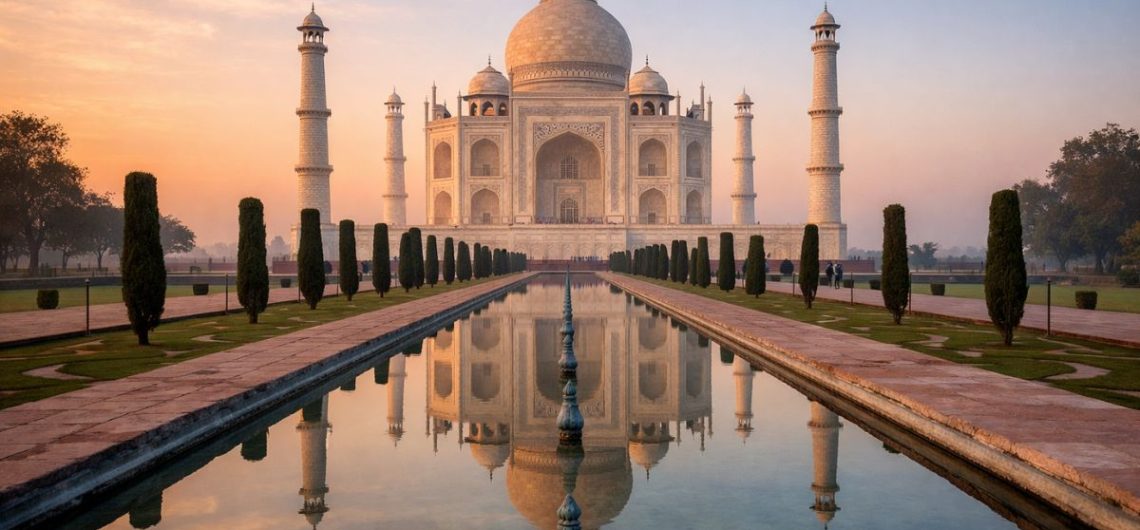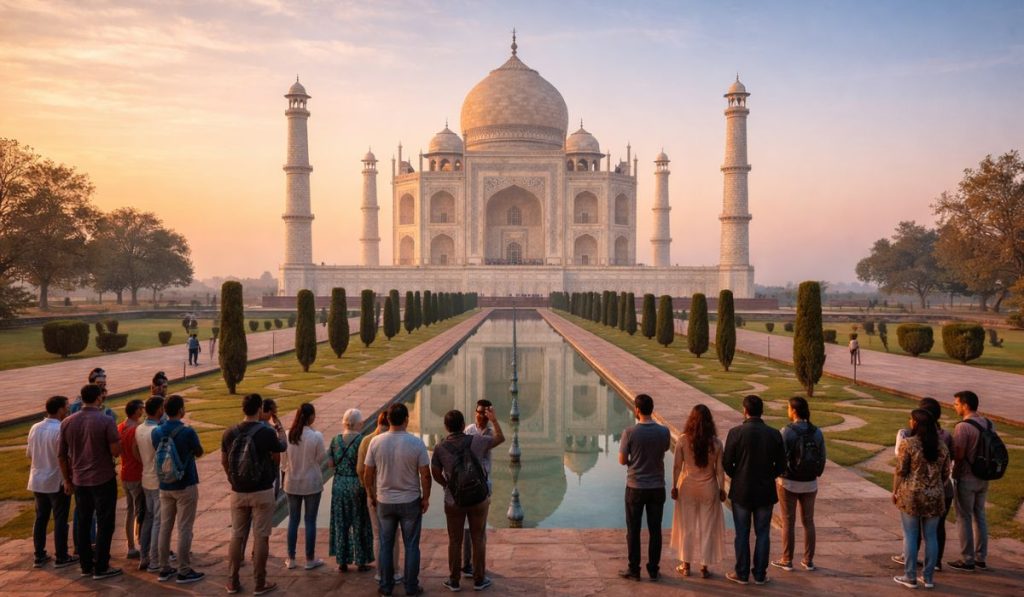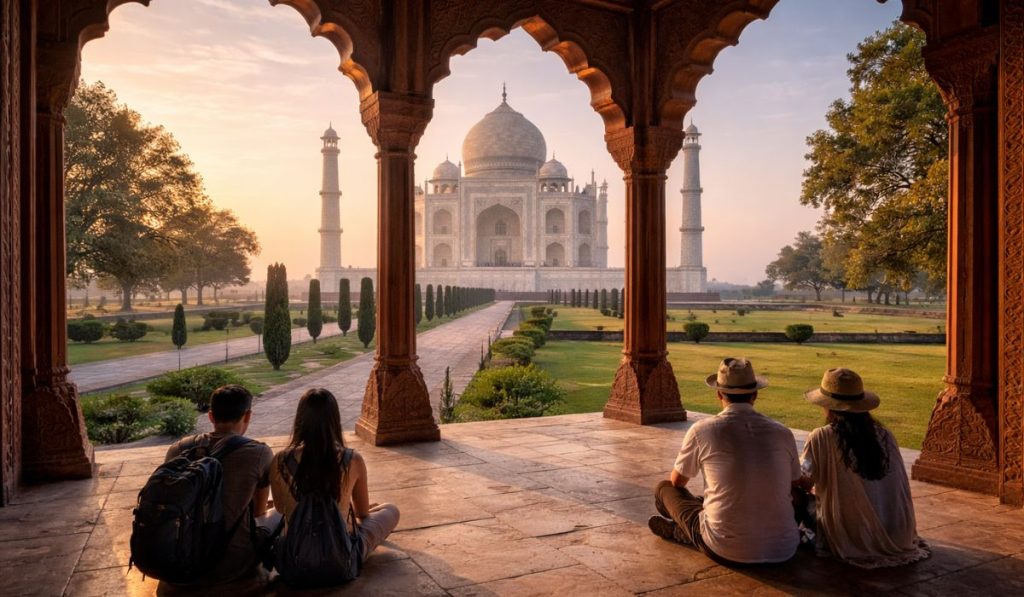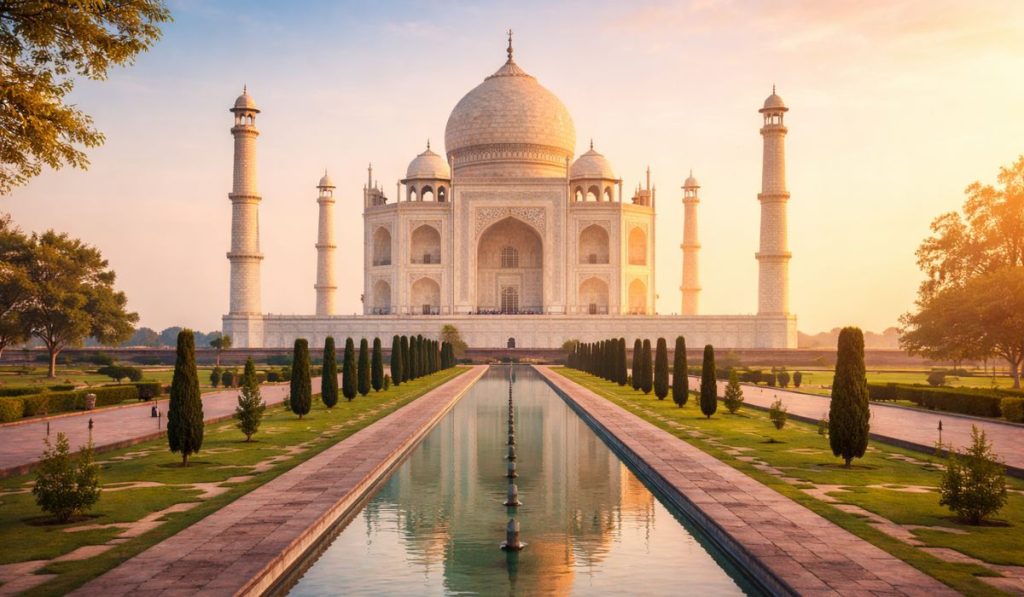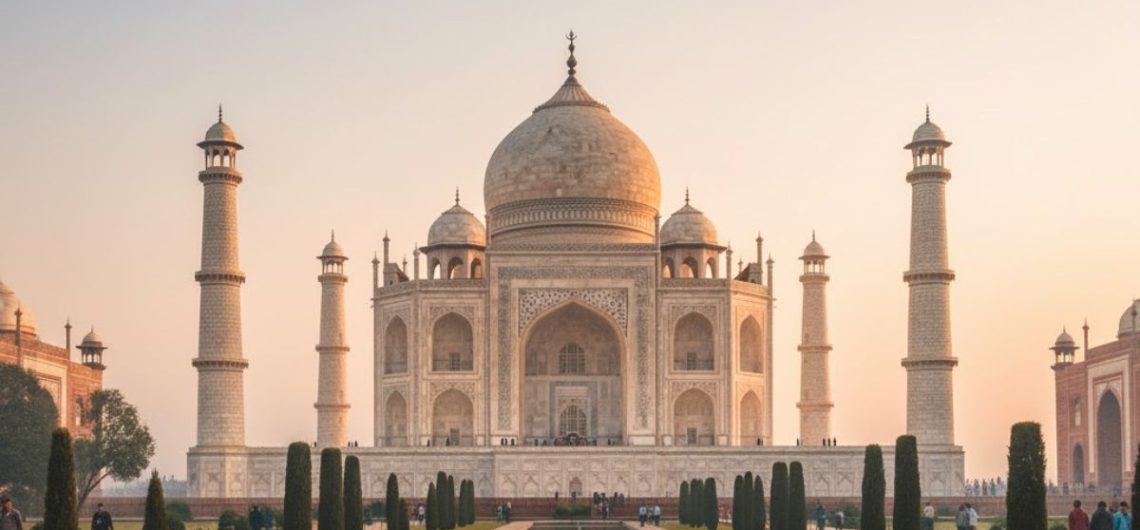
Quick Answer: Commissioned in 1631 by Mughal Emperor Shah Jahan to enshrine his empress Mumtaz Mahal, the Taj Mahal in Agra is a global benchmark of classical Mughal architecture. Built between 1631 and 1653 with Makrana marble under chief architect Ustad Ahmad Lahori, this UNESCO World Heritage Centre site embodies strict bilateral symmetry, theological allegories of Paradise, and revolutionary double-dome engineering.
1. The Jewel of Indo-Islamic Architecture
Few monuments in human history rival the enduring fascination of the Taj Mahal. Located on the southern bend of the Yamuna River in Agra, Uttar Pradesh, this seventeenth-century mausoleum represents the apex of the Mughal architectural renaissance. Designated a UNESCO World Heritage Site in 1983, it is celebrated as an unrivaled masterpiece of architectural proportion, structural poise, and decorative refinement.
While commonly romanticized as a solitary monument of devotion, historical records maintained by the Archaeological Survey of India and contemporary chronicles demonstrate that the complex was conceived as a vast imperial sanctuary. It combined sacred funerary architecture, hydraulic engineering, commercial bazaars, and theological symbolism into a unified aesthetic statement.
2. The Human Drama: Mumtaz Mahal, Shah Jahan, and Imperial Grief
The origins of the Taj Mahal lie in the royal romance and political partnership of Prince Khurram (who assumed the throne in 1628 as Emperor Shah Jahan) and Arjumand Banu Begum (bestowed the title Mumtaz Mahal). Married in 1612, Mumtaz Mahal was not merely an imperial consort; she was a trusted political advisor, custodian of the royal seal (Muhr-i Uzk), and companion during prolonged imperial campaigns.
In June 1631, while accompanying the Emperor on a southern military expedition to the Deccan, Mumtaz Mahal died at age 38 in the city of Burhanpur due to severe complications during the birth of their fourteenth child, Gauhar Ara Begum. Contemporary Mughal historians, such as Abdul Hamid Lahori in the Padshahnama, describe the Emperor’s profound sorrow: he renounced courtly luxuries, donned simple white mourning garments, and ordered the conception of a tomb without equal.
Her body was temporarily interred in Burhanpur’s Zainabad garden before being transported to Agra in December 1631. There, Shah Jahan secured a prime riverside estate from Raja Jai Singh of Amber, setting the stage for construction to begin.
3. Construction Timeline: From River Foundations to Completion (1631–1653)
Erecting a monumental stone structure on a dynamic riverbank presented immense engineering hurdles. The construction unfolded over two decades in carefully managed logistical stages:
| Milestone Period | Structural Objective | Historical & Engineering Execution |
|---|---|---|
| 1631–1632 | Hydraulic & Well Foundation | Deep wells were excavated down to hard clay, cased in timber, and filled with rubble masonry to create an earthquake-resistant foundation. |
| 1632–1638 | Plinth & Core Superstructure | Construction of the red sandstone riverfront terrace and primary brick masonry core, followed by initial marble cladding. |
| 1638–1643 | Dome, Minarets & Mausoleum | Erection of the bulbous double dome, four minarets, and interior cenotaph chamber; commemorated during the twelfth Urs ceremony in 1643. |
| 1643–1648 | Great Gate & Subsidiary Buildings | Completion of the sandstone Mosque, the matching Jawab, and the Darwaza-i Rauza (inscribed with completion year 1648 / 1057 AH). |
| 1648–1653 | Forecourt, Gardens & Bazaars | Final grading of the Charbagh garden, completion of the Jilaukhana courtyard, caravanserai, and bazaar arcades generating endowment revenues. |
According to royal expenditure registers, the core mausoleum consumed over 5 million contemporary silver rupees, while the entire complex was valued between 32 and 41 million rupees upon completion.
4. The Masterminds: Ustad Ahmad Lahori and the Guild of Artisans
Rather than crediting a solitary architect, Mughal history reveals that the monument was designed by an imperial collaborative council of specialists, overseen directly by Shah Jahan:
- Ustad Ahmad Lahori (Ahmad al-Mi’mar Lahori): Cited in the contemporary work Diwan-i-Muhandis by his mathematician son Lutfullah, Lahori was the chief architect and geometrician of both the Taj Mahal and the Red Fort in Delhi. His profound grasp of Euclidean geometry and Persianate masonry established the monument’s dimensional harmony.
- Amanat Khan Shirazi (Abd ul-Haq): The master calligrapher from Shiraz who personally curated the Quranic inscriptions and supervised their marble inlay. He was granted the rare privilege of signing his name upon the monument’s portals.
- Mir Abd-ul-Karim and Makramat Khan: Senior imperial administrators who directed logistical operations, material transport corridors, and fiscal accounts.
- Ismail Khan (Ismail Afandi): An Ottoman engineering specialist who directed the assembly of the soaring double dome.
- Chiranji Lal: A master lapidary from Delhi who directed the complex stone-inlay workshops.
Scholarly research, such as that by Ebba Koch in The Complete Taj Mahal, has established that seventeenth-century rumors attributing the monument to Italian jeweler Geronimo Veroneo lack any grounding in architectural style or contemporary Mughal records.
5. Sacred Geometry & Spatial Harmony: The Riverfront Master Plan
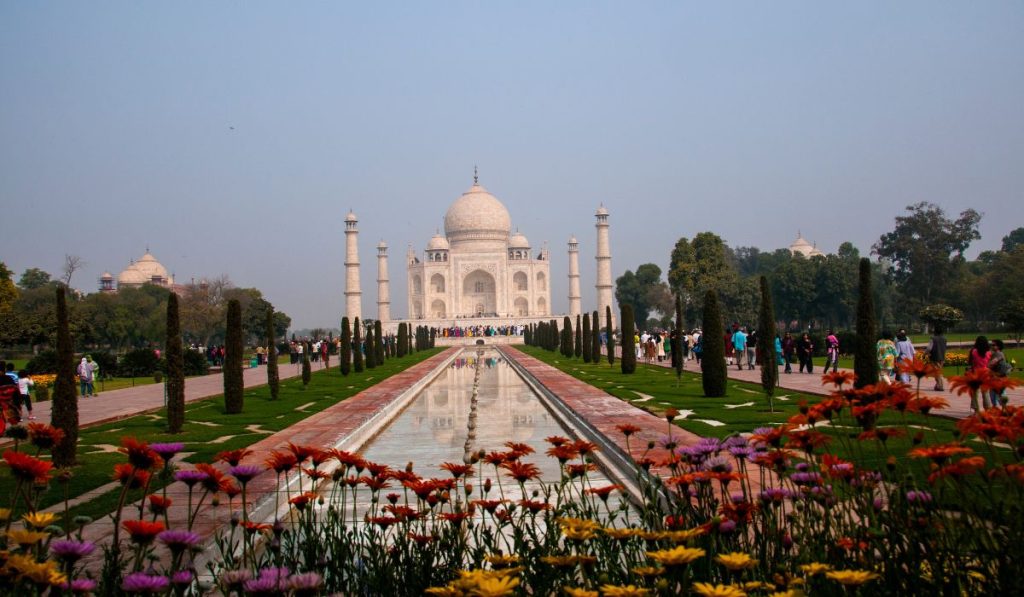
The architectural genius of the Taj Mahal is grounded in strict bilateral symmetry and modular geometric proportioning. The plan is organized along a north-south axis, where every architectural element finds its exact spatial twin.
| North: Yamuna River Terrace | ||
|---|---|---|
| Sandstone Mosque (West) | White Marble Mausoleum | Sandstone Jawab (East) |
| Four-Part Charbagh GardenFour Quadrants • Paved Walkways • Central Marble Reflecting Pool | ||
| Darwaza-i Rauza (Great Entrance Gateway) | ||
| Jilaukhana Forecourt & Outer Bazaars (South) | ||
The Riverfront Terrace Variant
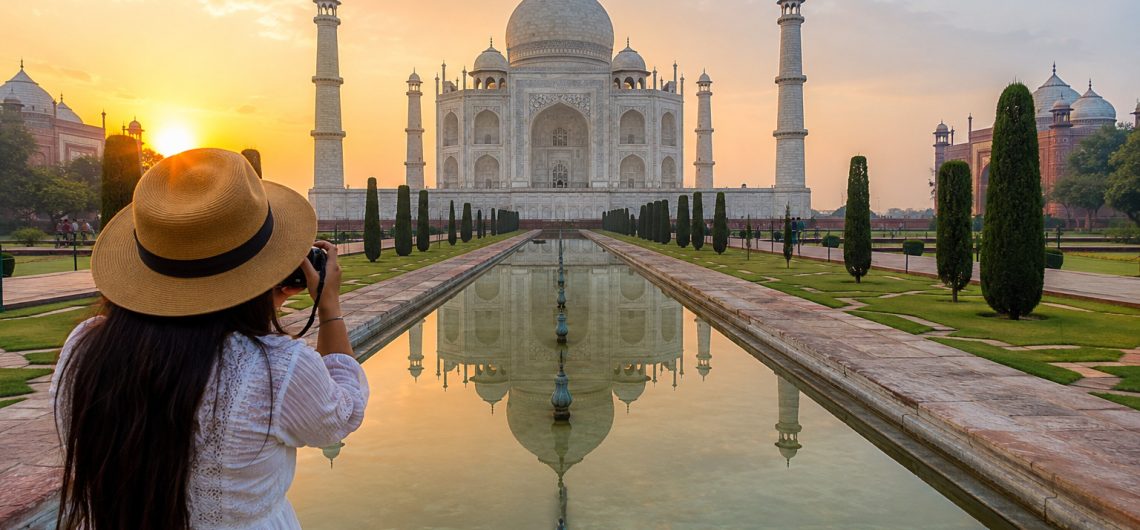
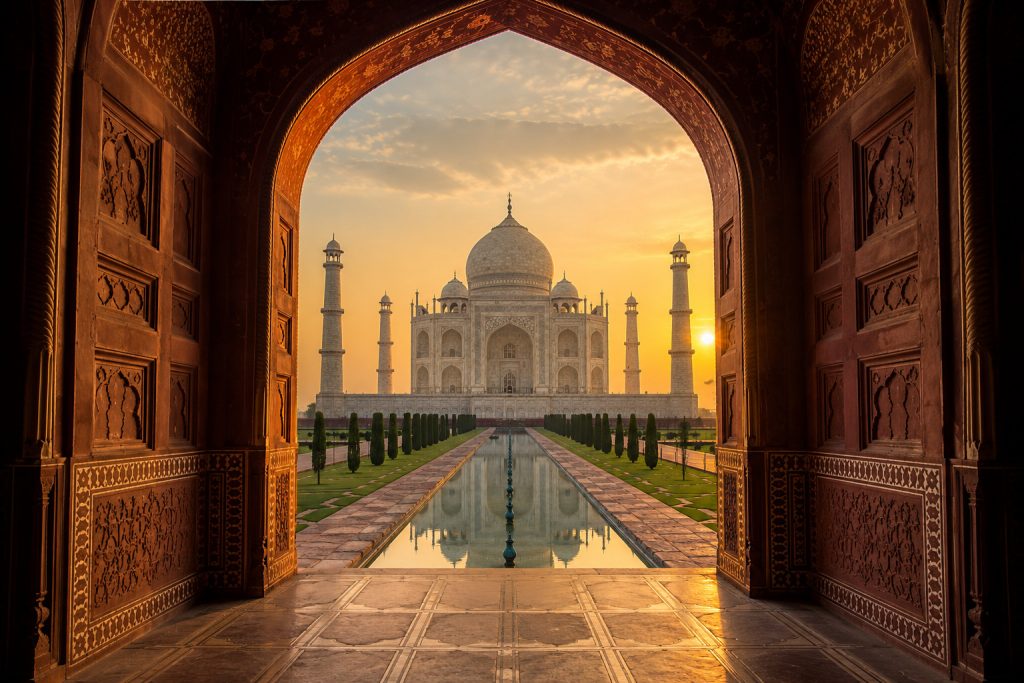
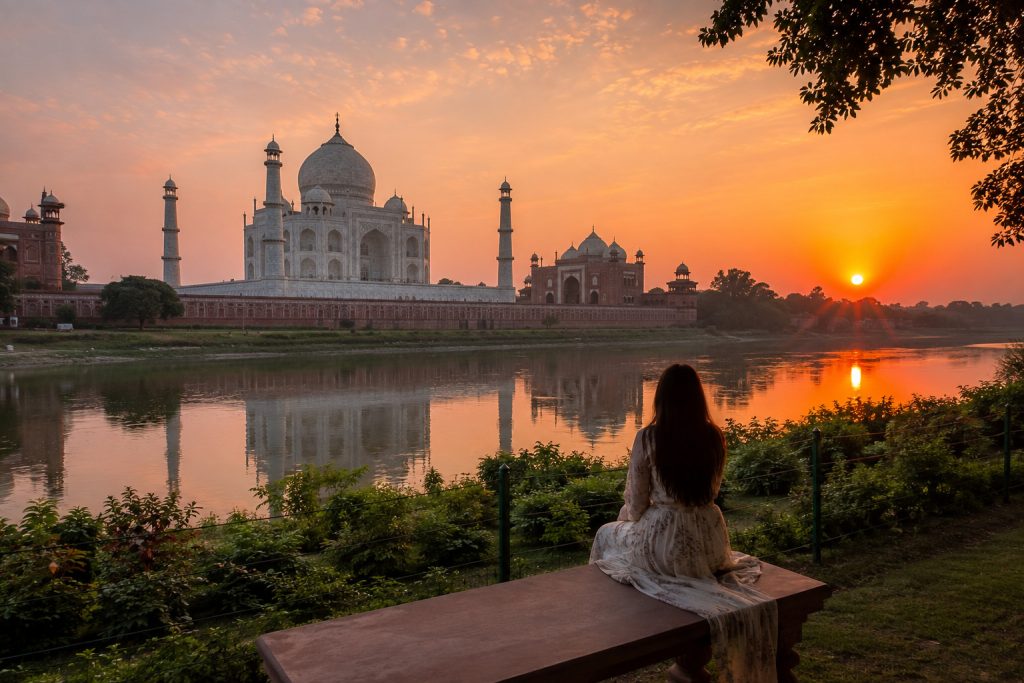
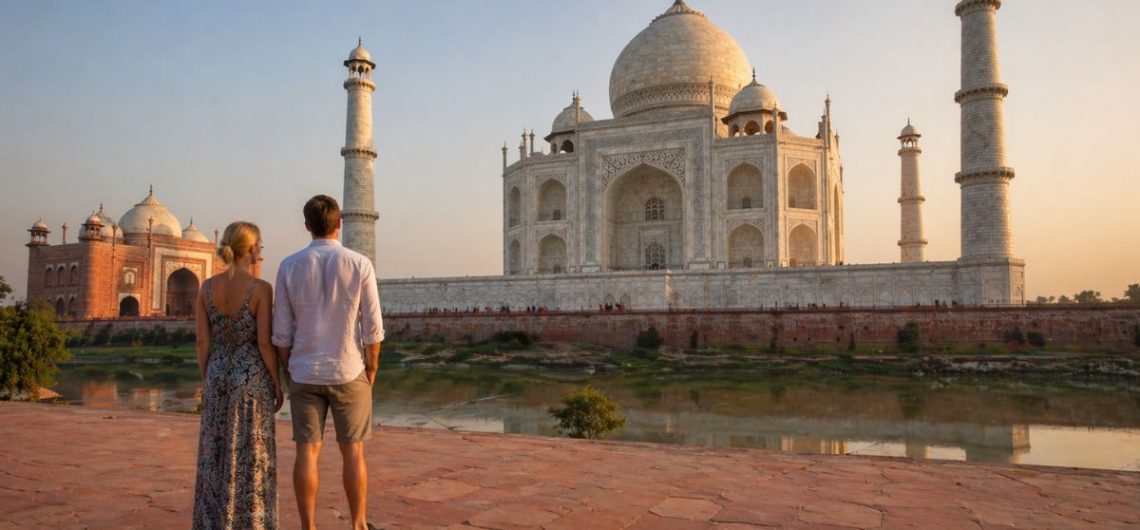
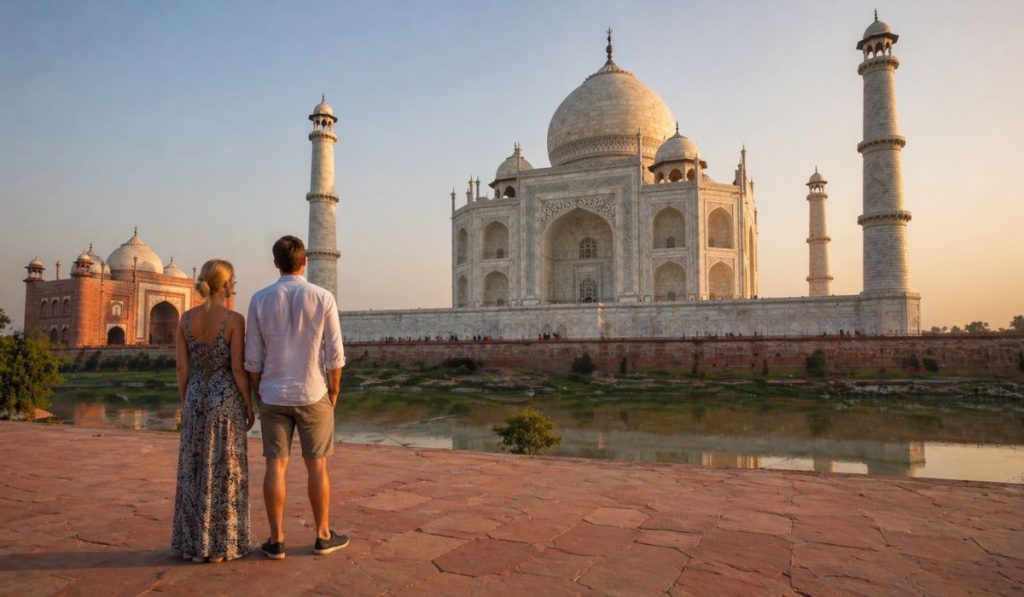
Traditional Mughal mausoleums (like Humayun’s Tomb in Delhi) placed the tomb in the geometric center of a square garden. At Agra, Shah Jahan broke with convention by setting the mausoleum on a raised river terrace at the garden’s northern edge. This riverfront orientation transformed the monument into a dynamic focal point that captured natural water breezes and cast brilliant reflections across both the garden pool and the Yamuna River.
The Hasht Bihisht (Eight Paradises) Floor Plan
The interior follows the ancient Persian Hasht Bihisht scheme: an octagonal central hall holding the royal cenotaphs is encircled by eight interconnected secondary rooms spread across two levels. This nine-fold plan creates smooth acoustic resonance and enables the solemn ritual of circumambulation (tawaf).
6. Geological Sourcing: Marbles, Sandstones, and Gemstones of Asia
The materials incorporated into the Taj Mahal were secured across thousands of kilometers through imperial supply chains:
| Material | Geographic Origin | Structural & Aesthetic Role |
|---|---|---|
| White Makrana Marble | Makrana, Rajasthan | Pristine outer facade, minarets, central dome, and inner ornamental screens. |
| Red Sandstone | Fatehpur Sikri & Tantpur | Supporting terrace plinth, Mosque, Jawab, Great Gate, and perimeter walls. |
| Lapis Lazuli | Badakhshan, Afghanistan | Deep azure petals and floral highlights in stone inlays. |
| Jade & Nephrite | Kashgar, Central Asia / China | Foliage, leaves, and intricate botanical stems. |
| Carnelian & Agate | Yemen & Khambhat, Gujarat | Luminescent orange and crimson floral centers. |
| Turquoise & Malachite | Tibet & Russia / Central Asia | Cyan accents and dark banded foliage. |
Dense, translucent Makrana marble was quarried over 300 kilometers away and hauled to Agra by vast teams of bullock carts and specially built flat-bottomed river barges.
7. Lapidary Mastery: The Secret Art of Parchin Kari
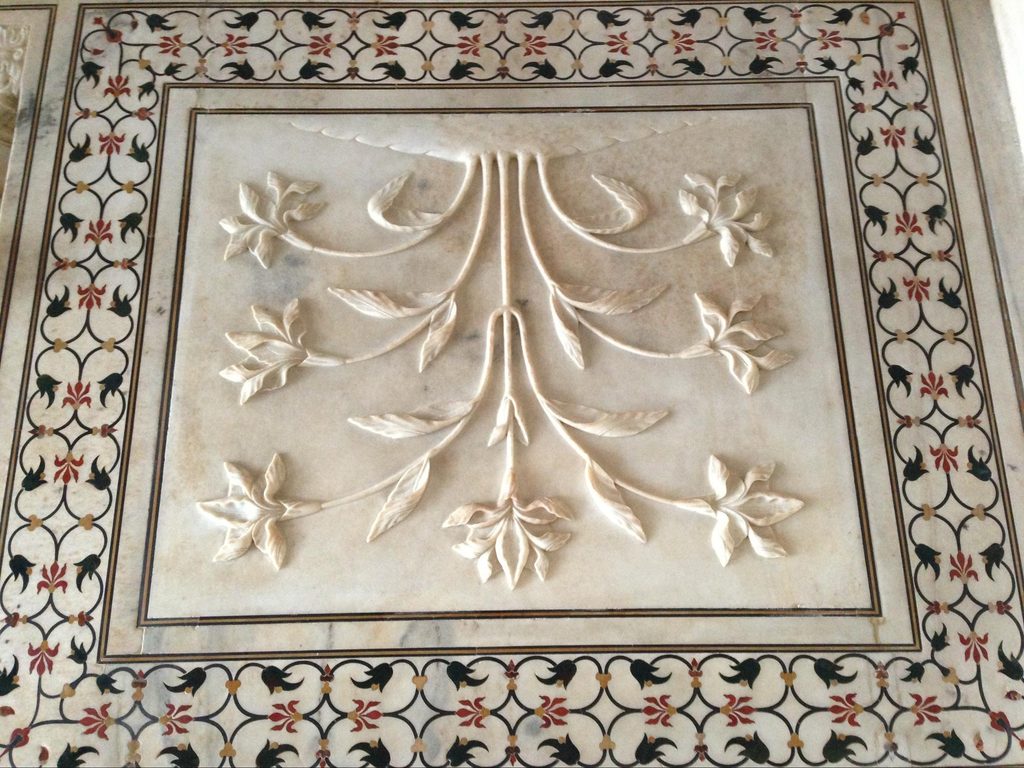
Figure 2: Intricate bas-relief marble carving and semi-precious stone inlay on the lower dado panels.
The hallmark of Taj Mahal ornamentation is Parchin Kari (stone inlay). In this technique, shallow beds were carved with micron-level precision into white marble slabs. Semi-precious stones were cut into delicate petal and leaf shapes using wire bow-drills and abrasive emery powders, glued into place with organic resin cements, and buffed flush with the marble surface.
Surrounding the royal cenotaphs is an octagonal jali screen, carved out of single blocks of solid white marble into delicate lace-like geometric openwork. This screen diffuses natural sunlight and ensures sacred privacy for the cenotaphs while allowing airflow throughout the burial hall.
8. Engineering Feats: Double Dome, Cantilevered Struts, and Tilted Minarets
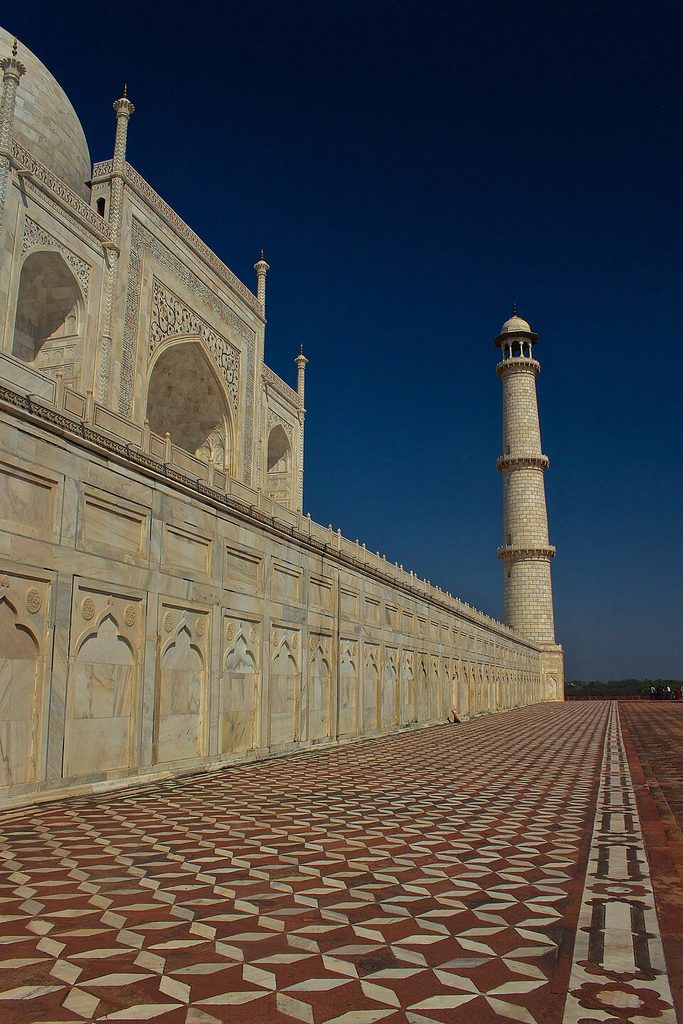
Figure 3: Detail of the eastern marble wall and three-storeyed minaret, engineered with a deliberate outward cant.
The structural longevity of the Taj Mahal relies on sophisticated engineering solutions:
- The Double-Dome Design: The soaring exterior bulbous dome (*amrud*) rises 35 meters, while an inner hemispherical dome sits lower inside the chamber. The 25-meter hollow void between them is braced by hidden radial masonry struts, allowing the exterior to command the city skyline while preventing the interior burial space from feeling hollow or cavernous.
- Outward-Tilted Minarets: The four 40-meter-tall corner minarets were deliberately erected with a subtle outward inclination of a fraction of a degree. This design choice fulfilled two crucial purposes:
- Visual Correction: It neutralizes the optical illusion that makes tall, parallel vertical towers appear to pinch inward toward a central dome when observed from the base.
- Earthquake Defense: In the event of catastrophic seismic shock, the minarets are calculated to collapse outward into the gardens rather than crashing inward upon the central tomb.
9. Sacred Epigraphy: Quranic Narrative and Visual Perspective
The calligraphic inscriptions on the Taj Mahal are a structured theological narrative designed by Amanat Khan Shirazi. Inscribed in black marble inlaid into white marble frames, the chosen surahs focus upon the Day of Judgment, Divine Mercy, and Paradise:
- Great Entrance Gateway: Features Surah 89 (Al-Fajr), inviting the righteous soul into celestial gardens.
- Mausoleum Portals: Inscribed with Surah 36 (Ya-Sin), Surah 67 (Al-Mulk), Surah 48 (Al-Fath), and Surah 98 (Al-Bayyina).
- Interior Cenotaphs: Adorned with the Ninety-Nine Beautiful Names of God (Asma al-Husna).
Optical Perspective Correction: Amanat Khan calculated the visual foreshortening effect on tall portals. The lettering at the upper apex (25 meters above the ground) is carved significantly larger than the lettering at eye level, ensuring that the script appears perfectly uniform to a viewer standing on the terrace.
10. The Paradise Garden: Hydraulics, Canals, and the Reflecting Pool
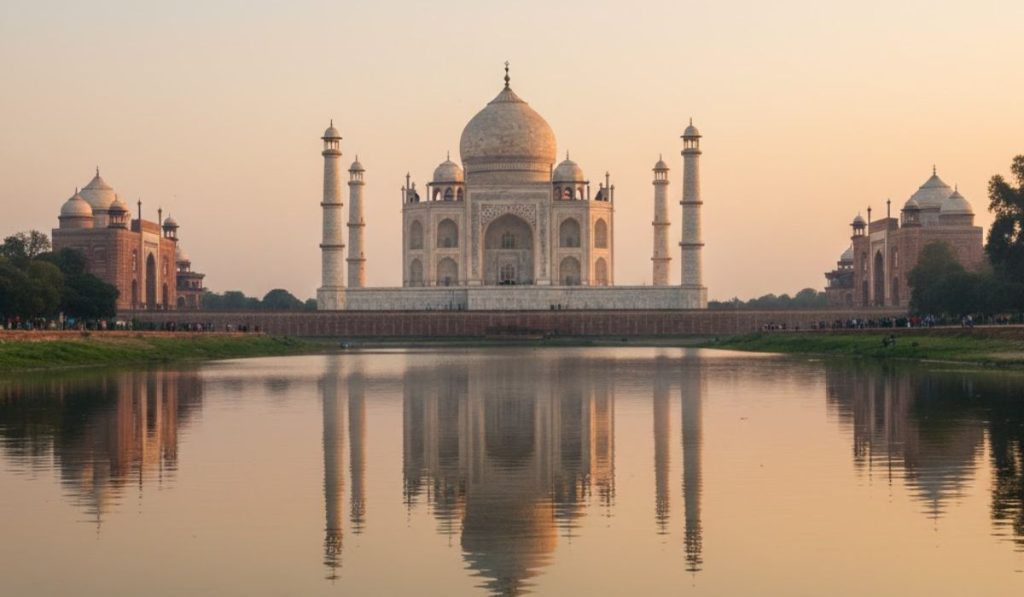
The 300-meter-square Charbagh represents the Islamic paradise (*Bihisht*), divided into four equal quadrants by intersecting water canals that represent the four rivers of Paradise. Water was drawn from the Yamuna River using an elaborate system of animal-powered waterwheels (*rahats*), stored in elevated aqueducts, and pressurized through terracotta conduits to feed copper fountain heads simultaneously.
At the center of the garden sits the raised marble lotus tank (*Al-Hawd al-Kawthar* / Pool of Abundance), positioned to capture the pristine reflection of the white marble dome across its calm surface.
11. The Complete Sanctuary: Mosque, Jawab, and Outer Forecourts
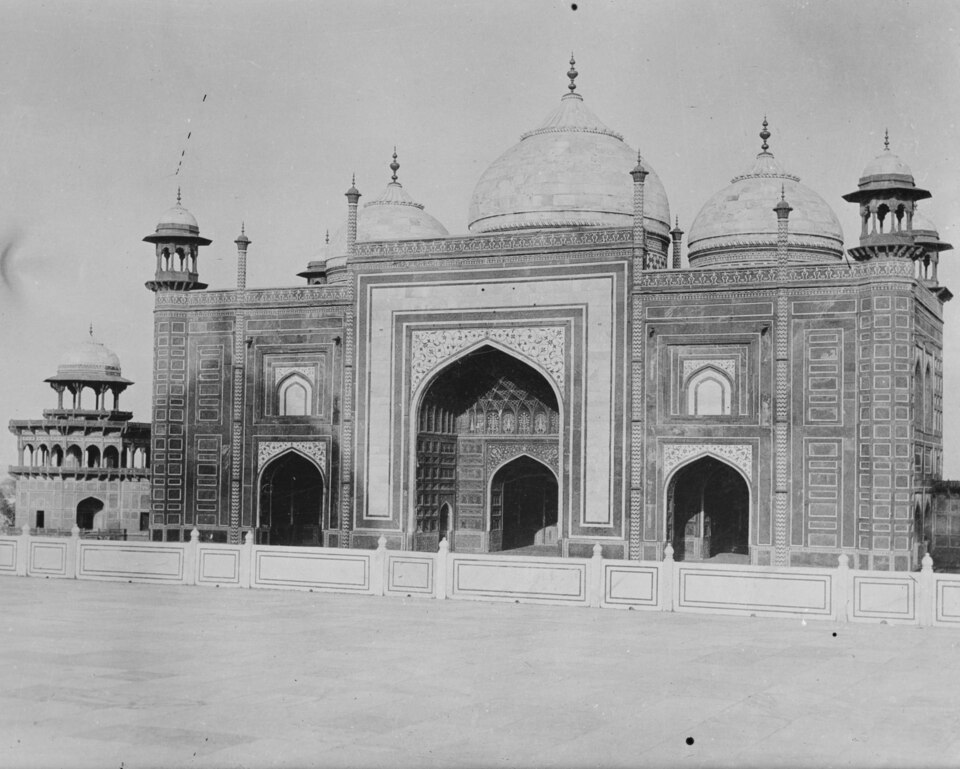
Figure 4: The three-domed red sandstone Mosque on the western flank of the terrace, oriented toward Mecca.
The Taj Mahal is not a standalone tomb, but the central element of an integrated architectural ensemble:
- The Mosque (Masjid): Positioned on the western side of the riverfront terrace facing Mecca, built of red sandstone with three white marble domes.
- The Jawab (Assembly Hall): Built on the eastern side to mirror the mosque’s exterior facade identically, preserving bilateral balance while historically functioning as a guesthouse.
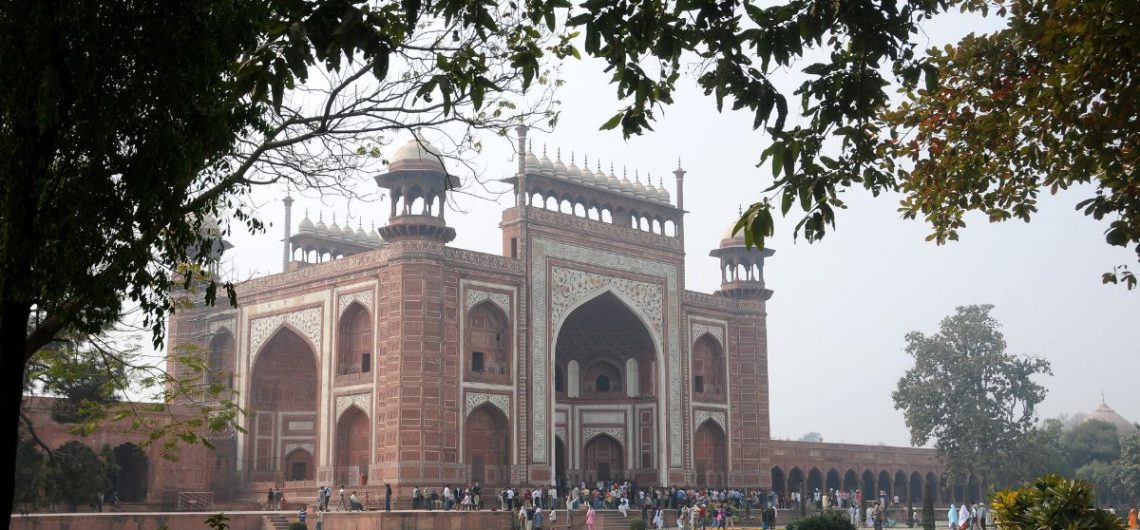
- Darwaza-i Rauza (The Great Gate): The monumental southern entrance made of red sandstone with white marble trim, topped by 22 domed kiosks (*chhatris*).
- Jilaukhana (Forecourt): An outer transitional courtyard where dignitaries dismounted, flanked by subsidiary royal tombs (*Saheli Burj*) and bazaar quarters whose market taxes supported the monument’s upkeep (*waqf*).
12. The Architectural Lineage: From Humayun’s Tomb to the Taj Mahal
The Taj Mahal represents the culmination of a century of Mughal architectural development:
- Humayun’s Tomb, Delhi (1570): Introduced the Persian double dome, monumental *iwan*, and four-fold *charbagh* to the subcontinent.
- Fatehpur Sikri (1571–1585): Synthesized indigenous Indian trabeate stone carving and Gujarati brackets with Islamic arched architecture under Akbar.
- Tomb of Itimad-ud-Daulah, Agra (1628): Commissioned by Empress Nur Jahan, pioneering the shift from red sandstone to white marble and introducing intricate stone inlay (*parchin kari*).
- The Taj Mahal (1631–1653): Reached the apex of classical refinement, harmonizing monumental scale, pure white Makrana marble, and rigorous mathematical proportion.
13. Historical Transitions: Plunder, Neglect, and Colonial Restorations
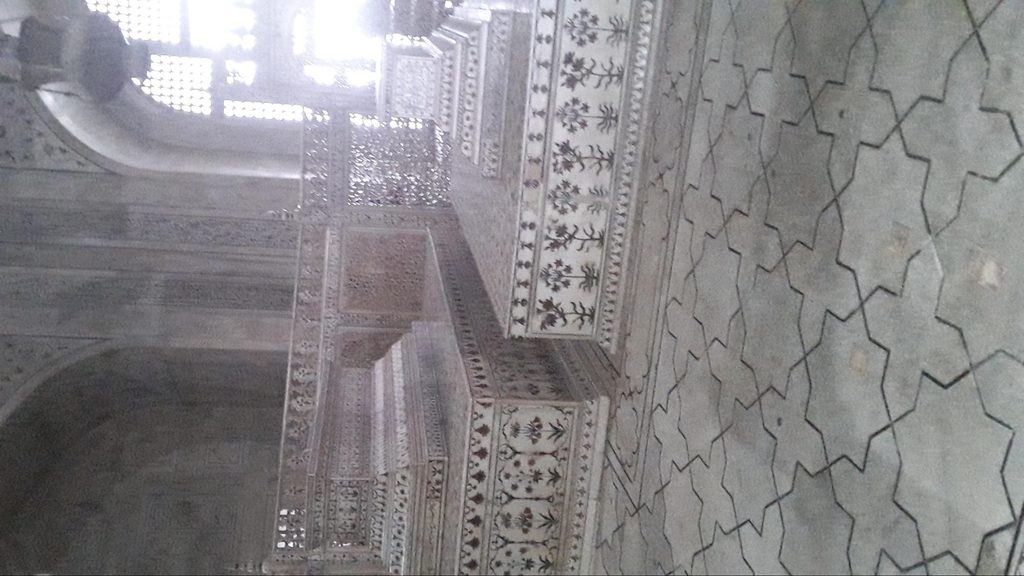
Figure 5: The historic burial grounds and memorial structures within the Taj Mahal complex.
Following Shah Jahan’s death in 1666—having spent his final eight years confined by his son Aurangzeb inside the Muasamman Burj of Agra Fort overlooking his creation—the Mughal capital moved, and royal revenues for maintenance dwindled.
During the eighteenth-century conflicts, the complex was looted. In 1761, Jat forces from Bharatpur took the solid silver inner gates and ornamental chandeliers. Under early nineteenth-century British rule, the gardens were used for colonial military parades and dances.
A major restoration turning point occurred between 1899 and 1905 under British Viceroy Lord Curzon. He initiated extensive structural stabilization, cleared military garrisons, ordered the replanting of the gardens into formal European-style open lawns, and gifted the large bronze hanging lamp designed by Cairo artists that hangs inside the central chamber today.
14. Debunking Persistent Legends: Hard Facts vs. Popular Fiction
| Popular Myth | Historical & Archival Reality | Historical Verdict |
|---|---|---|
| Workers’ hands chopped off | No contemporary chronicle or traveler journal mentions this. Master builders, including Ustad Ahmad Lahori, moved on to construct Old Delhi’s Red Fort and Jama Masjid. | Debunked Urban Legend |
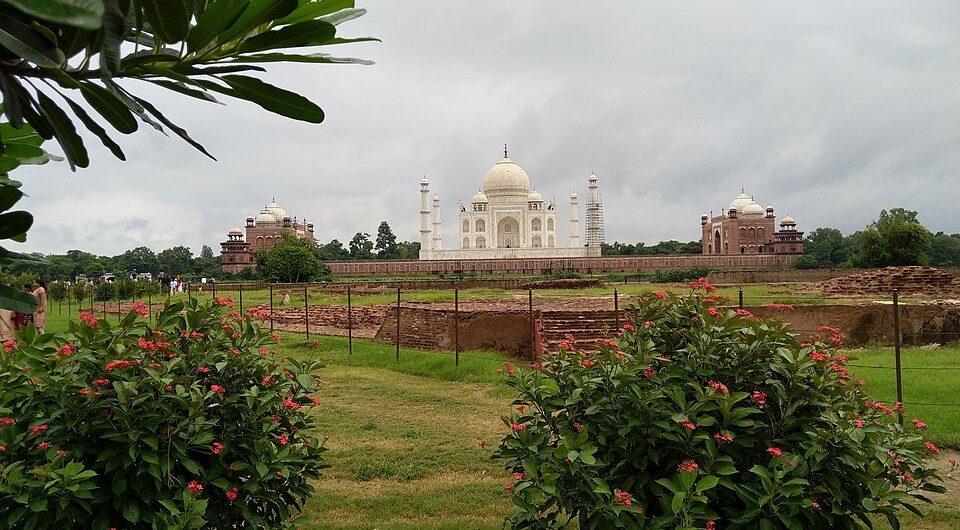
| A Black Taj Mahal was planned | ASI excavations in the 1990s at Mehtab Bagh found only red sandstone garden elements and an octagonal pool designed to view the white Taj Mahal. | Disproven Myth |
| Designed by an Italian architect | Attribution to Geronimo Veroneo by traveler Father Manrique is unsupported. Official records document an imperial board led by Ustad Ahmad Lahori. | Disproven Rumor |
| British planned to auction the marble | Lord Bentinck considered auctioning scrap stone from damaged bathhouses inside Agra Fort, never the Taj Mahal itself. | Distorted Record |
15. The Ecological Battle: Preserving White Marble in the Modern Era
Modern industrialization, traffic emissions, and foundry pollution in the Agra region caused sulfur dioxide and nitrogen oxide emissions to react with atmospheric moisture, causing marble yellowing known as “marble cancer.”
- Taj Trapezium Zone (TTZ): Established in 1996 by the Supreme Court of India, this 10,400-square-kilometer zone enforces strict emissions guidelines, mandates natural gas for local factories, and restricts fossil-fuel vehicles within 500 meters of the gates.
- Clay Pack Treatments (Multani Mitti): The Archaeological Survey of India periodically treats the marble with Fuller’s Earth mudpacks. This non-invasive paste draws trapped impurities out of the stone pores before being washed clean with distilled water.
- Yamuna Water Table: The monument’s foundation rests upon deep timber well caissons (*sal* wood) that require constant groundwater moisture to prevent desiccation. Maintaining river flow remains vital to long-term structural integrity.
16. Visiting the Monument: Essential Travel & Heritage Context
Welcoming millions of visitors annually, the Taj Mahal is an active cultural monument managed by the Archaeological Survey of India:
- Visiting Hours: Open from sunrise to sunset daily, except on Fridays (reserved exclusively for local Muslim worshippers attending congregational prayers).
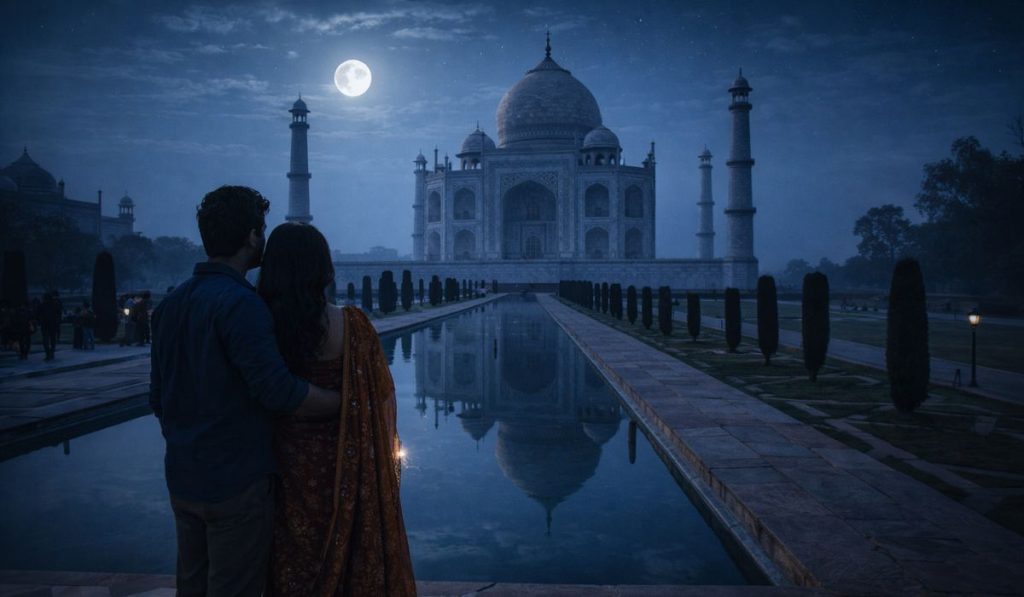
- Full Moon Night Viewing: Permitted for five nights per month (the full moon night plus two nights before and after, excluding Fridays and Ramadan).
- Access & Sustainability: Located in Tajganj, Agra, accessible via high-speed train and expressway from Delhi, with battery-operated shuttles transporting guests from parking terminals.
Frequently Asked Questions
What is the primary architectural style of the Taj Mahal?
The Taj Mahal represents the pinnacle of Mughal architecture, an Indo-Islamic synthesis that weaves together Persian geometric layouts, Central Asian Timurid double domes, and indigenous Indian stone-carving traditions.
Why was white Makrana marble chosen over red sandstone?
Makrana marble from Rajasthan has exceptional crystalline density and low porosity, allowing it to reflect changing daylight from pink at sunrise to brilliant white at noon and golden under moonlight.
Who was the real architect of the Taj Mahal?
Contemporary historical sources, notably the Diwan-i-Muhandis, identify Persianate master architect and mathematician Ustad Ahmad Lahori as the chief designer working under Emperor Shah Jahan’s direct patronage.
Where are Shah Jahan and Mumtaz Mahal actually buried?
The ornate marble tombs visible in the central chamber are decorative cenotaphs. Their actual bodies rest in modest, unadorned stone graves directly beneath in a lower underground crypt at garden level, in accordance with Islamic tradition.
What causes the Taj Mahal’s marble to discolor and how is it cleaned?
Airborne sulfur dioxide and particulate matter react with humidity to cause surface discoloration. The Archaeological Survey of India cleans the marble using non-abrasive Fuller’s Earth (Multani Mitti) clay packs that absorb surface grime without etching the stone.