
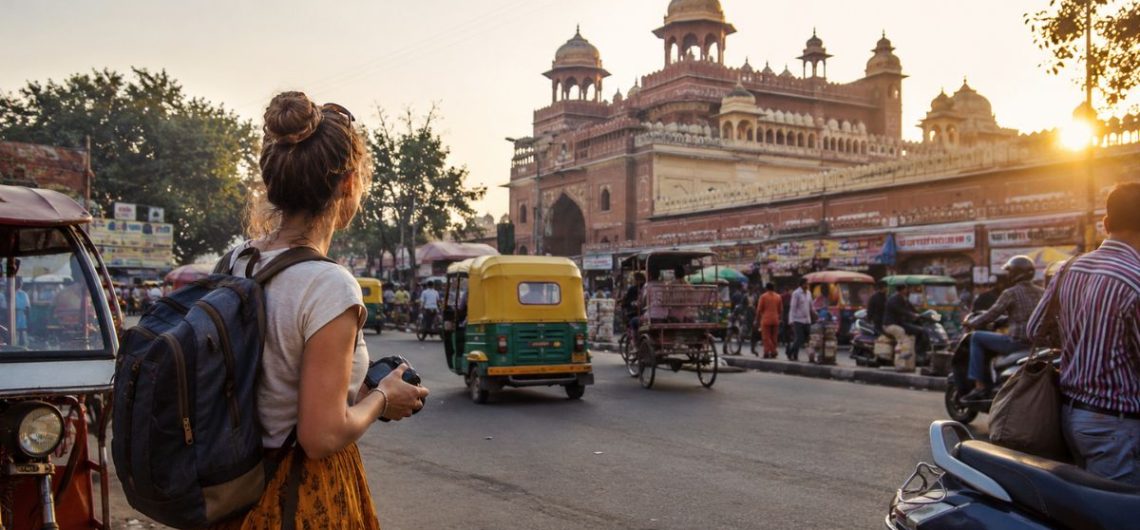
The moment you step off the plane and walk through the arrival gates at Indira Gandhi International Airport, something shifts. It’s not just the warmth that hits you — it’s everything, all at once. The smell of incense mixing with jet fuel and street food drifting in from somewhere unseen. The noise of a hundred conversations happening simultaneously in languages you’ve never heard. The flicker of marigold garlands at a nearby gift shop. The aunty in a turquoise sari arguing loudly with a taxi driver while her husband calmly sips tea from a tiny plastic cup, completely unbothered.
You stand there with your luggage, a little jet-lagged, a little wide-eyed, and you think: What is this place?
That feeling — that beautiful, disorienting, electric feeling — is India saying hello.
If you’re planning your first trip to India, this article is the honest guide nobody handed you at the airport. Not the sanitized brochure version. Not the fear-mongering warnings. Just real, experience-based advice from people who’ve walked these streets, shared chai with strangers, and come home forever changed.
1. India Can Feel Overwhelming at First — and That’s Completely Normal
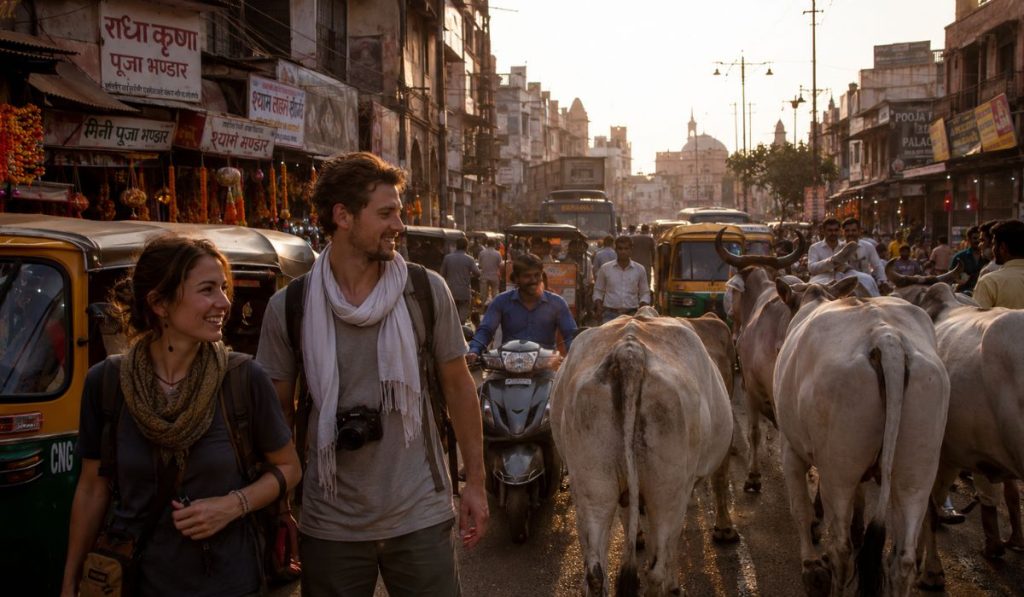
Let’s be honest: India is a lot. The traffic doesn’t flow so much as it negotiates. The street markets pulse with energy at ten in the morning and again at ten at night. Everywhere you look, something is happening — a wedding procession, a chai vendor, a cow sitting peacefully in the middle of a busy road like it owns the place (it does).
For first-time visitors, this sensory intensity can feel overwhelming. Your nervous system, accustomed to quieter streets and more predictable environments, may take a few days to recalibrate.
But here’s what experienced India travelers will tell you: don’t fight it. India isn’t chaotic — it just operates at a different frequency. Once you stop expecting it to feel like home and start letting it be exactly what it is, something magical happens. The noise becomes music. The crowds become community. The chaos becomes color.
Give yourself two or three days of gentle adjustment before you push into anything too intense. A quiet heritage hotel, a good meal, a slow walk — and by day three, you’ll wonder how you ever found it overwhelming at all.
2. Every Region of India Feels Like a Different Country
One of the most common mistakes first-time visitors make is thinking of India as one destination. It isn’t. India is more like thirty countries stacked inside one border, each with its own language, food, climate, religion, architecture, and personality.
Delhi is ancient and ambitious — Mughal ruins next to gleaming shopping malls, Old Delhi’s labyrinthine lanes against the sweeping boulevards of Lutyens’ city.
Rajasthan is a fever dream of desert sunsets, camel shadows on sand dunes, and palace hotels where maharajas once held court. Jaipur, Jodhpur, Udaipur — every city here has a colour of its own.
Kerala is the opposite of Rajasthan in almost every way — lush, green, unhurried, with backwaters threading through coconut groves and a cuisine so fresh and coconut-forward it’s practically a different food culture entirely.
Goa is beach bars and colonial Portuguese architecture and a laid-back energy that feels almost Mediterranean. Mumbai is all ambition and salt air and Bollywood dreams. Varanasi is something else entirely — ancient beyond words, spiritual to its core, the kind of place that rewires something deep inside you.
If this is your first visit to India, the Golden Triangle — Delhi, Agra, and Jaipur — gives you a beautifully curated introduction to the country’s history, food, and culture without overwhelming you. It’s the perfect starting point.
3. Indian Hospitality Will Catch You Off Guard
Nobody warned me about this part. About how a shopkeeper in Jaipur would insist I sit and have chai before looking at a single thing in his store. About how a family in Varanasi would invite me to share their dinner on a rooftop overlooking the Ganges — no agenda, just genuine warmth.
Indian people are extraordinarily curious about foreign visitors. You will be asked where you’re from, whether you’re married, how many children you have, and what you think of India — often within the first five minutes of meeting someone. It’s not intrusiveness. It’s genuine interest.
You’ll be pulled into selfies. You’ll be offered fruit on train journeys by strangers who speak no English but communicate entirely through smiles and gestures. A temple priest will explain a ritual you didn’t ask about because he wants you to understand, not because he wants anything in return.
Embrace it. This warmth is not a performance for tourists — it’s simply how people are here. Accept the chai. Pose for the photos. Answer the questions. Some of the most memorable conversations of your life will happen in these unscripted moments.
4. The Traffic Looks Chaotic but Actually Has Its Own Logic
The first time you sit in a tuk-tuk in Delhi traffic, you will grip the side rail and question every decision that led you to this moment. Scooters threading between buses. Pedestrians stepping into oncoming traffic with the calm confidence of people who have done this a thousand times. A cow, utterly serene, occupying the center lane.
And yet — almost magically — it works.
Indian traffic operates on a system of constant, democratic negotiation. The honking isn’t aggression; it’s communication. A short beep means I’m here. A long one means I’m coming through. Everyone is announcing themselves, and somehow, everyone adjusts.
Practical tips for navigating India’s roads:
- Use Uber or Ola for metered, predictable rides in most major cities. It removes pricing negotiations entirely.
- Hire a trusted private driver for longer day trips or inter-city travel. Your hotel concierge or a reputable tour company can arrange this.
- Book a private tour with a licensed guide — especially in cities like Delhi, Agra, and Jaipur — and you’ll move through the chaos with someone who knows exactly where they’re going.
- Look both ways twice before crossing any street. Then look again.
Crossing roads as a pedestrian in India is genuinely an art form. Walk confidently, make eye contact with oncoming drivers, and move at a steady pace — erratic movements are what cause problems.
5. Your Stomach May Need a Week to Adjust
Indian food is extraordinary. It’s also, for many first-time visitors, a significant adjustment.
The spice levels are real. The richness of certain dishes can be intense. And the sheer variety — hundreds of regional cuisines, street foods, and culinary traditions — means there’s no single “Indian food experience” to prepare for.
A few practical guidelines:
- Drink only bottled or filtered water. Tap water is not safe for foreign visitors. This is non-negotiable. Check that bottle seals are intact before drinking.
- Start conservatively. For the first few days, stick to hotel breakfasts and established restaurants. Let your gut settle before you dive into street food.
- Street food can be incredible — but choose stalls that are busy, use fresh ingredients cooked in front of you, and avoid anything sitting out for long periods.
- Carry basic digestive medication — probiotics, oral rehydration salts, and a mild antidiarrheal. Most trips are fine, but it’s sensible to be prepared.
- Tell restaurants your spice tolerance clearly. “Mild please” is understood everywhere. Some places will test this boundary — feel free to repeat yourself.
The food in India is one of the great joys of traveling here. Approach it with curiosity and a little caution, and it will reward you endlessly.
6. Time Works Differently in India — Learn to Love It
If you’re the kind of traveler who schedules every hour and measures the day in checkboxes, India will lovingly destroy you.
Things run late here. Construction projects, traffic delays, a conversation that extended well beyond its intended length — time in India is more of a suggestion than a contract. The phrase “coming soon” can mean anything from five minutes to fifty.
This is not disorganization. It’s a different relationship with time — one rooted in prioritizing people and present moments over rigid schedules.
How to make it work for you:
- Build buffer time into every day. Don’t plan more than two or three major activities.
- Practice the art of waiting without frustration. Bring a book. Talk to someone.
- Book organized tours with reputable companies — this genuinely reduces logistical stress. A professional guide who knows the roads, the sites, and the timings means you spend your energy experiencing India, not managing it.
The traveler who makes peace with India’s relationship with time has a far richer trip than the one who spends it checking their watch.
7. Dressing Respectfully Opens Doors
India is a deeply diverse country religiously, and dressing modestly at sacred sites is not a suggestion — it’s a genuine mark of respect.
Whether you’re visiting a Hindu temple, a Sikh gurdwara, a Jain mandir, or a mosque, modest clothing is expected. Shoulders and knees should be covered. Many sites provide wraps or scarves at the entrance if you need one — but it’s better to come prepared.
Simple guidelines:
- Pack lightweight linen trousers and loose cotton shirts or kurtas — they’re comfortable in the heat and appropriate everywhere.
- Women will feel more comfortable in looser, longer clothing in many parts of India, particularly in more conservative areas and smaller towns.
- Always remove your shoes before entering temples, mosques, and many traditional homes. You’ll usually see a pile of footwear at the entrance — follow the cue.
- A light scarf is one of the most versatile things you can carry — sun protection, temple cover, impromptu picnic blanket.
Dressing respectfully also tends to draw more genuine interactions. Locals notice and appreciate it.
8. India Works for Every Kind of Traveler
One of the most beautiful things about India is its range. This is a country where you can sleep in a ten-dollar guesthouse and have the experience of a lifetime, or check into a converted maharaja’s palace and feel like royalty — and both experiences are authentically India.
Backpackers thrive here. Affordable guesthouses, delicious cheap meals, overnight trains, and a hostel culture that’s warmer and more social than almost anywhere in Asia.
Luxury travelers will find India extraordinarily well-equipped for indulgent experiences. Heritage palace hotels in Rajasthan, private yoga retreats in Kerala, the legendary Maharajas’ Express luxury train crossing the subcontinent in jaw-dropping style — India’s luxury travel scene is world-class and often underpriced compared to equivalent experiences in Europe or Southeast Asia.
Family travelers, honeymooners, solo adventurers, spiritual seekers — India has a version of itself for everyone. The key is knowing what you want from the trip and planning accordingly.
First-time visitors especially benefit from a well-organized itinerary with private transfers and a knowledgeable local guide. It removes the logistical friction and lets you focus entirely on the experience.
9. Tourist Scams Exist — But They’re Easier to Avoid Than You Think
Every major tourist destination in the world has its share of people looking to make money from unwary visitors, and India is no exception. But the scams here are rarely sophisticated — mostly, they rely on a visitor being distracted, uninformed, or too polite to say no.
The most common ones to know:
- The “closed for government holiday” redirect — a friendly stranger tells you the attraction you want to visit is closed today and offers to take you somewhere better (which pays him commission). It almost never is closed. Verify online or with your hotel before believing anyone on the street.
- Unlicensed “official” guides at major monuments who offer services and then demand inflated fees. Book licensed guides in advance.
- Prepaid taxi scams at airports — avoid unlicensed taxis outside the terminal. Use the official prepaid taxi counters inside, or book a pickup in advance through your hotel or a trusted tour operator.
- Gem investment schemes in Jaipur — these are elaborate, often involving genuine-seeming friendly locals. No, the gems are not a guaranteed profit. Walk away.
The best protection against all of this: book transfers, guides, and tours through a reputable travel company before you arrive. When the logistics are handled, the opening for scammers disappears.
India is genuinely very safe for tourists who are alert and well-prepared. Millions of first-time foreign visitors travel here every year without incident.
10. India Will Change You — and You Won’t Fully Understand How Until You’re Home
This is the part that’s hardest to explain before you’ve experienced it.
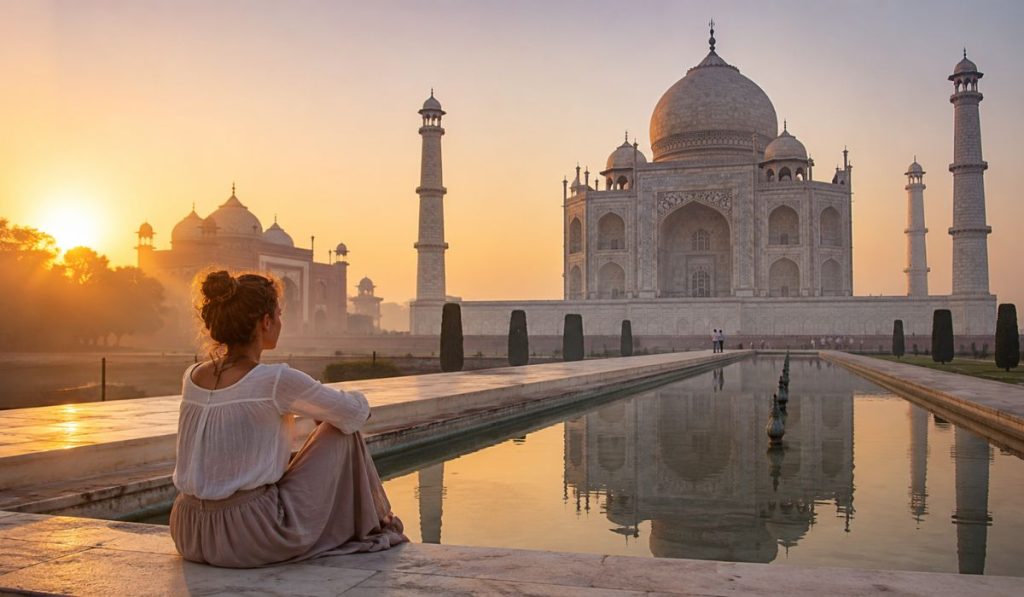
You’re standing at the Taj Mahal at sunrise, the sky turning from grey to pale gold, and the marble begins to glow. You’ve seen a thousand photographs of this place — you thought you knew what to expect. You were wrong. Nothing prepares you for the moment you actually see it. The scale of it. The silence that settles over people who were talking moments ago. The feeling that you are standing inside one of the great human expressions of love, and it’s more beautiful than you had words for.
Or it’s the Ganga Aarti in Varanasi — dozens of priests moving in synchrony on the ghats as darkness falls, fire and chanting and incense and the river stretching away into the dark. You don’t need to be religious to feel something enormous in that moment.
Or it’s a slower thing. A conversation with a local family in Rajasthan that runs well past the language barrier. A train journey where you watch the landscape shift from desert to green over eight hours. An evening in Udaipur when the lake turns silver and you sit on a rooftop and feel, with absolute certainty, that you are somewhere rare.
India asks something of you. It asks you to let go of your assumptions, your comfort, your need for everything to be familiar and controlled. In return, it gives you something that very few other places on earth can offer — a confrontation with the full, wild, extraordinary spectrum of what being human actually means.
You will leave India changed. Not necessarily because of any single moment — but because of the accumulation of all of them. The chai you didn’t ask for. The temple you didn’t plan to enter. The stranger who became, for twenty minutes on a train platform, someone you will never forget.
Plan the trip. Get on the plane. Say yes to India.
Frequently Asked Questions
Is India safe for first-time travelers?
Yes — India is very safe for first-time travelers who take standard precautions. Millions of foreign tourists visit every year without incident. Use reputable transport, book tours through licensed operators, stay in well-reviewed accommodations, and stay alert in crowded areas. Common-sense awareness covers most situations.
What should tourists avoid doing in India?
Avoid drinking tap water. Don’t accept unsolicited help from strangers at major tourist sites (they typically expect payment). Don’t disrespect religious customs at temples and mosques. Avoid photographing people, military installations, or religious ceremonies without permission. Don’t change money with unauthorized dealers on the street.
Can foreigners drink tap water in India?
No. Always drink bottled water with a sealed cap, or filtered/boiled water. This applies to brushing teeth, too, in many areas. Most hotels and restaurants catering to international tourists will provide safe drinking water.
What is the best month to visit India?
October to March is generally the best period for most of India — cooler temperatures, lower humidity, and dry conditions make sightseeing far more comfortable. For the Golden Triangle (Delhi, Agra, Jaipur), November to February is ideal. Summer (April to June) is very hot. Monsoon season (July to September) brings rain but also lush landscapes — it’s a different and beautiful experience if you’re prepared for it.
Is India expensive for tourists?
India offers extraordinary value for money. Budget travelers can live very comfortably on $30–$50 per day. Mid-range travel with comfortable hotels and private transport runs $80–$150 per day. Luxury travel — palace hotels, private guides, premium trains — is significantly cheaper than equivalent experiences in Europe, often at a fraction of the cost for world-class service.
What should women wear in India?
Lightweight, loose-fitting clothing that covers shoulders and knees is ideal — it’s comfortable in the heat, appropriate at religious sites, and generally reduces unwanted attention in more conservative areas. Kurtas (traditional Indian tunics) are excellent — cool, modest, and widely available. A light scarf is always useful. In resort areas like Goa, Western clothing is completely normal.
Is India good for solo travelers?
Absolutely. India has a thriving solo travel culture, and the warmth of local hospitality means you’re rarely alone for long. Solo women travelers should exercise standard urban caution — stay in well-reviewed accommodations, use reputable transport, share itineraries with someone at home, and trust their instincts in unfamiliar situations. Many solo female travelers report India as one of their most memorable and positive travel experiences when well-planned.
Ready to Experience India?
India doesn’t reveal itself to you all at once. It gives you pieces — a color here, a conversation there, a moment at sunset that catches you completely off guard — and over days and weeks, those pieces arrange themselves into something you couldn’t have imagined before you arrived.
The first trip is just the beginning. Most people who visit India once find themselves planning a return before the flight home has even landed.
Let Taj Adventure Holidays take care of the logistics — the transfers, the guides, the handpicked hotels, the carefully designed itineraries for our Golden Triangle Tours, Rajasthan Tours, Taj Mahal Tours, and Luxury India Experiences — so that every moment of your journey is spent exactly where it should be: fully present in one of the most extraordinary countries on earth.
Come with curiosity. Leave with a story worth telling.
Taj Adventure Holidays — Crafting Authentic India Experiences for Discerning Travelers

Comments