
Planning a same-day trip from India’s bustling capital to the serene marble mausoleum is a logistical feat. For most visitors, the journey from Delhi to Agra is not just a commute; it is an integral part of the experience.

The 230-kilometer route via the Yamuna Expressway presents travelers with a fundamental choice: Do you opt for a standard sedan, or do you elevate the journey with a premium vehicle?

For international tourists, NRI families, couples, and business travelers, this decision goes beyond aesthetics. It impacts comfort, fatigue levels, privacy, and ultimately, how fresh you feel when you finally stand before the Taj Mahal.

This guide breaks down the real differences between a standard and a premium Taj Mahal tour from Delhi, helping you choose the option that best suits your travel style without the aggressive sales pitch.

The Vehicle: Standard Sedans vs. Luxury Automobiles

Comparison of standard sedan, premium luxury car, and SUV for Taj Mahal tour from Delhi
Vehicle comparison showing standard sedan, premium luxury car, and SUV options for a Delhi to Agra Taj Mahal tour.

The most obvious distinction lies in the car you sit in for the duration of this 6–8 hour round trip.

What Defines a “Standard” Tour Car?

Standard tours typically utilize reliable, air-conditioned sedans. The most common vehicles you will encounter are the Toyota Etios, Maruti Suzuki Dzire, or similar models .

These are modern, well-maintained cars perfect for point-to-point transport. They offer comfortable seating for up to three passengers and are the workhorses of the Indian tourism industry.

They are practical, fuel-efficient, and get the job done.

What Defines a “Premium” Tour Car?

A premium tour upgrades you to the “Business Class” of Indian highways. These are high-end luxury vehicles designed for superior comfort and status.

Depending on the operator, you can expect Mercedes-Benz (E-Class or similar), BMW (3 Series or 5 Series), Audi A4, or high-end SUVs like the Toyota Fortuner.

These vehicles are not just about getting from A to B; they are about enjoying the space in between. With superior suspension, quieter cabins, plush leather interiors, and more legroom, they transform the car into a mobile lounge.

Yamuna Expressway: The Ultimate Proving Ground

To understand why the choice of car matters, you must understand the road. The Yamuna Expressway is a 165-km, six-lane controlled-access toll road designed for high-speed travel.

While it cuts travel time to roughly three hours, it is also known for its monotonous landscape, which can lead to “road hypnosis.”

The Standard Car Experience

In a standard sedan, the Yamuna Expressway is manageable. The car maintains a steady 100-110 kmph easily. However, wind and road noise are more noticeable at these speeds.

Over the course of three hours, the constant hum and smaller cabin space can begin to feel fatiguing.

The Premium Car Experience

A premium car is engineered specifically for high-speed touring. The German automakers, in particular, design their vehicles to “eat up” highways. At 120 kmph, a Mercedes or BMW feels significantly more planted and quieter than a standard sedan.

The cabin insulation is superior, meaning you arrive in Agra feeling as though you have taken a short drive rather than a three-hour journey .

The advanced suspension systems absorb the minor imperfections of the expressway, isolating you from road vibrations.

Comfort and Fatigue: How You Arrive Matters

The Taj Mahal requires walking. You will walk from the parking lot to the gate, through the grand entrance, and across the red sandstone platform to the mausoleum.

If you are tired, hot, or stiff from the drive, it diminishes the magic.

The “Arrival” Factor

  • Standard Tour: You will arrive feeling like you have just finished a long commute. You might be slightly stiff and eager to stretch your legs.
  • While you are ready to see the sights, a stop for coffee or a stretch break is often welcome before diving into the monument tour.
  • Premium Tour: You arrive relaxed. The ability to recline in premium seats, the quiet environment, and the smooth ride mean you conserve your energy for the sights.
  • This is particularly crucial for senior citizens or business travelers who may be jet-lagged and need to preserve their stamina for the afternoon.

Fatigue and Safety Data

The choice of vehicle also has a safety implication tied directly to driver fatigue. Data from the Yamuna Expressway Industrial Development Authority (YEIDA) reveals that between 2012 and 2023, there were 7,625 accidents and 1,321 fatalities on this stretch . A staggering number of these incidents—3,364 accidents—were caused by drivers dozing off .

How Premium Tours Mitigate This Risk:
While fatigue is a risk for any driver, premium tour operators typically employ more experienced chauffeurs who are accustomed to long-haul luxury travel.

Furthermore, the superior comfort of a premium vehicle means the driver is operating a less stressful environment, allowing them to remain more alert.

When you book a premium service, you are often paying for a higher standard of driver training and rest protocols, which is a safety feature you cannot see but absolutely benefits from .

Privacy and Flexibility: The Intangibles

Both standard and premium tours offer a private car, meaning it is just your party in the vehicle. However, the quality of that privacy differs.

  • Standard Privacy: You have your own space, away from group tours. You can ask the driver to stop for photos or skip a lunch spot.
  • Premium Privacy: This extends to discretion. The tinted windows are darker, the partition (in some high-end sedans) is more effective, and the overall atmosphere is one of seclusion.
  • For honeymooners or high-profile business travelers, this cocoon-like environment allows for rest or private conversation without the feeling of being on a tourist conveyor belt. You aren’t just avoiding strangers; you are creating a bubble of personal space.

Who Should Choose a Premium Tour?

Based on the factors above, certain travelers are ideally suited for the upgrade:

  • Honeymooners and Couples: The romantic element of the trip is enhanced by the luxury experience. Arriving at the Taj Mahal in a sleek Mercedes sets a different tone than arriving in a standard taxi .
  • Senior Citizens or Those with Mobility Issues: The easier ingress/egress of an SUV or the plush suspension of a luxury sedan makes a tangible difference in physical strain.
  • Business Travelers/VIPs: For those accustomed to a certain standard of travel, a premium car aligns with their expectations. It allows them to work on the way or decompress quietly after meetings.
  • Travelers with Early Morning Starts: If you are leaving Delhi at sunrise (or earlier), being able to rest deeply in a premium seat during the drive is invaluable.

When Standard Tours Are Sufficient

Standard tours are far from inferior; they are simply designed for a different priority: value.

  • Budget-Conscious Families: If you are a family of three looking for a safe, clean, and efficient way to see Agra, a standard sedan is perfect. You are saving money for souvenirs, a nicer lunch, or future travel .
  • Solo Travelers: For a solo traveler, a standard sedan offers ample space. Upgrading to a limousine might feel excessive.
  • First-Time Visitors on a Packed Schedule: If your main goal is to check off the Taj Mahal and Agra Fort efficiently, the standard car provides all the functionality you need without the premium price tag.

Car vs. Train: A Quick Comparison

Often, travelers compare a premium car tour against the high-speed train option (Gatimaan Express). Here is how they stack up:

FeaturePremium Car (e.g., Mercedes/BMW)Gatimaan Express Train
Travel Time3–3.5 hours (door-to-door flexibility)1 hour 40 mins (station-to-station) 
ComfortPrivate, personalized space; lie-flat seatsComfortable, but shared carriage 
FlexibilityHigh: Stop for photos, change plansLow: Fixed schedule, must return on time 
PrivacyComplete privacy for your groupPublic setting with other passengers
Experience“The journey is the destination” luxuryEfficient, fast transit 
LuggageIn car with youLimited, must carry yourself

Verdict: If your primary goal is raw speed and you are comfortable with fixed schedules, the train is excellent. However, if you value privacy, personalized service, door-to-door convenience, and the experience of traveling in a luxury automobile, a premium car tour is the superior choice .

Side-by-Side Comparison: Premium vs. Standard

To visualize the difference, consider this breakdown of a typical Delhi to Agra day trip:

FactorStandard Taj Mahal TourPremium Taj Mahal Tour
Typical VehiclesToyota Etios, Maruti Dzire, LoganMercedes E-Class, BMW 5 Series, Audi, Fortuner 
Interior SpaceAdequate for 2-3 passengersSuperior legroom and shoulder room
Noise LevelsNoticeable wind/road noise at high speedWhisper-quiet cabin insulation 
Yamuna Expressway RideStable, but transmits road feel“Glides” over the tarmac; absorbs bumps
Fatigue Factor (Arrival)Moderate stiffness after 3+ hoursRelaxed and refreshed 
Photo StopsPossible, but feels like a detourSeamless; part of the luxury tour
Driver InteractionProfessional driverProfessional, often senior chauffeur
Best ForValue seekers, small familiesHoneymooners, executives, luxury lovers

Conclusion

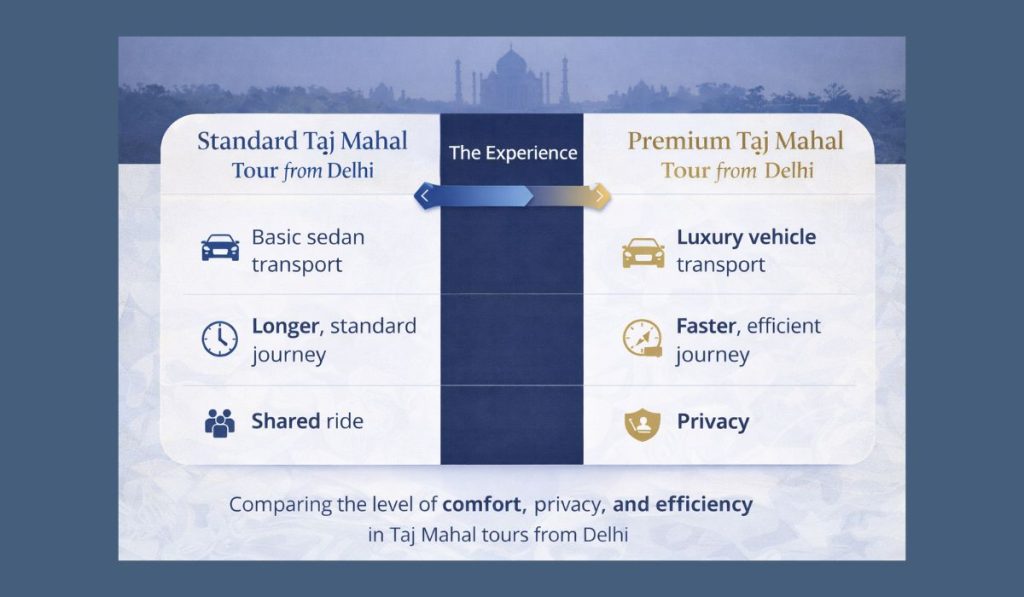
Infographic comparing standard and premium Taj Mahal tours from Delhi highlighting comfort, privacy, and travel efficiency
Visual comparison of standard and premium Taj Mahal tours from Delhi focusing on comfort, privacy, and journey efficiency.

Choosing between a premium and standard Taj Mahal tour from Delhi is ultimately a question of what you value most for your time and money.

If you view the car as merely a utility to reach a destination, a standard sedan is a perfectly rational and comfortable choice.

However, if you view the journey as part of the overall experience—a chance to rest, to travel in style, and to arrive at one of the world’s most romantic monuments feeling your absolute best—then the investment in a premium vehicle like a Mercedes or BMW is justified.

It transforms a long day trip into a seamless, luxurious excursion where the quality of the ride matches the grandeur of the destination.

Frequently Asked Questions (FAQs)

1. Is the drive from Delhi to Agra really that tiring?

The drive is approximately 3 to 3.5 hours each way. While the Yamuna Expressway is smooth, the total of 6-7 hours on the road can lead to fatigue, especially if you are in a smaller car or not used to long drives. This is why comfort and the ability to rest in the car are important factors to consider .

2. Why should I choose a Mercedes or BMW for a Taj Mahal tour?

Choosing a Mercedes, BMW, or Audi elevates the journey from a simple transfer to a luxury experience. These vehicles offer superior comfort, quieter cabins, and smoother rides, significantly reducing travel fatigue. This ensures you arrive at the Taj Mahal feeling fresh and relaxed rather than tired and stiff .

3. Are premium car tours only for large groups?

Not at all. In fact, premium sedans like the Mercedes E-Class are perfect for couples or small families (2-3 people). They offer intimate luxury. For groups of 4 or more, a premium SUV like the Toyota Fortuner is often the better choice, ensuring everyone has ample space .

4. Is the Taj Mahal open every day for visitors?

No. The Taj Mahal is closed to tourists every Friday. This is reserved for prayers at the mosque inside the complex. You must plan your trip accordingly .

5. How does a premium car tour differ from the Gatimaan Express train?

The Gatimaan Express is faster in terms of pure travel time (about 90 minutes) but requires you to get to and from train stations and adhere to a strict schedule . A premium car tour offers door-to-door service, complete privacy, and the flexibility to stop along the way or linger at a site .

6. Do premium tours include a better guide or lunch?

Often, yes. Premium tour packages frequently bundle in additional high-end services. This can include [internal link: expert guides with historical degrees], lunch at 5-star hotels (like the ITC Mughal or Marriott), and skip-the-line access at the monuments, creating a completely hassle-free VIP experience
Planning a trip to see the Taj Mahal is one of those exciting travel moments that usually involves a lot of research. You know you want to see it, but the biggest question is usually how. For most people based in Delhi, the default option is a frantic same-day trip. But there’s another way: an overnight stay.

While a day trip sounds efficient on paper, it often leaves you exhausted and a little disconnected from the experience. An overnight Agra tour from Delhi, on the other hand, lets you see the city the way it was meant to be seen—slowly. This guide will walk you through everything you need to know to decide if spending a night in Agra is the right choice for you.

Why Consider an Overnight Agra Tour from Delhi?

We’ve all heard of people who woke up at 3 AM to catch a cab to Agra, rushed through three monuments, and drove back in the dark. That is the classic same-day trip. But is it the best way to experience one of the Seven Wonders of the World? Usually, it isn’t.

An overnight trip offers something a day trip simply cannot: time. It gives you the space to pause, breathe, and actually absorb the stories behind the stone. Instead of watching the clock, you start watching the details—the way light hits the marble, the quiet corners of the gardens, and the taste of food when you aren’t rushing.

If you are wondering, “is overnight agra tour worth it,” consider this: travel fatigue is real. Spending four to five hours in the car on the same day you are walking miles under the sun is exhausting. Splitting that sightseeing over two days, with a good night’s sleep in between, changes your entire perspective on the city.

Same-Day vs. Overnight: A Detailed Comparison

To help visualize the difference, here’s a simple breakdown of what each itinerary feels like:

FeatureSame-Day Tour (The Rush)Overnight Tour (The Rhythm)
Start TimePre-dawn pickup (3:00 – 4:00 AM)Comfortable late morning start
Travel PaceHigh-speed highway dashLeisurely drive with breaks
Taj Mahal VisitMid-day, often crowded and hotSunrise option (peaceful & cool) or late afternoon
SightseeingTop 2 monuments (Taj & Agra Fort)Taj, Agra Fort, plus Baby Taj, Mehtab Bagh, local markets
Fatigue LevelHigh (you return exhausted)Low (you return refreshed)
Key ExperienceRacing against the sunsetWatching the sunrise in peace

As the table shows, the choice boils down to whether you want to see the Taj Mahal or experience it.

The Unmatched Magic of a Sunrise Taj Mahal Visit

Sunrise view of Taj Mahal during overnight Agra tour from Delhi
Early morning view of the Taj Mahal during a relaxed overnight Agra tour from Delhi.

One of the primary reasons travelers book a Taj Mahal sunrise tour is the atmosphere. There is a reason photographers and travel bloggers rave about the early morning hours at the Taj.

Witnessing the Changing Colors of the Marble

As the sun rises over the horizon, the white marble of the Taj Mahal undergoes a subtle, stunning transformation. It shifts from a soft, milky pink to a brilliant, shimmering white. This natural light show is something you completely miss if you arrive mid-morning when the sun is high and harsh.

Enjoying Fewer Crowds and More Peace

By 10 AM, the queues are long, and the gardens are buzzing. At sunrise, however, the compound is relatively empty. You can actually find a quiet bench, sit down, and just look at the monument without someone photobombing your view. It is a much more spiritual and personal experience.

Exploring Agra’s Masterpieces Without the Rush

Beyond the Taj, Agra is home to centuries of Mughal architecture. Rushing through these sites does them a disservice. An overnight agra tour by car gives you the bandwidth to appreciate the details.

The Taj Mahal: Beyond the Iconic Photo

On a rushed trip, you might take the classic photo at the bench and leave. With an overnight stay, you have the time to walk to the far end of the complex, admire the intricate pietra dura (stone inlay) work up close, and read about the history without feeling like you are holding up the group.

The Grandeur of Agra Fort

Just a few kilometers away, the Agra Fort is a massive sandstone fortress that served as the main residence of the Mughal emperors. Inside, you can explore the Diwan-i-Khas (Hall of Private Audience) and the Musamman Burj, the octagonal tower where Shah Jahan was imprisoned. From here, he gazed across the river at the Taj Mahal—a story that feels much more poignant when you aren’t rushing to the next exit.

Mehtab Bagh: The Perfect Sunset Point

Often skipped by day-trippers due to time constraints, Mehtab Bagh (the Moonlight Garden) is a garden complex directly across the Yamuna River from the Taj Mahal. It offers a breathtaking, unobstructed view of the monument. It is the perfect spot to wind down in the evening and watch the marble glow in the dusk light.

Itmad-ud-Daulah: The “Baby Taj”

This exquisite tomb is often considered a draft of the Taj Mahal. It is smaller, incredibly detailed, and far less crowded. Known locally as the “Baby Taj,” it was the first Mughal structure to be built entirely of marble. The intricate lattice work here is mesmerizing.

The Comfort and Flexibility of a Private Car Tour

One of the biggest advantages of booking a private overnight taj mahal tour from delhi is the control it gives you over your environment.

The Yamuna Expressway Road Trip Experience

The drive from Delhi to Agra is primarily via the Yamuna Expressway, a modern, six-lane highway that cuts travel time down to about three to four hours. In a private car, you control the AC, the music, and the stops. You can ask the driver to pull over for a chai break or to stretch your legs, which is impossible on a crowded group bus. This flexibility turns the drive into a pleasant part of the holiday rather than a grueling commute.

Why It’s Ideal for Families and Seniors

If you are traveling with parents or young children, a 2 days Agra tour from Delhi is often the only sensible option. A day trip is simply too long and tiring for elderly travelers or toddlers. Splitting the journey with a hotel stay in the middle makes the trip accessible for everyone. It allows for afternoon naps and a relaxed pace, ensuring that the travel fatigue comparison heavily favors the overnight option.

Practical Insights for a Smooth Overnight Trip

After speaking with frequent travelers and local guides, a few practical tips consistently come up that can make or break your experience.

Best Hotel Areas to Stay in Agra

Where you stay matters.

  • Taj Ganj: This is the area directly south of the Taj Mahal. It is packed with budget hotels and rooftop restaurants that offer incredible views of the monument. It is bustling, a bit chaotic, but full of character.
  • Fatehabad Road: This is the main tourist corridor. It is cleaner, wider, and home to most of the mid-range and luxury hotels. It is quieter and more convenient if you prefer comfort over chaos, but you are a short auto-rickshaw ride away from the Taj.
  • The Civil Lines: Located north of the Taj, this is a posh, quiet area with high-end hotels. It is further from the action but offers a peaceful retreat.

How Early to Reach the Taj Gate

For the sunrise experience, you need to be at the gate at least 30 to 45 minutes before the official sunrise time. The gates open about 30 minutes before sunrise. Reaching early means you can be among the first few people through security, giving you that coveted clear view without a crowd in front of you.

Which Gate is Less Crowded?

The Taj Mahal has three gates: West, South, and East.

  • West Gate: This is the main gate and the most crowded, as it is closest to the budget hotel district.
  • South Gate: Also busy, but opens a bit later than the others.
  • East Gate: This is the least crowded entrance. It is slightly further from the main Taj Ganj area, but most taxis and auto-rickshaws know the way. If you want a smoother entry with shorter queues, ask your driver to drop you at the East Gate.

Who Should Avoid an Overnight Agra Tour?

While an overnight trip is magical for most, it isn’t for everyone. Being honest about this helps you plan better.

  • Tight Schedule Travelers: If you are in Delhi for less than 24 hours and your primary goal is simply to check the Taj Mahal off your list, a day trip, despite its intensity, might be your only logistical option.
  • Ultra-Budget Travelers: An overnight trip adds the cost of a hotel and dinner. If you are traveling on a shoestring budget and want to minimize expenses, a same-day trip, though tiring, will be cheaper.
  • Business Layover Visitors: If you have a long layover at Delhi airport and want to see Agra in between flights, a customized day trip with an early return might be safer and more practical than checking into a hotel.

Sample Relaxed 2-Day Itinerary Flow

To give you an idea of how relaxed this can be, here is a sample flow of a 2 days Agra tour from Delhi. Notice the lack of strict timings, which is the hallmark of a private car tour benefits experience.

  • Day 1: The Arrival & The Fort
    • Leave Delhi after a relaxed breakfast.
    • Arrive in Agra in time for lunch at your hotel.
    • Visit Agra Fort in the late afternoon when the heat subsides.
    • Check into your hotel and rest.
    • Evening visit to Mehtab Bagh for sunset views over the Taj.
    • Dinner at a rooftop restaurant with a view.
  • Day 2: Sunrise & The Details
    • Early morning entry to the Taj Mahal for sunrise photography.
    • Return to the hotel for a hearty breakfast.
    • Visit the serene Itmad-ud-Daulah (Baby Taj).
    • Explore a local marble inlay workshop to see artisans at work.
    • Lunch at a local restaurant (try the Mughlai cuisine).
    • Begin the drive back to Delhi, arriving in the evening.

Is an Overnight Tour Worth It? Scenarios and Suitability

So, is overnight agra tour worth it specifically for you?

  • For Couples: Absolutely. Watching the sunrise at the Taj is an incredibly romantic moment you won’t get on a rushed day trip.
  • For Families: Yes. The reduced travel fatigue makes it safer and more enjoyable for children and grandparents.
  • For Photography Enthusiasts: 100%. You need the golden hours (sunrise and sunset) to capture the Taj at its best.
  • For History Buffs: Yes. Having time to visit the “Baby Taj” and really explore the Fort adds so much context to the main event.

Essential Agra Travel Planning Tips

To make the most of your Agra overnight tour package, a little planning goes a long way.

  • Best Time to Visit Agra: The ideal months are from October to March. The weather is cool and pleasant, perfect for walking and exploring the Mughal architecture in Agra. Summers (April-June) are extremely hot, and the monsoon (July-September) can be humid, though the gardens are lush.
  • What to Pack: Comfortable walking shoes are non-negotiable. You will be doing a lot of walking on marble and stone pathways. Also, carry sunscreen, a hat, and a power bank for your phone—you’ll be taking a lot of photos.
  • Footwear at the Taj: You will either need to remove your shoes or wear the provided shoe covers when walking on the marble platform of the Taj Mahal. This is to protect the marble.

Frequently Asked Questions (FAQs)

1. How long does it take to drive from Delhi to Agra?
The drive typically takes 3 to 4 hours via the Yamuna Expressway, depending on traffic conditions in Delhi.

2. Is the Taj Mahal open every day?
No, the Taj Mahal is closed on Fridays for prayers. Your itinerary should account for this if you are planning a weekend trip.

3. Can I see the Taj Mahal at night?
Yes, night viewing is possible on full moon nights and the two nights before and after, but tickets are limited and must be booked in advance with the Archaeological Survey of India.

4. What are the entry fees for the Taj Mahal?
For foreign tourists, the entry fee is approximately ₹1,100. For Indian citizens, it is ₹50. This usually includes a bottle of water and shoe covers.

5. What other historical sites are near Agra?
About 40 kilometers from Agra is Fatehpur Sikri, a UNESCO World Heritage site and former Mughal capital. It is often included in 2-day itineraries if time permits.

6. Is Agra safe for solo female travelers?
Yes, Agra is generally safe for tourists. However, like any busy tourist city, it is wise to dress modestly, avoid isolated areas late at night, and use reputable transportation services.

7. What food is Agra famous for?
Agra is famous for Petha (a sweet made from ash gourd). For breakfast, try the local favorite Bedai (fried bread) with Jalebis. Don’t leave without trying the Mughlai curries.

8. Do I need a guide for the monuments?
While you can explore on your own, hiring a certified guide enriches the experience. They provide historical context and stories you won’t read on the information plaques.

Conclusion: Choosing the Right Pace for Your Journey

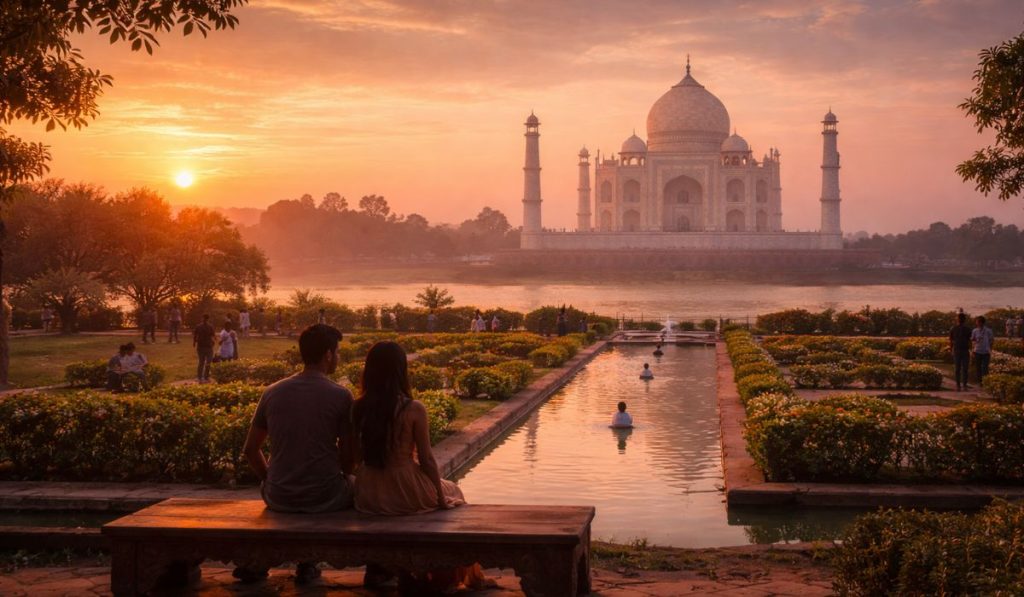
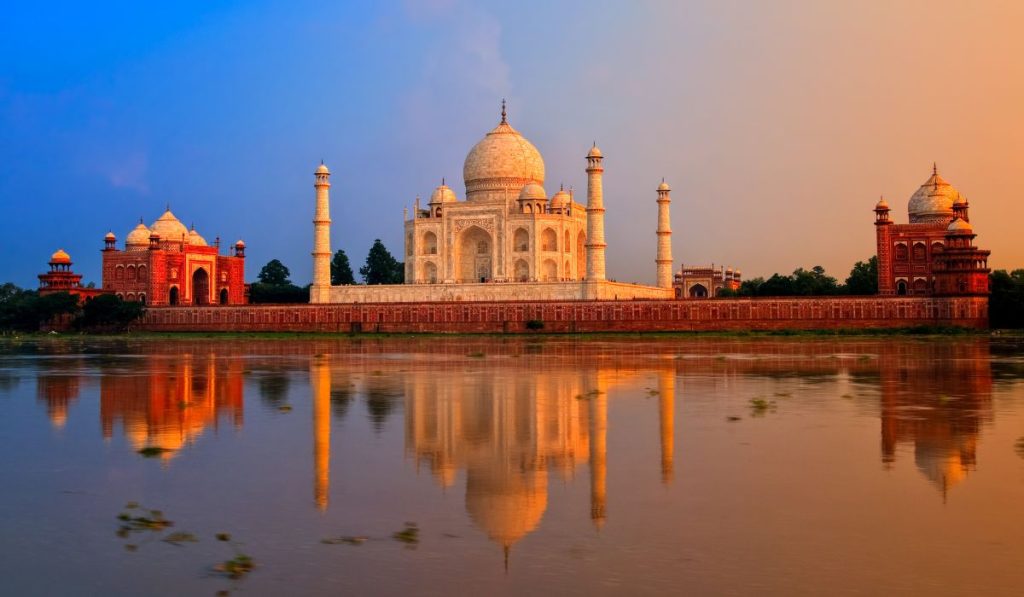
Sunset view of Taj Mahal from Mehtab Bagh during overnight Agra tour
Evening view of the Taj Mahal from Mehtab Bagh during a relaxed overnight Agra tour from Delhi.

Travel isn’t just about collecting photos; it’s about collecting moments. A same-day trip to Agra will give you a photo of the Taj Mahal. An overnight Agra tour from Delhi by car gives you the memory of standing in silence as the sun paints the marble gold, the taste of a relaxed dinner, and the stories whispered by the ancient walls of the fort.

If your schedule allows for it, choose the slower pace. Give yourself the gift of time in the City of Love. You’ll return to Delhi not just with souvenirs, but with a genuine sense of having been somewhere truly special.

If you are planning carefully, reviewing a structured overnight Agra tour from Delhi by car can help you understand logistics and hotel options better, ensuring your journey is as smooth as it is memorable.

For the global traveler, the first mental image conjured by the word “India” is often a specific one: a perfect white dome framed by minarets, reflected in still water.

The Taj Mahal has transcended its physical existence to become a global symbol, carrying the weight of representing an entire subcontinent’s history, culture, and identity.

For decades, it has served as the gravitational center of the Indian travel experience. While some seasoned travelers seek to bypass the obvious, the reality remains that the overwhelming majority of first-time itineraries—from rushed five-day layovers to leisurely three-week explorations—begin the same way: with Taj Mahal Tours.

This is frequently dismissed as tourist cliché, but a closer analysis reveals a more strategic truth.

Beginning an Indian journey in Agra is not about following a crowd. It is a profoundly logical decision grounded in psychology, logistics, narrative structure, and even digital-era travel behavior.

This article deconstructs why the Taj Mahal serves as the perfect prologue to the Indian story, and why planning a Taj Mahal Tour from Delhi first is less about convention and more about strategic intelligence.

The Psychology of the Icon: Why We Need the Anchor First

Before examining train schedules and hotel bookings, one must understand the traveler’s mindset. Arriving in India for the first time is an intense sensory experience. The goal of the first 48 hours is not exploration but orientation.

Managing First Impressions in a Complex Destination

India is vast, chaotic, and diverse. For a first-time visitor, the sheer scale can be overwhelming. Psychologically, travelers engage in “risk management” when planning a trip to a high-complexity destination. They seek a predictable anchor—a known quantity that guarantees a return on their emotional and financial investment.

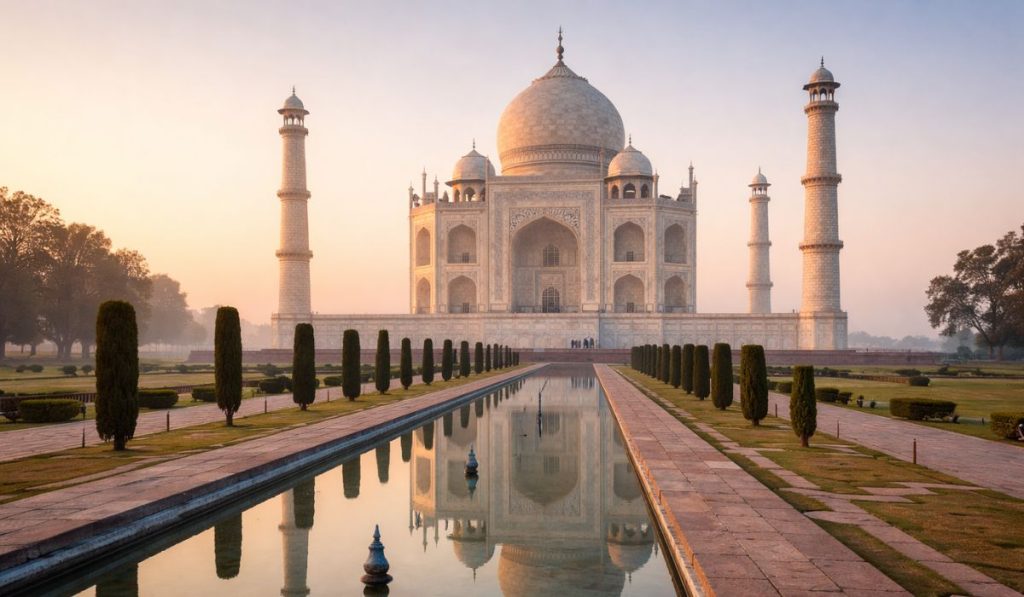
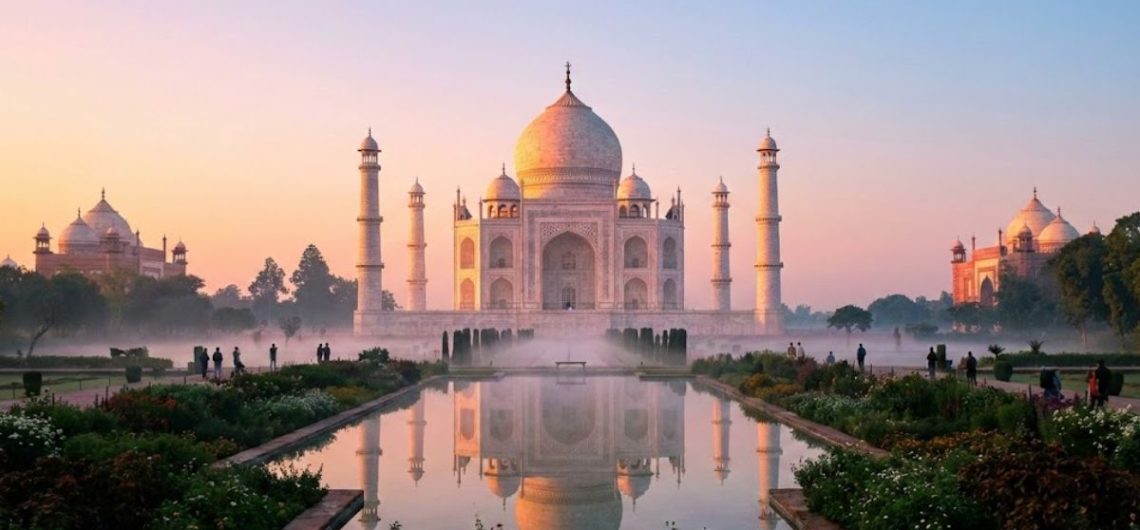
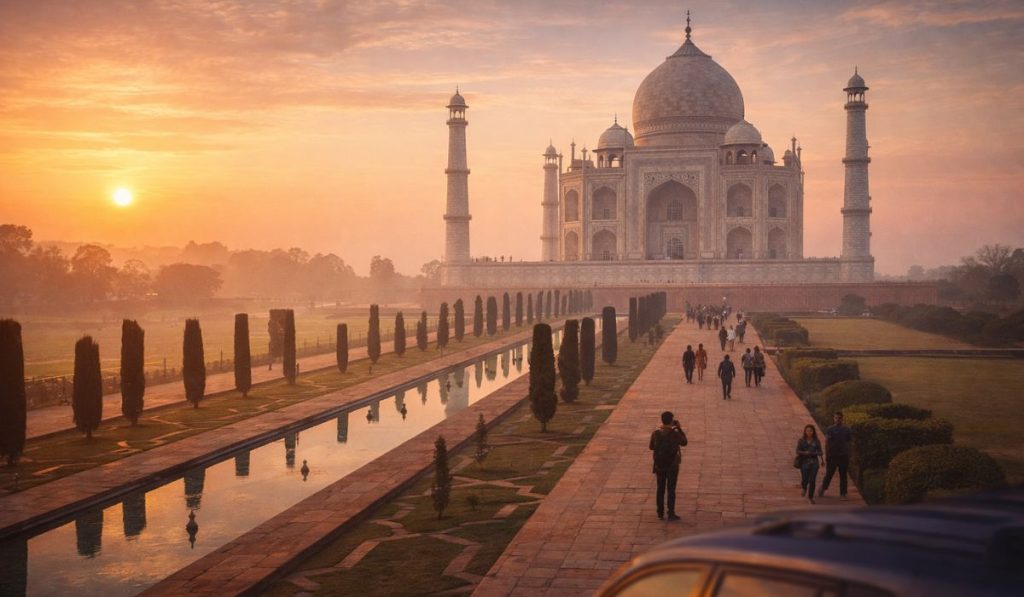
Sunrise view of the Taj Mahal in Agra with reflection in the water garden during early morning
The Taj Mahal at dawn in Agra, often the first stop on a North India travel itinerary.

The Taj Mahal serves as this anchor. It is the one variable in the travel equation that requires no justification. By planning Taj Mahal Tours at the very beginning, the traveler secures the “centerpiece” immediately.

This strategy ensures that even if jet lag, digestive adjustments, or unexpected weather disrupt later plans, the primary objective has already been achieved.

It reduces travel anxiety. The tourist can relax into the subsequent chaos of India, knowing they have already captured its most famous reward. This psychological security is invaluable when navigating a country as layered as India.

Aligning Expectations with Reality

There is also a phenomenon of “first impression bias.” The first major site a traveler visits sets the tone for their perception of the entire trip. If that first site is the Taj Mahal, it establishes a benchmark of awe. It validates the decision to travel 8,000 miles.

Beginning with a sunrise Taj Mahal visit is particularly effective in this regard. Dawn in Agra offers a moment of tranquility that mediates the transition from the traveler’s home environment to the rhythm of India. The soft light and relative quiet act as a buffer, introducing the grandeur of Mughal history in its most digestible form.

Architectural Intelligence: Understanding What You’re Seeing

To understand why the Taj Mahal anchors trips so effectively, one must appreciate what the monument actually is. It is not just a pretty building; it is a masterpiece of architectural intelligence that rewards close study.

The Physics of Marble and Light

The Taj Mahal was engineered to interact with light. The white marble is not uniformly white; it contains traces of semiprecious stones like jade, turquoise, and lapis lazuli inlaid through the pietra dura technique.

This composition causes the monument to reflect different colors at different times of day—pinkish in the morning, milky white in the evening, and golden under moonlight.

This optical behavior explains why Taj Mahal Tours prioritize specific timing. The monument is a dynamic experience, not a static object. First-time visitors who arrive at sunrise witness a chromatic transformation that sets a sensory standard for the rest of their journey.

The Geometry of Paradise

The Taj is also a coded message. Its symmetrical layout, the Persian-style Charbagh garden dividing the space into four quarters, and its riverside location are all architectural translations of paradise, as described in Mughal texts. The four waterways represent the four rivers of Jannah, or paradise, mentioned in the Quran.

Understanding this context transforms a visit from sightseeing to interpretation. By starting here, travelers calibrate their ability to “read” Indian architecture. The symmetry of the Taj becomes a reference point for understanding the Red Fort in Delhi or the celestial observation at Jantar Mantar in Jaipur. It teaches the eye what to look for.

The Logistical Logic: Delhi as the Unavoidable Hub

Beyond the psychological and architectural benefits, the decision to prioritize Taj Mahal Tours is rooted in hard logistics. You cannot plan an efficient trip to India without acknowledging the role of Delhi.

The Gateway of the North

For most international flights, especially from North America and Europe, the primary port of entry is Indira Gandhi International Airport in Delhi. While Mumbai is a significant hub, Delhi remains the most practical starting point for the northern cultural circuit. When structuring an India travel itinerary, Delhi’s connectivity is unmatched.

If a traveler arrives in Delhi, they face a choice: venture south into the heart of India, or head east. Agra lies a mere 200 kilometers southeast of the capital. This proximity means that Agra is not a detour—it is the most logical extension of the capital region. To land in Delhi and skip Agra would be strategically inefficient.

Connectivity and Time Efficiency

The infrastructure connecting Delhi to Agra is disproportionately developed compared to other routes. The Yamuna Expressway is a modern, six-lane highway that cuts travel time between the two cities to approximately three hours.

Furthermore, the Gatimaan Express and other high-speed train options have made the Delhi-Agra corridor one of the most reliable transit links in the country. When planning a trip, “time on the ground” versus “time in transit” is the ultimate metric. A Taj Mahal Tour from Delhi can be executed with surgical precision because the transport vectors are established and reliable.

Attempting to start a trip in, say, Kerala or Mumbai and then “work up” to Agra involves multiple internal flights and a significant expenditure of vacation days. For the first-timer, starting in Delhi and moving south is simply more efficient. This is why the Golden Triangle route remains the industry standard for North India travel.

The Golden Triangle: A Coherent Historical Narrative

Once the decision is made to visit Agra from Delhi, the route naturally extends to form the “Golden Triangle” (Delhi-Agra-Jaipur). This circuit is the most successful travel product in India because it functions like a three-act play.

A Progressive Historical Arc

If a traveler starts their journey with the Taj Mahal, they are not just seeing a building; they are establishing the “Mughal” chapter of their trip.

  • Act I (Delhi): The traveler witnesses the seats of power—the Red Fort, the bustling streets of Old Delhi, and the grandeur of empires that set the stage. The Qutub Minar and Humayun’s Tomb provide early context for the architectural evolution that culminates in Agra.
  • Act II (Agra): The traveler experiences the emotional and architectural peak of the Mughal dynasty. The Taj Mahal represents the story of Emperor Shah Jahan, a tale of love and loss that humanizes the history learned in Delhi. Agra Fort, where Shah Jahan was imprisoned, adds a layer of tragic narrative. A well-planned Agra tour usually includes both sites for this reason.
  • Act III (Jaipur): The traveler transitions from Mughal rule to Rajput valor. The pink-hued forts and palaces of Jaipur offer a distinct aesthetic and cultural palette, introducing a different martial and artistic tradition.

By starting with the Taj Mahal, the traveler allows this narrative to unfold chronologically and geographically. It provides a framework to understand how power shifted and how aesthetics evolved across North India. Many travelers ultimately book a Golden Triangle tour from Delhi specifically for this narrative cohesion.

Cultural Calibration

There is a deeper, often overlooked benefit to this sequence. The Taj Mahal serves as a “cultural reference point.” For many first-time visitors, India challenges deeply held stereotypes about infrastructure, crowding, and noise.

Experiencing the perfect symmetry and quiet dignity of the Taj on day one resets these expectations. It proves that India is capable of world-class preservation and order. This realization makes the traveler more receptive to the controlled chaos of Delhi that follows, rather than being shocked by it. It calibrates the senses for the diversity to come.

The Strategic Advantage of Sunrise

A critical component of the “why start here” argument involves the experience of the monument itself. The Taj Mahal is not a static object; it is a responsive surface that changes with the light.

Thermal and Sensory Comfort

From a practical standpoint, a sunrise Taj Mahal visit is a defense against the elements. Agra can be mercilessly hot and humid by midday. By arriving at the gates as they open, travelers maximize their comfort and the clarity of the air.

The early morning light reduces glare and provides the soft, diffuse illumination necessary for architectural appreciation. It is also the time when the Yamuna River side of the monument is most visible, offering perspectives that are hazy and obscured later in the day. The reflection in the central pool is also at its most photogenic before breezes disturb the water.

Crowd Dynamics and Meditative Space

Furthermore, the monument is subject to the laws of tourism physics. By 10:00 AM, the queues lengthen and the gardens fill. Starting the India trip with an early morning visit allows the traveler to experience the site in a state closer to its intended solitude—a meditative space rather than a busy public square.

This quality of experience is difficult to replicate later in the day. The stillness of dawn at the Taj creates a memory that is intimate rather than chaotic, setting a high standard for the visits to come.

It is the difference between seeing a photograph and stepping inside the frame.

Why the Taj Mahal Still Dominates Global Travel Algorithms

In the digital age, travel planning is increasingly visual and search-driven. The Taj Mahal’s dominance in this space reinforces why starting there remains strategically sound.

Image Search and Social Media Gravity

The Taj Mahal is one of the most photographed structures on Earth. On platforms like Instagram and Pinterest, its silhouette is instantly recognizable, generating billions of impressions annually. For the modern traveler, seeing these images creates a pre-travel emotional connection.

When travelers begin researching India travel planning, the algorithm serves them more Taj Mahal content.

This creates a feedback loop: the monument’s digital dominance ensures it remains top-of-mind, and its physical visitation numbers reinforce its digital footprint. Starting a trip there taps into this pre-existing mental library.

UNESCO Heritage and Global Perception

As a UNESCO World Heritage Site, the Taj Mahal carries institutional legitimacy. For first-time international travelers, UNESCO designation acts as a filter—a guarantee of significance. In a country with dozens of major heritage sites, the Taj Mahal’s status as the “crown jewel” simplifies decision-making.

This algorithmic and institutional dominance means that starting a trip with Taj Mahal Tours is not just about personal preference. It is about aligning personal itineraries with global consensus, which reduces the cognitive load of planning.

The Counterargument: When Starting Elsewhere Makes Sense

To maintain an objective analysis, it is important to address the counterargument. Is it always wise to start with Taj Mahal Tours? For a specific subset of travelers, the answer is no.

The Regional Specialist

If a traveler has a very specific interest—such as the temples of Khajuraho, the backwaters of Kerala, or the wildlife of Madhya Pradesh—flying directly into Mumbai, Chennai, or Cochin might be more logical. For these travelers, Agra might be an add-on, or omitted entirely.

The “Peak” Problem

Some critics argue that starting with the “best” is a mistake. They suggest that if you see the Taj Mahal on day one, everything else—forts, palaces, tombs—will suffer by comparison. This is a valid aesthetic concern.

However, this critique often fails to account for the diversity of Indian architecture. The red sandstone might of Agra Fort is not diminished by the white marble of the Taj; it is contextualized by it. The intricate carvings of the stepwells in Abhaneri offer a different kind of wonder.

The “peak” does not ruin the journey; it provides a summit from which to view the rest of the range.

The Varanasi Contrast

Some travelers choose to start in Varanasi, seeking spiritual immersion rather than architectural grandeur. This is a valid alternative.

However, Varanasi is intense. For many, beginning in the controlled environment of Agra provides a gentler entry point before tackling the sensory depth of the Ganges.

Why the Taj Mahal Remains the Most Efficient Entry Point into North India Travel

When analyzing North India travel patterns, one factor consistently emerges: efficiency. The Taj Mahal is not just a monument; it is a logistical hub that unlocks the entire region.

Gateway to the Heartland

A successful Agra tour positions travelers perfectly for the two other major poles of North Indian tourism: the political history of Delhi and the royal architecture of Rajasthan.

The road and rail networks connecting these three points form a perfect triangle, minimizing back-tracking and maximizing sightseeing hours.

For travelers mapping out their India travel itinerary, this efficiency translates directly into more experiences and less transit fatigue. You can cover three distinct cultural zones—Mughal, modern, and Rajput—in a single, logical loop.

Scalability for Longer Trips

Starting with the Taj also allows for natural expansion. From Jaipur, travelers can venture deeper into Rajasthan toward Jodhpur and Udaipur. From Delhi, they can head north into the Himalayan foothills.

The Taj functions as the hinge point; once you’ve seen it, the rest of North India opens up without the pressure of needing to circle back.

This is why even travelers with month-long itineraries still place Taj Mahal Tours near the beginning. It clears the headliner early, freeing the mind for deeper exploration.

Practical Advantages for Travel Planning

Finally, the decision to prioritize Agra simplifies the nuts and bolts of travel planning for the first-timer.

Acclimatization and Pacing

A structured Agra tour provides a gentle introduction to dealing with Indian service culture. Travelers can pre-book a private car and guide, creating a controlled environment for their first encounters with the country. This is less daunting than immediately navigating a local bus system in a remote region.

Building Itinerary Momentum

By securing the Golden Triangle—the most established circuit—the traveler builds momentum. A successful first three days in Agra and Delhi generates confidence. Once the traveler understands how transport, guiding, and payments work, they are far better equipped to venture off the beaten path.

Flexibility for Short and Long Trips

For those on a tight schedule, a focused Taj Mahal Tour from Delhi can be completed in a single day, freeing up time for other regions. For those with weeks to spare, it serves as the cornerstone of a longer exploration. This flexibility makes it the logical starting point regardless of trip duration.

Frequently Asked Questions (Strategic Planning)

Is one day enough for a Taj Mahal Tour from Delhi?

Yes, for time-constrained travelers, a day trip is feasible thanks to the expressway and train links. However, an overnight stay allows for a sunrise visit, which is the optimal experience for photography and crowd avoidance.

Is sunrise at the Taj Mahal worth the early wake-up?

Statistically and experientially, yes. The combination of soft light, cooler temperatures, and significantly smaller crowds makes sunrise the superior choice for contemplation and image quality.

Can you skip the Golden Triangle and just visit the Taj Mahal?

Absolutely. Many travelers fly into Delhi specifically for a Taj Mahal Tour before connecting to other regions like Goa or Rishikesh. The Taj works well as either the start of a longer journey or a standalone highlight.

When is the best time to plan Taj Mahal Tours?

The cooler months from October to March offer the most pleasant weather for North India travel. This period provides clear skies ideal for sunrise viewing and comfortable temperatures for exploring the exterior grounds.

Conclusion

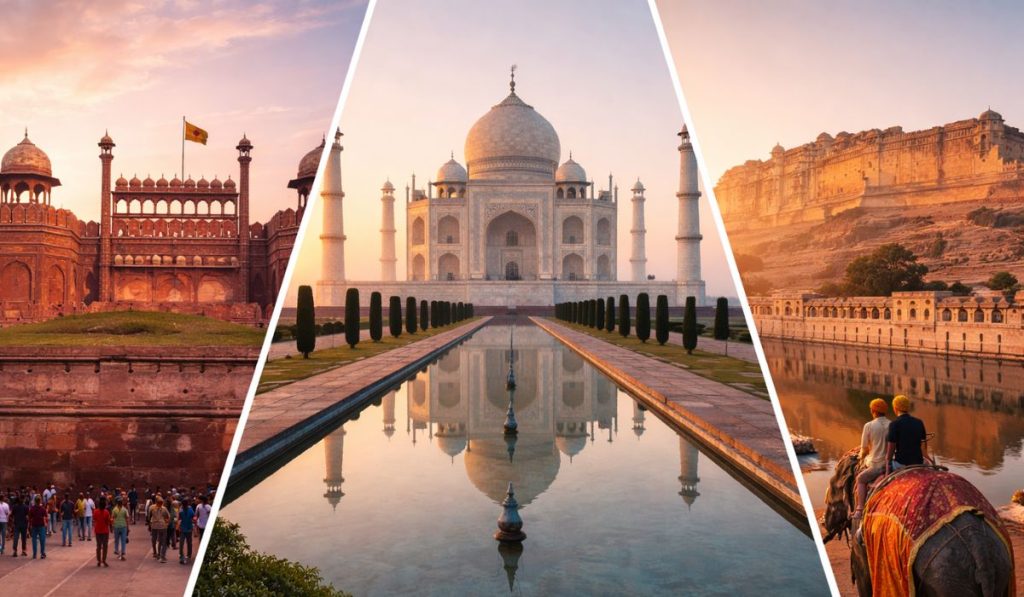
Collage showing Delhi Red Fort, Taj Mahal in Agra, and Jaipur Amer Fort representing the Golden Triangle tour in North India
The Golden Triangle route connecting Delhi, Agra, and Jaipur forms the backbone of most North India travel itineraries.

In conclusion, the prevalence of Taj Mahal Tours at the start of Indian vacations is not a mark of unoriginality, but a sign of strategic intelligence.

It leverages the primary international airport hub, utilizes the country’s most efficient transport corridor, aligns with a traveler’s psychological need for an anchoring experience, and capitalizes on the monument’s global digital presence.

By witnessing the sunrise over the Yamuna, the traveler does not simply check a box; they calibrate their senses to the scale of India. They establish a historical baseline against which all subsequent forts, palaces, and landscapes will be measured.

For those planning their journey, services like Taj Adventure Holidays can facilitate this complex choreography, ensuring that the logistical execution matches the grandeur of the ambition.

If you’re structuring your India travel itinerary, starting with a well-organized Taj Mahal Tour from Delhi often simplifies the entire route.

In the architecture of travel, the Taj Mahal is not just the door—it is the keystone. Starting there doesn’t make you a tourist; it makes you a student of a story worth telling right the first time.

Whether you have five days or five weeks, beginning with the monument ensures your journey is built on a foundation of informed choice, not accidental itinerary. It remains, for sound strategic reasons, the most intelligent place to start.

Stepping through the arched gate just as dawn breaks over the Taj Mahal is unforgettable. The ivory-marble mausoleum on the banks of the Yamuna becomes a glowing vision in the soft golden light. Millions of tourists flock to this UNESCO World Heritage “monument of love” each year, but the Taj Mahal Sunrise Tour is a truly magical experience few forget. In fact, experts agree that early morning – around sunrise – is the best time to visit the Taj Mahal.

Cooler air, gentle colors, and almost no crowds combine to create a peaceful, almost spiritual moment. As one travel writer put it, “Sunrise is by far the best time to visit the Taj Mahal… the early morning light turns the dome a soft, golden colour, and there are the least amount of tourists”. In this travel guide, I’ll explain why dawn reigns supreme over a midday or sunset visit, share first-person tips and common pitfalls, and help you plan the perfect Taj Mahal morning experience. 

Many travellers who want to see the Taj in its most peaceful form choose a Taj Mahal Sunrise Tour, as it lets you enter early, avoid the crowds, and enjoy the monument in golden morning light.

Why Sunrise is the Best Time to See the Taj Mahal

Visiting the Taj Mahal at sunrise feels like stepping into a painting. In the cool dawn, the white marble shimmers pink and gold as the sun peeks up, and the air carries a gentle mist from the Yamuna. I still remember walking the empty gardens as the monument lit up – it was breathtakingly calm. Travel blogs describe this scene as “so calm and surreal”, a contrast to the afternoon bustle.

With virtually no crowds yet, you can admire the intricate marble inlay work and carvings up close. As one tourist shared, she “took my best photos of the Taj Mahal during sunrise. The light was perfect, and I had the place almost to myself!”. Sunrise also means cooler temperatures – often in the pleasant 15–25 °C range – so you aren’t wilting in the heat.

In short, the soft morning light and serene atmosphere make dawn the most photogenic and peaceful time to be here.

Sunrise vs Daytime: Light, Crowds, and Heat

By mid-morning, the Taj Mahal grounds become a whirlwind. Tour buses and dozens of guides arrive, cameras flash, and lines for the mausoleum grow long. In contrast, the dawn visit is almost private. One traveler noted that at sunrise “not only is the light better, the experience is better – and no dealing with midday tour buses”. With far fewer people, you can frame your shots without dozens of photobombers and actually feel the monument’s grandeur.

The slanted morning sun also casts sculptural shadows that bring out the carvings and marble veins, whereas the harsh overhead sun at noon can flatten everything. Perhaps most dramatically, the midday sun in Agra can be brutally hot.

Travel experts warn that after 10 AM it becomes “uncomfortably hot” and even “afternoon heat can be extreme”. I remember enjoying a hot chai by 8 AM while others were scrambling off buses in the blinding sunlight. Early morning is crisp and cool, making every step through the gardens comfortable and every photo radiant.

Sunrise vs Sunset: Dawn Serenity vs Golden Dusk

Sunset at the Taj Mahal certainly has its fans – the white domes turn rosy as the sky deepens into orange and pink. It can feel romantic and dramatic, with bigger crowds gathering on the Mehtab Bagh side. But the vibe is entirely different from dawn. At sunrise, there’s a hushed spirituality in the air; at sunset, it’s more of a celebration.

As one guide summed up: “early risers will appreciate the Taj Mahal morning light… quiet reflection… cool morning air” – whereas “sunset brings a lively atmosphere… dramatic visuals and a romantic vibe”. In practice, that means a bit more elbow room in the morning.

By the time the sun dips, the crowd is often larger and louder. Personally, I’ve done both – and while the colors of dusk are beautiful, there’s something almost intimate about seeing the Taj at dawn, with the silence broken only by birdsong and the occasional call of “ticket please!”

Taj Mahal Sunrise Tour from Delhi: Getting There

Many visitors from New Delhi make a pilgrimage to see the Taj Mahal, and some companies even market “Taj Mahal Sunrise Tour from Delhi.” In reality, it’s a very early start! The journey from Delhi takes about 3–4 hours by train or car, so you’ll likely need to travel overnight or arrive in Agra the day before.

If you’re coming from Delhi, consider taking a late-night train or hiring a driver so you can sleep en route and wake up near Agra. Better yet, stay overnight in Agra itself.

In fact, travel blogs strongly advise against a same-day rush: one blogger said a day trip from Delhi would mean “rush hour, harsh afternoon lighting and crowded atmosphere,” so she “stayed two nights in Agra” to fully enjoy the Taj. By the time I stepped out of a pre-dawn taxi at Agra’s East Gate, I already felt glad we’d made the effort.

(Pro tip: the East Gate is closest to parking and emptiest at sunrise, whereas the West Gate attracts most domestic crowds.)

While many people prefer an early morning visit, some travellers choose a same day Taj Mahal tour from Delhi when they have limited time but still want to experience the Taj Mahal without staying overnight.

Tips for First-Time Visitors

To make the most of your sunrise tour, here are some practical tips:

  • Buy Tickets in Advance. Don’t waste precious morning minutes in a ticket line. Use the official website (ASIS PayU) to purchase tickets a day or two ahead. Note: You can’t buy tickets for Fridays (the Taj is closed every Friday).
  • Arrive Extra-Early. The Taj Mahal officially opens 30 minutes before sunrise (around 6 AM). Plan to be at the entrance by 5:30 AM. In practice, getting there by 5:30 often means being at the front of the queue. (On one visit, there were already ~20 people waiting at 5:30; by 6:00, nearly 250 people had lined up.) Early arrival means you walk in first and can dash to the best photo spots.
  • Pack Light. Security is tight and bag checks are slow. Entering without a bag (or with only a tiny purse) lets you breeze through the metal detectors. The author of one Taj sunrise guide says, “The bigger your bag, the longer you’ll wait… If you enter without a bag, or with a very small bag, you’ll be waived right through the security line”. In fact, leave non-essentials (tripods, large cameras, snacks, etc.) at your hotel. You can bring one 500 ml water bottle and your phone/camera. They provide a complimentary small water bottle with each ticket. (Tripods and professional camera rigs are not allowed inside.)
  • Dress and Behave Respectfully. The Taj Mahal is a mosque and mausoleum; cover shoulders and knees out of respect. You’ll also remove your shoes or wear provided shoe covers before entering the main platform. Keep voices low in the gardens to preserve the peaceful vibe.
  • Head to the Main Platform First. Once inside, many guides say the central fountain platform is the classic first shot. It’s front-and-center. If you move quickly, you can secure that space before tour groups arrive. Then explore the side mosque arches and reflecting pools for different angles.
  • Mausoleum Timing. If you want to go inside the mausoleum (to see the tombs), do it at the end of your visit. Guards let small groups in briefly; it’s easier to join in later once the bigger crowd photoshoots are done.
  • Plan 2–3 Hours. Most first-time visitors spend around 2–3 hours at the Taj. If you enter at 6:00 AM, you could be finished by 8:30–9:00. By 10:00, the sun can be very hot again, so after morning exploring, you might head back to your hotel for breakfast and a rest.

Mistakes to Avoid on a Sunrise Tour

Even experienced travelers can slip up. Common pitfalls include:

  • Sleeping In. Missing the sunrise defeats the purpose. If you oversleep and arrive late, you’ll face the long lines and intense heat. I’ve heard horror stories of visitors arriving at 10 AM in full sun and swearing never again.
  • Going in Peak Heat or Monsoon. Avoid April–June if you can (temperatures in Agra often hit 45–50 °C) and July–September if heavy monsoon rains are possible. Winter (Oct–Dec) and spring (Feb–Mar) are ideal. Keep in mind that winter dawns can be foggy (December–January fog is common), but some travelers love the Taj shrouded in mist.
  • Ignoring Gates and Days Off. The Taj closes every Friday and also closes between late afternoon and sunset (last entry ~30 minutes before sundown). Check the calendar before you book any travel arrangements.
  • Packing Prohibited Items. Remember: no food or outside drink, no lighters, and no large electronic devices aside from your camera/phone. If you pack these, security will keep them and make you wait.
  • Day-Trip from Delhi Mistake. It might be cheaper to book a same-day tour from Delhi, but it’s often exhausting and rushed. Travelers routinely advise against it: one blogger warned that a day tour means battling crowds and fatigue, whereas staying in Agra made the sunrise visit “truly memorable”. If possible, arrange to sleep in Agra or leave Delhi late at night so you wake up nearby.
  • Believing Only Sunset is Beautiful. Some people assume sunset is the only “pretty” time, but trust us – sunrise has its own mesmerizing beauty. Don’t let a little haze or chill scare you off; even a pastel-draped Taj in winter has a charm all its own.

Best Months to Visit the Taj Mahal

The best seasons for an Agra trip are October through March. In these months, the skies tend to be clear and the weather cool. December and January are peak tourist months, so expect crowds (especially during holidays) and possibly foggy mornings.

Many experts recommend the shoulder months of February–March or October–November to balance weather and crowds. I chose March once and found 15–30 °C weather and manageable crowds. If you do come in winter, embrace the fog: it gives the Taj a dreamy, mystical look (and on a clear morning you still get gorgeous sun rays). Just remember, summer (Apr–Jun) can be brutally hot, and heavy monsoon rains (Jul–Sep) can interrupt outdoor plans.

Who Should Choose a Sunrise Tour?

A Taj Mahal sunrise visit is ideal for anyone who cherishes quiet moments and photography. Early birds and honeymooning couples will love the romance of the empty gardens. Architecture buffs and heritage travelers can study the Mughal details without jostling crowds. If you’re sensitive to heat or large crowds, the cooler morning hours are far more comfortable.

Even families: while it’s an early wake-up, children can enjoy the adventure of being the “first” visitors of the day and spotting little wildlife in the gardens. Photographers unanimously prefer dawn – as Agoda’s guide notes, “the golden hour, just before sunrise, is a magical time for photography”. And for anyone coming from Delhi or nearby, I’d say: yes, the early start is challenging, but the reward is unmatched.

Instead of racing through Agra on the way back to Delhi, you’ll have a calm, complete experience. As one Agra travel writer recommends, skip that same-day whirlwind. Book a hotel in Agra so you can stroll up for sunrise well-rested.

Final Verdict: Embrace the Dawn

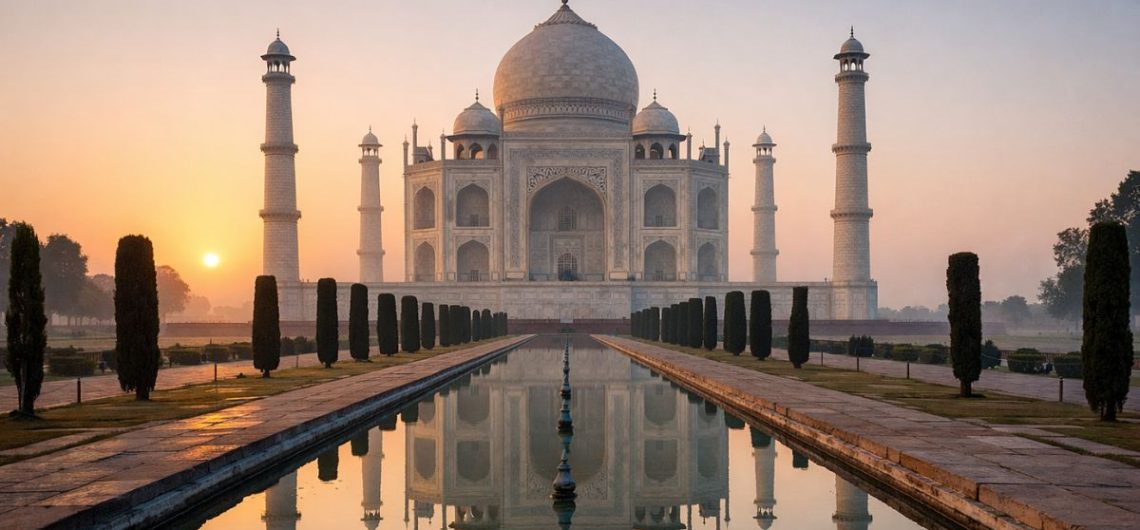
An empty view of the Taj Mahal at sunrise with no people, showing the monument's reflection in the calm water of the long pool.
An unobstructed, crowd-free view of the Taj Mahal at dawn, showcasing its stunning architecture and serene reflection in the perfect morning light.

After all, if you want to truly capture the spirit of the Taj Mahal, sunrise is not just an option – it’s the only way to go. The serene morning light, the solitude, and the cool air make the experience feel almost private. Guides and travelers alike say it:

“Yes, sunrise visits offer lower crowd density, softer light, and a more relaxed experience” compared to later in the day. In my many travels, few moments compare to standing in that vast garden as the sun gently illuminates the dome.

You emerge as a better photographer, a calmer traveler, and with a story worth sharing. So set your alarm clock for an early train or taxi, and join the happy few who saw the Taj Mahal at dawn. You’ll leave convinced that the only right time to visit the Taj Mahal is at sunrise.

Sources: Author’s experience and travel guides, including first-person travel blogs and Taj visitor FAQs, which confirm that mornings mean fewer crowds, cooler air, and perfect light for photos. All advice above is drawn from reliable travel sources and expert tips.