
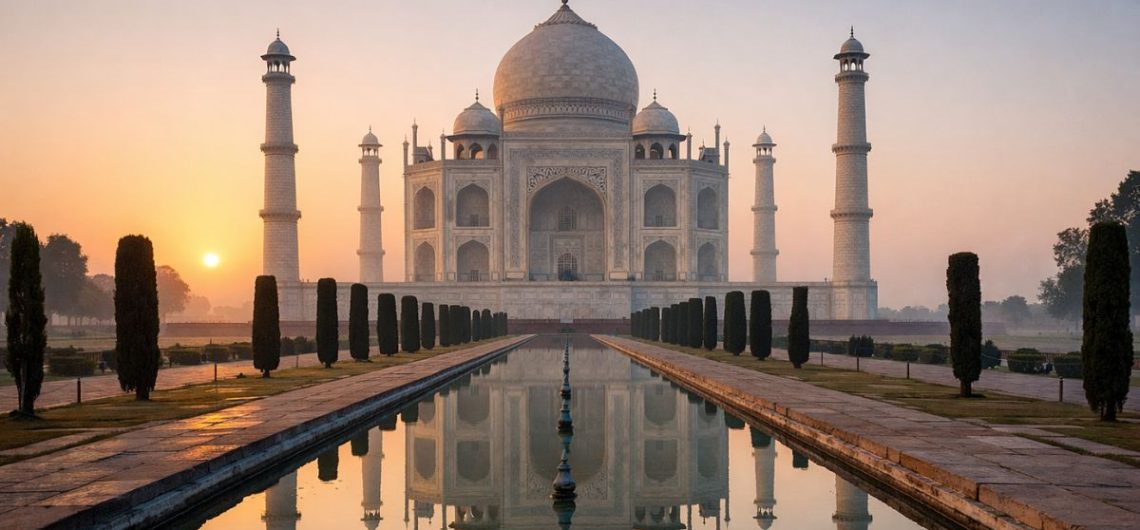
For the global traveler, the first mental image conjured by the word “India” is often a specific one: a perfect white dome framed by minarets, reflected in still water.
The Taj Mahal has transcended its physical existence to become a global symbol, carrying the weight of representing an entire subcontinent’s history, culture, and identity.
For decades, it has served as the gravitational center of the Indian travel experience. While some seasoned travelers seek to bypass the obvious, the reality remains that the overwhelming majority of first-time itineraries—from rushed five-day layovers to leisurely three-week explorations—begin the same way: with Taj Mahal Tours.
This is frequently dismissed as tourist cliché, but a closer analysis reveals a more strategic truth.
Beginning an Indian journey in Agra is not about following a crowd. It is a profoundly logical decision grounded in psychology, logistics, narrative structure, and even digital-era travel behavior.
This article deconstructs why the Taj Mahal serves as the perfect prologue to the Indian story, and why planning a Taj Mahal Tour from Delhi first is less about convention and more about strategic intelligence.
The Psychology of the Icon: Why We Need the Anchor First
Before examining train schedules and hotel bookings, one must understand the traveler’s mindset. Arriving in India for the first time is an intense sensory experience. The goal of the first 48 hours is not exploration but orientation.
Managing First Impressions in a Complex Destination
India is vast, chaotic, and diverse. For a first-time visitor, the sheer scale can be overwhelming. Psychologically, travelers engage in “risk management” when planning a trip to a high-complexity destination. They seek a predictable anchor—a known quantity that guarantees a return on their emotional and financial investment.
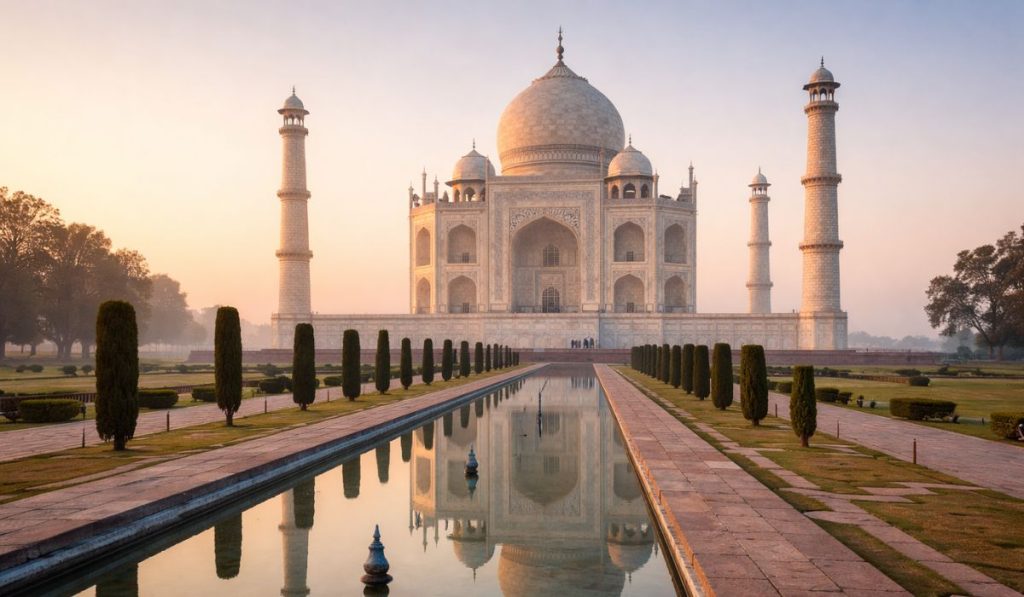
The Taj Mahal serves as this anchor. It is the one variable in the travel equation that requires no justification. By planning Taj Mahal Tours at the very beginning, the traveler secures the “centerpiece” immediately.
This strategy ensures that even if jet lag, digestive adjustments, or unexpected weather disrupt later plans, the primary objective has already been achieved.
It reduces travel anxiety. The tourist can relax into the subsequent chaos of India, knowing they have already captured its most famous reward. This psychological security is invaluable when navigating a country as layered as India.
Aligning Expectations with Reality
There is also a phenomenon of “first impression bias.” The first major site a traveler visits sets the tone for their perception of the entire trip. If that first site is the Taj Mahal, it establishes a benchmark of awe. It validates the decision to travel 8,000 miles.
Beginning with a sunrise Taj Mahal visit is particularly effective in this regard. Dawn in Agra offers a moment of tranquility that mediates the transition from the traveler’s home environment to the rhythm of India. The soft light and relative quiet act as a buffer, introducing the grandeur of Mughal history in its most digestible form.
Architectural Intelligence: Understanding What You’re Seeing
To understand why the Taj Mahal anchors trips so effectively, one must appreciate what the monument actually is. It is not just a pretty building; it is a masterpiece of architectural intelligence that rewards close study.
The Physics of Marble and Light
The Taj Mahal was engineered to interact with light. The white marble is not uniformly white; it contains traces of semiprecious stones like jade, turquoise, and lapis lazuli inlaid through the pietra dura technique.
This composition causes the monument to reflect different colors at different times of day—pinkish in the morning, milky white in the evening, and golden under moonlight.
This optical behavior explains why Taj Mahal Tours prioritize specific timing. The monument is a dynamic experience, not a static object. First-time visitors who arrive at sunrise witness a chromatic transformation that sets a sensory standard for the rest of their journey.
The Geometry of Paradise
The Taj is also a coded message. Its symmetrical layout, the Persian-style Charbagh garden dividing the space into four quarters, and its riverside location are all architectural translations of paradise, as described in Mughal texts. The four waterways represent the four rivers of Jannah, or paradise, mentioned in the Quran.
Understanding this context transforms a visit from sightseeing to interpretation. By starting here, travelers calibrate their ability to “read” Indian architecture. The symmetry of the Taj becomes a reference point for understanding the Red Fort in Delhi or the celestial observation at Jantar Mantar in Jaipur. It teaches the eye what to look for.
The Logistical Logic: Delhi as the Unavoidable Hub
Beyond the psychological and architectural benefits, the decision to prioritize Taj Mahal Tours is rooted in hard logistics. You cannot plan an efficient trip to India without acknowledging the role of Delhi.
The Gateway of the North
For most international flights, especially from North America and Europe, the primary port of entry is Indira Gandhi International Airport in Delhi. While Mumbai is a significant hub, Delhi remains the most practical starting point for the northern cultural circuit. When structuring an India travel itinerary, Delhi’s connectivity is unmatched.
If a traveler arrives in Delhi, they face a choice: venture south into the heart of India, or head east. Agra lies a mere 200 kilometers southeast of the capital. This proximity means that Agra is not a detour—it is the most logical extension of the capital region. To land in Delhi and skip Agra would be strategically inefficient.
Connectivity and Time Efficiency
The infrastructure connecting Delhi to Agra is disproportionately developed compared to other routes. The Yamuna Expressway is a modern, six-lane highway that cuts travel time between the two cities to approximately three hours.
Furthermore, the Gatimaan Express and other high-speed train options have made the Delhi-Agra corridor one of the most reliable transit links in the country. When planning a trip, “time on the ground” versus “time in transit” is the ultimate metric. A Taj Mahal Tour from Delhi can be executed with surgical precision because the transport vectors are established and reliable.
Attempting to start a trip in, say, Kerala or Mumbai and then “work up” to Agra involves multiple internal flights and a significant expenditure of vacation days. For the first-timer, starting in Delhi and moving south is simply more efficient. This is why the Golden Triangle route remains the industry standard for North India travel.
The Golden Triangle: A Coherent Historical Narrative
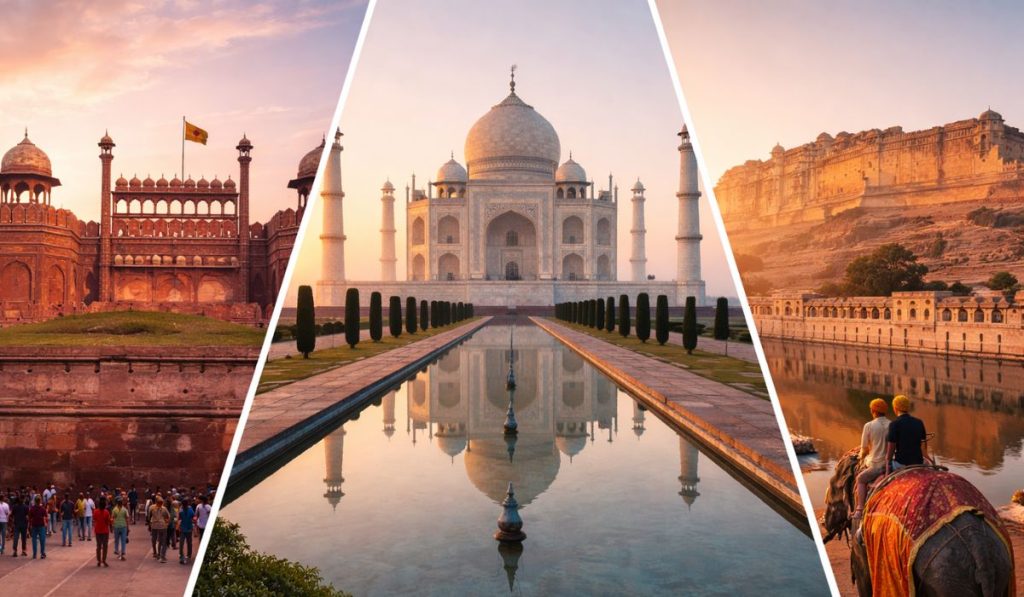
Once the decision is made to visit Agra from Delhi, the route naturally extends to form the “Golden Triangle” (Delhi-Agra-Jaipur). This circuit is the most successful travel product in India because it functions like a three-act play.
A Progressive Historical Arc
If a traveler starts their journey with the Taj Mahal, they are not just seeing a building; they are establishing the “Mughal” chapter of their trip.
- Act I (Delhi): The traveler witnesses the seats of power—the Red Fort, the bustling streets of Old Delhi, and the grandeur of empires that set the stage. The Qutub Minar and Humayun’s Tomb provide early context for the architectural evolution that culminates in Agra.
- Act II (Agra): The traveler experiences the emotional and architectural peak of the Mughal dynasty. The Taj Mahal represents the story of Emperor Shah Jahan, a tale of love and loss that humanizes the history learned in Delhi. Agra Fort, where Shah Jahan was imprisoned, adds a layer of tragic narrative. A well-planned Agra tour usually includes both sites for this reason.
- Act III (Jaipur): The traveler transitions from Mughal rule to Rajput valor. The pink-hued forts and palaces of Jaipur offer a distinct aesthetic and cultural palette, introducing a different martial and artistic tradition.
By starting with the Taj Mahal, the traveler allows this narrative to unfold chronologically and geographically. It provides a framework to understand how power shifted and how aesthetics evolved across North India. Many travelers ultimately book a Golden Triangle tour from Delhi specifically for this narrative cohesion.
Cultural Calibration
There is a deeper, often overlooked benefit to this sequence. The Taj Mahal serves as a “cultural reference point.” For many first-time visitors, India challenges deeply held stereotypes about infrastructure, crowding, and noise.
Experiencing the perfect symmetry and quiet dignity of the Taj on day one resets these expectations. It proves that India is capable of world-class preservation and order. This realization makes the traveler more receptive to the controlled chaos of Delhi that follows, rather than being shocked by it. It calibrates the senses for the diversity to come.
The Strategic Advantage of Sunrise
A critical component of the “why start here” argument involves the experience of the monument itself. The Taj Mahal is not a static object; it is a responsive surface that changes with the light.
Thermal and Sensory Comfort
From a practical standpoint, a sunrise Taj Mahal visit is a defense against the elements. Agra can be mercilessly hot and humid by midday. By arriving at the gates as they open, travelers maximize their comfort and the clarity of the air.
The early morning light reduces glare and provides the soft, diffuse illumination necessary for architectural appreciation. It is also the time when the Yamuna River side of the monument is most visible, offering perspectives that are hazy and obscured later in the day. The reflection in the central pool is also at its most photogenic before breezes disturb the water.
Crowd Dynamics and Meditative Space
Furthermore, the monument is subject to the laws of tourism physics. By 10:00 AM, the queues lengthen and the gardens fill. Starting the India trip with an early morning visit allows the traveler to experience the site in a state closer to its intended solitude—a meditative space rather than a busy public square.
This quality of experience is difficult to replicate later in the day. The stillness of dawn at the Taj creates a memory that is intimate rather than chaotic, setting a high standard for the visits to come.
It is the difference between seeing a photograph and stepping inside the frame.
Why the Taj Mahal Still Dominates Global Travel Algorithms
In the digital age, travel planning is increasingly visual and search-driven. The Taj Mahal’s dominance in this space reinforces why starting there remains strategically sound.
Image Search and Social Media Gravity
The Taj Mahal is one of the most photographed structures on Earth. On platforms like Instagram and Pinterest, its silhouette is instantly recognizable, generating billions of impressions annually. For the modern traveler, seeing these images creates a pre-travel emotional connection.
When travelers begin researching India travel planning, the algorithm serves them more Taj Mahal content.
This creates a feedback loop: the monument’s digital dominance ensures it remains top-of-mind, and its physical visitation numbers reinforce its digital footprint. Starting a trip there taps into this pre-existing mental library.
UNESCO Heritage and Global Perception
As a UNESCO World Heritage Site, the Taj Mahal carries institutional legitimacy. For first-time international travelers, UNESCO designation acts as a filter—a guarantee of significance. In a country with dozens of major heritage sites, the Taj Mahal’s status as the “crown jewel” simplifies decision-making.
This algorithmic and institutional dominance means that starting a trip with Taj Mahal Tours is not just about personal preference. It is about aligning personal itineraries with global consensus, which reduces the cognitive load of planning.
The Counterargument: When Starting Elsewhere Makes Sense
To maintain an objective analysis, it is important to address the counterargument. Is it always wise to start with Taj Mahal Tours? For a specific subset of travelers, the answer is no.
The Regional Specialist
If a traveler has a very specific interest—such as the temples of Khajuraho, the backwaters of Kerala, or the wildlife of Madhya Pradesh—flying directly into Mumbai, Chennai, or Cochin might be more logical. For these travelers, Agra might be an add-on, or omitted entirely.
The “Peak” Problem
Some critics argue that starting with the “best” is a mistake. They suggest that if you see the Taj Mahal on day one, everything else—forts, palaces, tombs—will suffer by comparison. This is a valid aesthetic concern.
However, this critique often fails to account for the diversity of Indian architecture. The red sandstone might of Agra Fort is not diminished by the white marble of the Taj; it is contextualized by it. The intricate carvings of the stepwells in Abhaneri offer a different kind of wonder.
The “peak” does not ruin the journey; it provides a summit from which to view the rest of the range.
The Varanasi Contrast
Some travelers choose to start in Varanasi, seeking spiritual immersion rather than architectural grandeur. This is a valid alternative.
However, Varanasi is intense. For many, beginning in the controlled environment of Agra provides a gentler entry point before tackling the sensory depth of the Ganges.
Why the Taj Mahal Remains the Most Efficient Entry Point into North India Travel
When analyzing North India travel patterns, one factor consistently emerges: efficiency. The Taj Mahal is not just a monument; it is a logistical hub that unlocks the entire region.
Gateway to the Heartland
A successful Agra tour positions travelers perfectly for the two other major poles of North Indian tourism: the political history of Delhi and the royal architecture of Rajasthan.
The road and rail networks connecting these three points form a perfect triangle, minimizing back-tracking and maximizing sightseeing hours.
For travelers mapping out their India travel itinerary, this efficiency translates directly into more experiences and less transit fatigue. You can cover three distinct cultural zones—Mughal, modern, and Rajput—in a single, logical loop.
Scalability for Longer Trips
Starting with the Taj also allows for natural expansion. From Jaipur, travelers can venture deeper into Rajasthan toward Jodhpur and Udaipur. From Delhi, they can head north into the Himalayan foothills.
The Taj functions as the hinge point; once you’ve seen it, the rest of North India opens up without the pressure of needing to circle back.
This is why even travelers with month-long itineraries still place Taj Mahal Tours near the beginning. It clears the headliner early, freeing the mind for deeper exploration.
Practical Advantages for Travel Planning
Finally, the decision to prioritize Agra simplifies the nuts and bolts of travel planning for the first-timer.
Acclimatization and Pacing
A structured Agra tour provides a gentle introduction to dealing with Indian service culture. Travelers can pre-book a private car and guide, creating a controlled environment for their first encounters with the country. This is less daunting than immediately navigating a local bus system in a remote region.
Building Itinerary Momentum
By securing the Golden Triangle—the most established circuit—the traveler builds momentum. A successful first three days in Agra and Delhi generates confidence. Once the traveler understands how transport, guiding, and payments work, they are far better equipped to venture off the beaten path.
Flexibility for Short and Long Trips
For those on a tight schedule, a focused Taj Mahal Tour from Delhi can be completed in a single day, freeing up time for other regions. For those with weeks to spare, it serves as the cornerstone of a longer exploration. This flexibility makes it the logical starting point regardless of trip duration.
Frequently Asked Questions (Strategic Planning)
Is one day enough for a Taj Mahal Tour from Delhi?
Yes, for time-constrained travelers, a day trip is feasible thanks to the expressway and train links. However, an overnight stay allows for a sunrise visit, which is the optimal experience for photography and crowd avoidance.
Is sunrise at the Taj Mahal worth the early wake-up?
Statistically and experientially, yes. The combination of soft light, cooler temperatures, and significantly smaller crowds makes sunrise the superior choice for contemplation and image quality.
Can you skip the Golden Triangle and just visit the Taj Mahal?
Absolutely. Many travelers fly into Delhi specifically for a Taj Mahal Tour before connecting to other regions like Goa or Rishikesh. The Taj works well as either the start of a longer journey or a standalone highlight.
When is the best time to plan Taj Mahal Tours?
The cooler months from October to March offer the most pleasant weather for North India travel. This period provides clear skies ideal for sunrise viewing and comfortable temperatures for exploring the exterior grounds.
Conclusion
In conclusion, the prevalence of Taj Mahal Tours at the start of Indian vacations is not a mark of unoriginality, but a sign of strategic intelligence.
It leverages the primary international airport hub, utilizes the country’s most efficient transport corridor, aligns with a traveler’s psychological need for an anchoring experience, and capitalizes on the monument’s global digital presence.
By witnessing the sunrise over the Yamuna, the traveler does not simply check a box; they calibrate their senses to the scale of India. They establish a historical baseline against which all subsequent forts, palaces, and landscapes will be measured.
For those planning their journey, services like Taj Adventure Holidays can facilitate this complex choreography, ensuring that the logistical execution matches the grandeur of the ambition.
If you’re structuring your India travel itinerary, starting with a well-organized Taj Mahal Tour from Delhi often simplifies the entire route.
In the architecture of travel, the Taj Mahal is not just the door—it is the keystone. Starting there doesn’t make you a tourist; it makes you a student of a story worth telling right the first time.
Whether you have five days or five weeks, beginning with the monument ensures your journey is built on a foundation of informed choice, not accidental itinerary. It remains, for sound strategic reasons, the most intelligent place to start.

Comments